
Guides
Built-in bookcases vs home library
Built-in bookcases occupy one wall or alcove within a room used for other things, while a home library treats an entire room around its shelving, so the decision generally rests on how many books you have and how much of the room you are prepared to give over to them.
Built-in bookcases vs home library
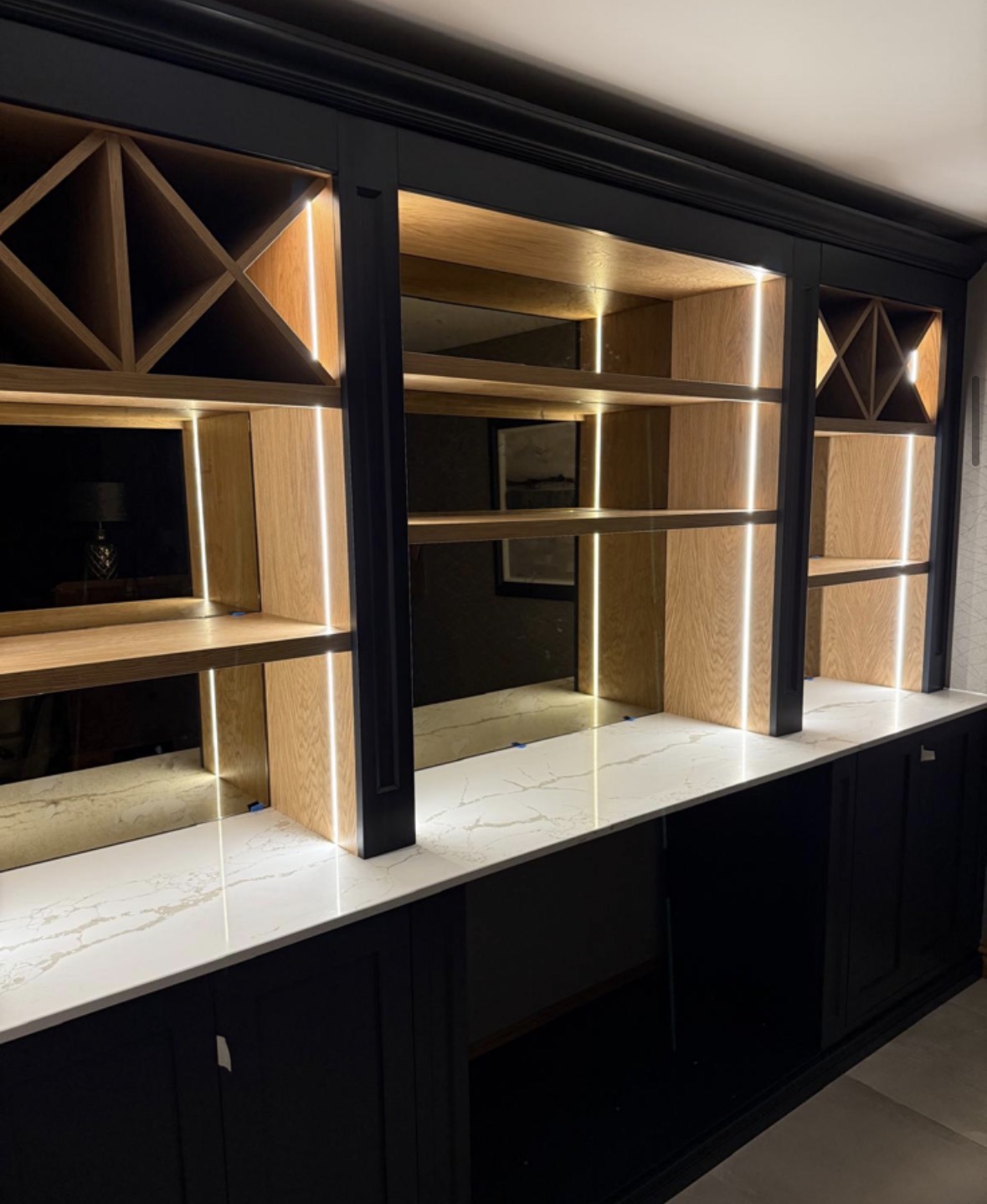
Both approaches store and display books in fitted, made-to-measure cabinetry, but they differ in scale and ambition. Built-in bookcases are usually installed against a single wall, within an alcove either side of a chimney breast, or along one section of a living room, study or hallway, sitting alongside the room's other functions.
A home library treats book storage as the organising idea for an entire room, with shelving running across multiple walls, often floor to ceiling, and frequently combined with a reading chair, integrated desk or library ladder. It is a more significant undertaking, both in the space it requires and in the design decisions involved, but it delivers a room with genuine architectural character rather than simply storage.
Neither is a smaller or lesser version of the other; a well-designed run of built-in bookcases can be the strongest feature of a room, while a home library only succeeds where there is enough space and enough books to justify treating an entire room this way. Getting the scale wrong in either direction, over-building a small room or under-using a large one, is the more common mistake.
Chester Thomas designs both, from single runs on built-in bookcases to full rooms on home libraries, with detailed library cabinetry on library cabinetry and integrated desk and shelving solutions on study bookcases, and this comparison sets out how to judge which suits your space.
Built-in bookcases vs home library
| Consideration | Built-in bookcases | Home library |
|---|---|---|
| Installation | A single wall or alcove within an existing room | Multiple walls, often the full room |
| Room-wide design | Coexists with other furniture and room functions | The room is organised entirely around the shelving |
| Storage capacity | High for one wall, bounded by that run | Substantially higher across multiple full-height walls |
| Integrated desk | Possible within the run where space allows | Frequently included as part of the room design |
| Reading space | Often shares space with existing seating in the room | Can be designed around a dedicated reading chair or nook |
| Lighting | Shelf or feature lighting within the single run | A considered lighting scheme across the whole room |
| Architectural impact | A strong feature within an otherwise multi-purpose room | Defines the character of the entire room |
| Space required | One wall or alcove, minimal disruption to the room's layout | A room that can be dedicated substantially to the library |
Scale and installation
Built-in bookcases are the more flexible starting point, since they can be introduced into almost any room, whether that is filling an alcove beside a fireplace or running along an otherwise blank wall in a hallway or study. The room continues to serve its existing purpose, with the bookcases as one feature among several, as covered on built-in bookcases.
A home library asks for a room, or at least a large part of one, to be given over to the idea entirely. This suits a spare room, a generously sized study or a converted loft or garden room, where shelving can run across two, three or four walls without competing with an unrelated function such as sleeping or dining.
Storage capacity and collection size
For a modest to moderate book collection, a single run of built-in bookcases, particularly if taken floor to ceiling, will comfortably hold what most households own without needing to occupy an entire room. This is often the more proportionate choice, since a home library built for a collection that does not fill it can end up looking sparse rather than considered.
Where a genuinely large collection exists, or is intended to grow, a home library's use of multiple walls provides substantially more capacity, and the room can be designed with future growth in mind from the outset, an approach discussed in detail on home libraries.
Integrated desk and reading space
A desk can be built into a single run of bookcases where the wall is long enough, giving a study a combined working and storage wall, as seen in the desk and shelving combinations on study bookcases. This works well where a full library room is not justified but a proper working surface is wanted alongside the books.
A home library more naturally accommodates a dedicated reading space, whether a window seat, an armchair positioned away from the desk, or a quiet corner with its own lighting, since the room is not being asked to do anything else. This is one of the clearest practical differences between the two approaches.
Lighting and architectural impact
Lighting for built-in bookcases is usually integrated within or above the shelving itself, picking out spines and objects on display without needing to light the whole room around it. A home library, by contrast, benefits from a considered scheme across the whole space, combining shelf lighting with general room lighting and any dedicated reading light.
The architectural impact follows the same pattern. Built-in bookcases are a strong feature within a room that still has its own identity, whereas a home library becomes the identity of the room, an effect that suits a house with the space to dedicate a whole room to it but can feel disproportionate in a smaller property.
Cost and space trade-offs
Because a home library uses considerably more cabinetry, across more walls and often to a greater height, it represents a larger undertaking than a single run of bookcases, though the specific figures depend entirely on the room and specification involved. The more useful comparison for a specific house is made directly through the contact page, once the size of the collection and the available room are known.
Which suits your space and collection?
01
Choose built-in bookcases when
You want strong storage and display within a room that also serves another purpose, such as a living room or hallway.
02
Choose a home library when
You have a spare room or generously sized space and a collection, or ambition, large enough to justify dedicating it entirely to books.
03
Choose built-in bookcases when
You want an integrated desk within the same wall as your books, without giving over a whole room to the idea.
04
Choose a home library when
You want a dedicated reading space, such as a window seat or armchair, alongside substantial book storage.
05
Choose built-in bookcases when
The room's proportions or existing function mean a full library treatment would feel disproportionate to the space.
How we work
Both scales of project follow the same process, from an initial survey of the room and collection through to drawings and manufacture in our Derbyshire workshop, described fully on the process page.
Questions we are asked
General
- How many books do I need to justify a home library?
- There is no fixed number, since it depends as much on the room as the collection. A home library suits a household with a substantial or growing collection and a room that can be dedicated to it, while a smaller collection is usually better served by a single run of built-in bookcases.
Design
- Can built-in bookcases include a desk?
- A desk can be built into a run of bookcases where the wall length allows, combining working and storage space in one feature, an approach used in the desk and shelving combinations on study bookcases. This suits a study or home office where a full library room is not justified but a proper working surface is still wanted alongside the shelving.
Room requirements
- Does a home library need its own room?
- A home library generally needs a room, or a substantial part of one, given over largely to the idea, since it is designed around multiple walls of shelving rather than a single run. A spare room, study or converted loft space are common choices.
Terminology
- What is library cabinetry, as distinct from bookcases?
- Library cabinetry, described on library cabinetry, refers to the detailed design of shelving, closed storage and any ladders or library-specific features within either a bookcase run or a full home library, rather than a separate category of room. It is the level of joinery detail applied to the shelving, not a different scale of project, so the term can apply equally to a single alcove or a whole room.
Storage
- Can a home library include closed storage as well as open shelving?
- A home library commonly combines open shelving for display with closed cabinetry for less decorative items, files or equipment, balanced according to how the room is used, as part of the wider design on home libraries. The proportion of open to closed storage is agreed during layout, based on how much needs to stay on view and how much is better kept out of sight.
Design
- Is a library ladder necessary for a home library?
- A library ladder is only practical, and only necessary, where shelving runs high enough that upper shelves cannot be reached comfortably by hand. It is considered where full-height shelving is specified, rather than included as standard, and the track or rail it runs on is planned into the design from the outset so it does not interrupt the shelving layout.
Installation
- Can built-in bookcases be added to an existing living room?
- Built-in bookcases can be introduced into an existing living room, typically within an alcove beside a chimney breast or along a spare wall, without disrupting the room's other furniture or function. Existing skirting, coving and picture rails are surveyed first so the new cabinetry can be scribed neatly into the room rather than sitting awkwardly against period detailing.
Lighting
- How is lighting handled in a home library compared with built-in bookcases?
- A home library uses a considered lighting scheme across the whole room, combining shelf lighting with general and reading light, while built-in bookcases usually rely on lighting integrated within or above the shelving itself, without needing to address the wider room.
Cost
- What does a home library cost compared with built-in bookcases?
- A home library involves considerably more cabinetry across more walls than a single run of bookcases, so it represents a larger project overall, though the exact figure depends on the room and specification. Contact us through the contact page with details of your space for an accurate response.
Layout
- Can a home library also function as a study?
- A home library can incorporate a desk and working area alongside its shelving, functioning as a study as well as a library, which is a common brief and is planned into the room layout from the outset. Positioning the desk away from the main door and any glare from a window helps the room work for concentrated reading or writing as well as for browsing shelves.
Application
- Do built-in bookcases suit a hallway?
- Built-in bookcases can work well in a wide hallway or landing, provided there is enough depth for shelving without obstructing movement through the space, and this is assessed during a design visit against the specific layout. Shallower shelving is often used in a hallway than in a living room, since passing traffic makes a deep, projecting run less practical.
Layout
- Is a reading chair included as standard in a home library design?
- A reading chair or dedicated seating area is not standard but is a common addition, positioned within the room design where space allows, alongside the shelving and any desk, and discussed as part of the initial brief. Where a window seat or nook is preferred instead of a freestanding chair, this can be built into the cabinetry as part of the same scheme.
Where to go next
Built-in bookcases
A single wall or alcove run of fitted shelving.
Bespoke home libraries
Room-wide shelving and library design.
Bespoke library cabinetry
Detailed shelving, storage and ladder design.
Bespoke study bookcases
Bookcases combined with an integrated desk.
Wall-to-wall bookcases
A single wall taken fully floor to ceiling.
Floor-to-ceiling bookcases
Maximising height within a single bookcase run.
Related guides
Alcove units vs built-in bookcases
Whether closed alcove cabinetry or open built-in bookcases makes better use of the space beside your chimney breast.
Media wall vs TV unit
A media wall reworks the whole wall around the television; a TV unit is a single piece of furniture. Scale is the real difference.
How to choose materials
How to think through timber, paint, stone, glass and metal choices for a bespoke piece.
Home bar vs drinks cabinet
Whether a dedicated home bar or a fitted drinks cabinet better suits your room and how you entertain.
To talk a decision through, call Chester Thomas on +44 7418 627358, email info@chesterthomas.com or discuss your library or bookcase project.
Planning Something Bespoke?
Tell us about your space, what you're looking to create and where the project is located.