
Guides
Media wall vs TV unit: which suits your living room?
A media wall is a fitted scheme built across a wall, typically incorporating the television, storage, shelving and often a fireplace, while a TV unit is a single piece of furniture the television sits on. The right choice depends largely on scale and how much of the wall you want to resolve.
Media wall vs TV unit
A TV unit is a defined, contained piece of furniture, a cabinet or sideboard the television sits on or is mounted above, with a clear footprint and a clear job. A media wall is a larger undertaking: a fitted scheme that treats the whole wall as one composition, typically bringing together the television, storage for AV equipment, open or closed shelving, lighting and, in many living rooms, a fireplace, into a single designed piece rather than a scatter of separate items.
The practical difference that follows from this is scale. A TV unit can be specified and fitted into an existing room with minimal disruption, since it is a standalone piece rather than something built into the wall itself. A media wall generally involves floor to ceiling joinery, sometimes recessed sections, and is designed around the exact proportions of the wall, which makes it a bigger design and installation undertaking but also allows it to resolve far more of the room in one go.
Fireplace integration is where this distinction shows up most clearly. A TV unit sitting near a fireplace generally leaves the fireplace as a separate feature, with the television positioned to one side or above it as a secondary consideration. A media wall, by contrast, is often designed specifically to bring the fireplace and television together within one composition, as on the Chester Thomas project in Solihull, where a media wall was designed around an existing fireplace with a stone surround, integrated shelving and lighting either side.
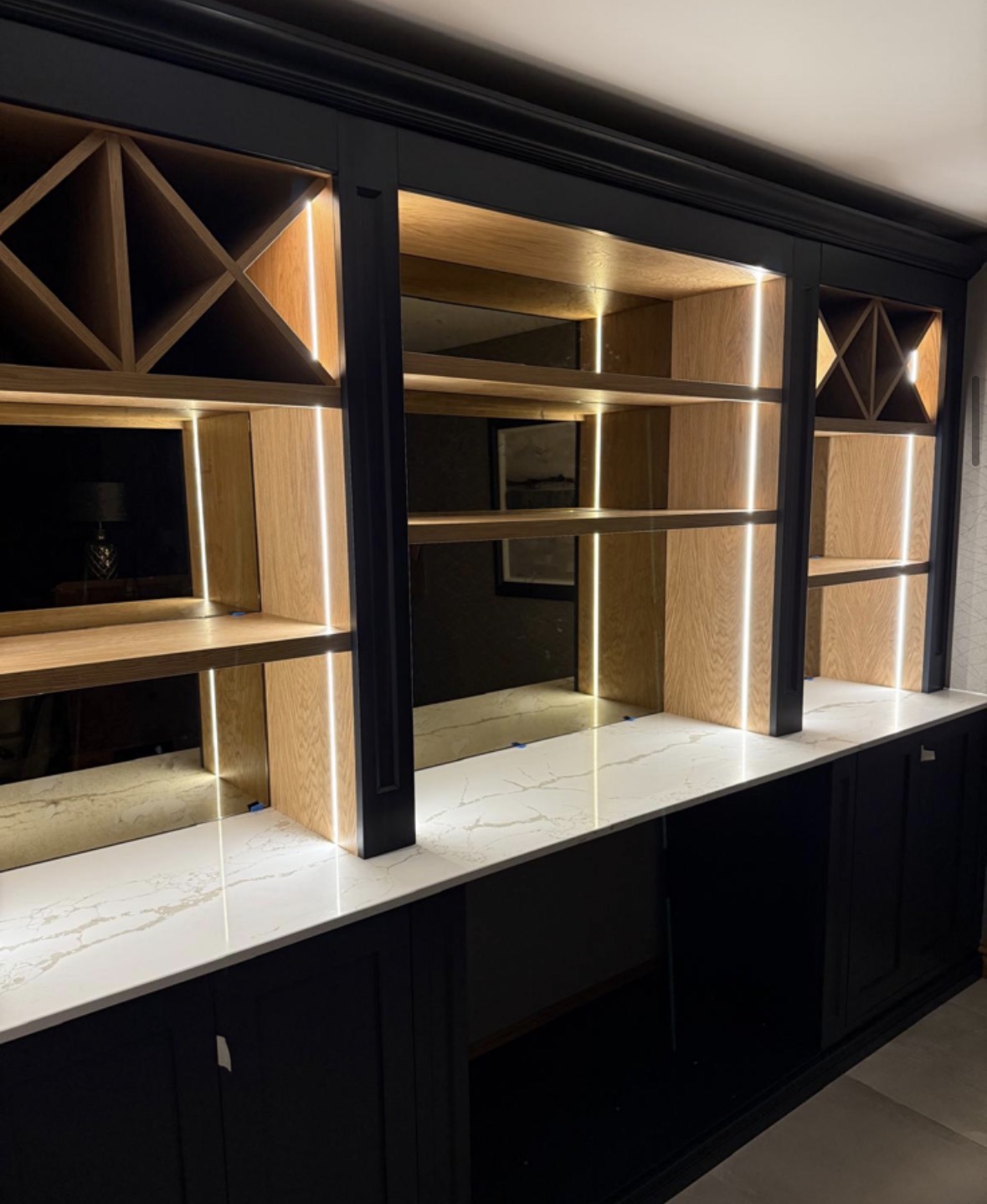
Storage capacity generally favours a media wall, simply because there is more of it, floor to ceiling cabinetry either side of the television, closed storage for AV equipment and cables, open shelving for display, whereas a TV unit's storage is limited to its own footprint. AV equipment and cabling are also easier to conceal within a media wall's depth than within a shallower standalone unit, and lighting can be integrated into shelving and recesses in a way that a freestanding piece rarely accommodates as fully.
None of this makes a media wall the automatic answer. A TV unit costs less to design and install, disturbs the room far less, and suits smaller rooms or rented properties where floor to ceiling joinery is not appropriate or possible. The decision comes down to how much of the wall you want resolved as one design, and what the room and budget can accommodate.
Media wall vs TV unit
| Consideration | Media wall | TV unit |
|---|---|---|
| Scale | Floor to ceiling, full wall composition | Single, contained piece of furniture |
| Storage | Extensive closed and open storage | Limited to the unit's own footprint |
| Fireplace integration | Can be designed around an existing fireplace | Fireplace remains a separate feature |
| Shelving | Open and closed shelving built into the design | Limited or no additional shelving |
| Lighting | LED lighting integrated into shelving and recesses | Rarely includes integrated lighting |
| AV equipment | Concealed within the depth of the joinery | Concealed only within the unit itself |
| Installation | Substantial, built into the room | Straightforward, minimal disruption |
| Cost factors | Reflects scale, materials and fireplace work | Reflects a single piece of furniture |
| Room suitability | Suits rooms where the wall is a focal point | Suits smaller rooms or rented properties |
Scale and architectural impact
A media wall changes the character of a room, since it treats the whole wall, sometimes the full height and width of it, as a single designed element rather than a piece of furniture sitting against a backdrop. This has a considerably greater architectural impact than a TV unit, for better or worse depending on the room, and is worth weighing against the disruption involved in installing it.
Storage and shelving
Where a household has a genuine need for storage around the television, media units, books, ornaments, games consoles, a media wall generally offers substantially more of it than a standalone unit, and can mix closed cabinetry for equipment with open shelving for display, discussed in more detail on media wall storage.
Fireplace integration
Rooms with an existing fireplace often benefit most from a media wall, since it allows the fireplace, television and surrounding storage to be designed as one composition rather than three separate elements competing for attention, an approach covered on fireplace media walls. A TV unit can still work well alongside a fireplace, but tends to sit as a secondary piece rather than part of an integrated design.
Lighting and AV equipment
Integrated LED lighting within shelving or recesses is one of the more distinctive features a media wall can offer, and it is considered at design stage alongside the joinery itself, with any electrical connection carried out by a qualified electrician. AV equipment and cabling are also more easily concealed within the greater depth of a media wall than within a shallower TV unit.
Cost and installation factors
A media wall involves considerably more design, material and installation work than a TV unit, since it is a fitted, floor to ceiling scheme rather than a single piece of furniture, and where a fireplace is involved, coordination with the client's other trades is generally needed. A TV unit, by contrast, involves comparatively little disruption and can often be installed in a single visit, as covered on bespoke TV units.
Which suits your room?
01
Choose a media wall when…
the television wall includes a fireplace, and you want it, the storage and the screen resolved as one composition.
02
Choose a TV unit when…
you want a straightforward, contained piece with minimal disruption to the room, particularly in a smaller space.
03
Choose a media wall when…
you need substantial storage for AV equipment, media and display, more than a single unit's footprint can hold.
04
Choose a TV unit when…
you are in a rented property or unlikely to stay long enough to justify fitted, floor to ceiling joinery.
Related project
A 5.58m elevation with a book-matched marble surround, stained oak framework and shelving, and lighting beneath every shelf: the scale at which a media wall stops being a TV unit.
Bespoke media wall, Solihull →How we work
Whether a room calls for a media wall or a TV unit is worked out during a survey and design conversation, considering the wall, any existing fireplace and how the room is used, before manufacture begins. The full sequence is set out on the process page.
Questions we are asked
General
- Is a media wall always better than a TV unit?
- Not always. A media wall offers more storage, lighting and architectural integration, particularly where a fireplace is involved, but a TV unit is quicker to install, less disruptive and better suited to smaller rooms or where flexibility matters more than a fitted scheme.
Fireplace
- Can a media wall be built around an existing fireplace?
- This is one of the most common reasons clients choose a media wall, since it allows the fireplace, television and surrounding storage to be designed as a single composition rather than three separate elements competing for attention on the same wall, as set out on fireplace media walls. The fireplace itself is coordinated with the client's other trades, such as a fireplace fitter or heating engineer, rather than installed by us as part of the joinery.
Storage
- How much storage does a media wall typically offer?
- Considerably more than a standalone TV unit, since a media wall can include closed cabinetry for AV equipment either side of the television, plus open shelving for display, discussed in more detail on media wall storage. Exact capacity depends on the wall's dimensions and the layout chosen.
Fireplace
- Does a media wall need a fireplace to work?
- No, a fireplace is not required. A media wall can be designed purely around the television, storage and shelving, giving a similarly considered, floor to ceiling composition without a fire feature present. That said, rooms with an existing fireplace are a particularly strong case for the approach, since a media wall resolves both the television and the fireplace surround together rather than leaving them as separate, competing focal points on the same wall.
Lighting
- Can lighting be built into a media wall?
- LED lighting within shelving, recesses or a fireplace surround is a common feature of a media wall, and it is considered at design stage alongside the joinery so cable routes and fixings are planned in from the outset rather than added afterwards. Any electrical connection is carried out by a qualified electrician rather than as part of the joinery work itself, and the two trades are coordinated so the lighting sits exactly where the design intended.
Installation
- Is a TV unit easier to install than a media wall?
- Yes. A TV unit is a standalone piece of furniture and can generally be installed with minimal disruption to the room, whereas a media wall involves fitted, floor to ceiling joinery and typically a longer installation process, as described on bespoke TV units.
General
- Can a TV unit still be bespoke?
- A TV unit can absolutely be designed and made specifically for a room's proportions and a client's storage needs, rather than chosen from a standard range, without taking on the scale or wall-to-wall fixing of a media wall. It can still include integrated lighting, closed AV storage and a considered choice of material, simply within a smaller, more contained footprint that suits a room where a full media wall would feel too dominant.
AV equipment
- How is AV equipment concealed in a media wall?
- AV equipment and cabling are generally housed within closed cabinetry built into the depth of the media wall, with ventilation and cable routes considered at design stage so the equipment continues to function properly once concealed, rather than overheating behind a closed door. Discreet vents, cable pathways to sockets and enough depth for the components involved are all planned before manufacture, working around the client's actual equipment where dimensions are known in advance.
Space
- Does a media wall suit a small living room?
- It can, though the design needs to respond to the room's actual proportions rather than assuming full floor to ceiling joinery is appropriate. A smaller room may suit a more restrained media wall or a TV unit instead, which a survey will help establish.
Cost
- What does a bespoke media wall cost compared with a TV unit?
- A media wall generally costs more than a TV unit, reflecting its greater scale, materials and installation complexity, though the exact figure depends heavily on the specific design and any fireplace work involved. The clearest way to understand cost for your room is through the contact page.
Design
- Can a media wall be designed without built-in shelving?
- Shelving is a common feature of a media wall but it is not a requirement. A design can focus more heavily on closed storage, a plain panelled composition or a simpler arrangement around the television and fireplace, depending on what the room and client prefer and how much display space is actually wanted. Some clients prefer a cleaner, less visually busy wall with fewer open sections to keep tidy.
Where to go next
Media walls
Full-wall schemes combining television, storage and often a fireplace.
Bespoke TV units
Standalone units designed for a specific room.
Media wall storage
Closed and open storage built into a media wall.
Fireplace media walls
Media walls designed around an existing fireplace.
AV cabinets
Storage designed to house and conceal AV equipment.
Related guides
Built-in vs floating TV unit
A floor-standing built-in unit and a wall-mounted floating unit solve the same problem in different ways. Wall type and cleaning access often decide it.
Bespoke vs fitted furniture
Fitted describes how furniture sits in a room. Bespoke describes how specifically it was designed. The two are not the same question.
Alcove units vs built-in bookcases
Whether closed alcove cabinetry or open built-in bookcases makes better use of the space beside your chimney breast.
To talk a decision through, call Chester Thomas on +44 7418 627358, email info@chesterthomas.com or discuss a media wall.
Planning Something Bespoke?
Tell us about your space, what you're looking to create and where the project is located.