
Guides
Alcove units vs built-in bookcases
Alcove units typically combine base cabinetry with shelving above for a mix of closed storage and display, while built-in bookcases favour full-height open shelving for books, so the choice depends on whether concealed storage or book capacity matters more in that space.
Alcove units vs built-in bookcases
The two are closely related and often occupy exactly the same physical space, the recesses either side of a chimney breast, but they answer slightly different needs. An alcove unit typically combines a run of base cabinetry, useful for concealing media equipment, files or general clutter, with open shelving above for books, objects and display.
Built-in bookcases lean further toward open shelving throughout, often floor to ceiling, prioritising book capacity and display over concealed storage. Where an alcove unit is a hybrid piece designed to do several jobs at once, a built-in bookcase is closer to a single-purpose piece of furniture built around the books themselves.
In practice, many projects sit somewhere between the two, and the terms are sometimes used loosely to describe the same chimney-breast cabinetry. What matters more than the label is deciding, room by room, how much of the space should be closed storage, how much should be open shelving, and whether a television or other equipment needs to be accommodated within the design.
Chester Thomas designs both approaches for chimney-breast recesses, described on alcove units and built-in bookcases, alongside broader chimney-breast cabinetry on chimney breast cabinetry and display-led designs on display cabinets, and this guide sets out how to choose between them for a specific room.
Alcove units vs built-in bookcases
| Consideration | Alcove units | Built-in bookcases |
|---|---|---|
| Layout | Base cabinetry with shelving above | Predominantly open shelving, often floor to ceiling |
| Base cabinetry | Included as standard, concealing equipment or clutter | Optional, and less central to the design |
| Book storage | Moderate, on the shelving above the base units | High, since shelving typically runs full height |
| Display | A mix of closed storage below and display above | Predominantly open display across the full run |
| TV integration | Common, with the television often set within or above the base units | Less common, since the design favours books over equipment |
| Closed storage | A defined feature of the design | Minimal unless specifically requested |
| Chimney-breast layout | Fills both recesses, often bridging over the chimney breast | Fills both recesses, sometimes including the breast face for shelving |
| Visual impact | A considered, furniture-like feature within the room | A strong, book-led architectural statement |
Chimney-breast layouts
Both approaches are most commonly built into the recesses either side of a chimney breast, and both can be designed to bridge across the top of the breast itself, tying the two alcoves together visually. The difference lies in what fills that space: an alcove unit is more likely to include a bridging unit with concealed storage or a display shelf, while a bookcase design often continues shelving straight across.
Where a fireplace remains in use, clearances around it are considered carefully during design, and this applies equally to both approaches, since neither should compromise safe use of the fireplace below.
Base cabinetry and closed storage
Base cabinetry is one of the defining features of an alcove unit, giving a place to conceal media equipment, cables, files or general household items behind doors, while the shelving above remains open for display. This is a large part of why alcove units are so often chosen for living rooms, where a television and its associated equipment need to be accommodated tidily, as described on alcove units.
Built-in bookcases can include some closed storage at the base, but it is not central to the design in the way it is for an alcove unit. Where book capacity is the priority, the base is often given over to further shelving rather than cabinetry, maximising the run available for books.
Book storage, display and TV integration
For a genuinely large book collection, floor-to-ceiling open shelving, the approach favoured by built-in bookcases, provides considerably more capacity than a design that gives up its lower third to base cabinetry. This makes bookcases the better choice where books are the primary concern.
Where a television needs to sit within the scheme, an alcove unit's base cabinetry gives a natural place to house it, often centred beneath a bridging unit, an approach also considered on chimney breast cabinetry. Built-in bookcases can still accommodate a television, but it tends to sit less naturally within a design built primarily around books.
Display and closed storage balance
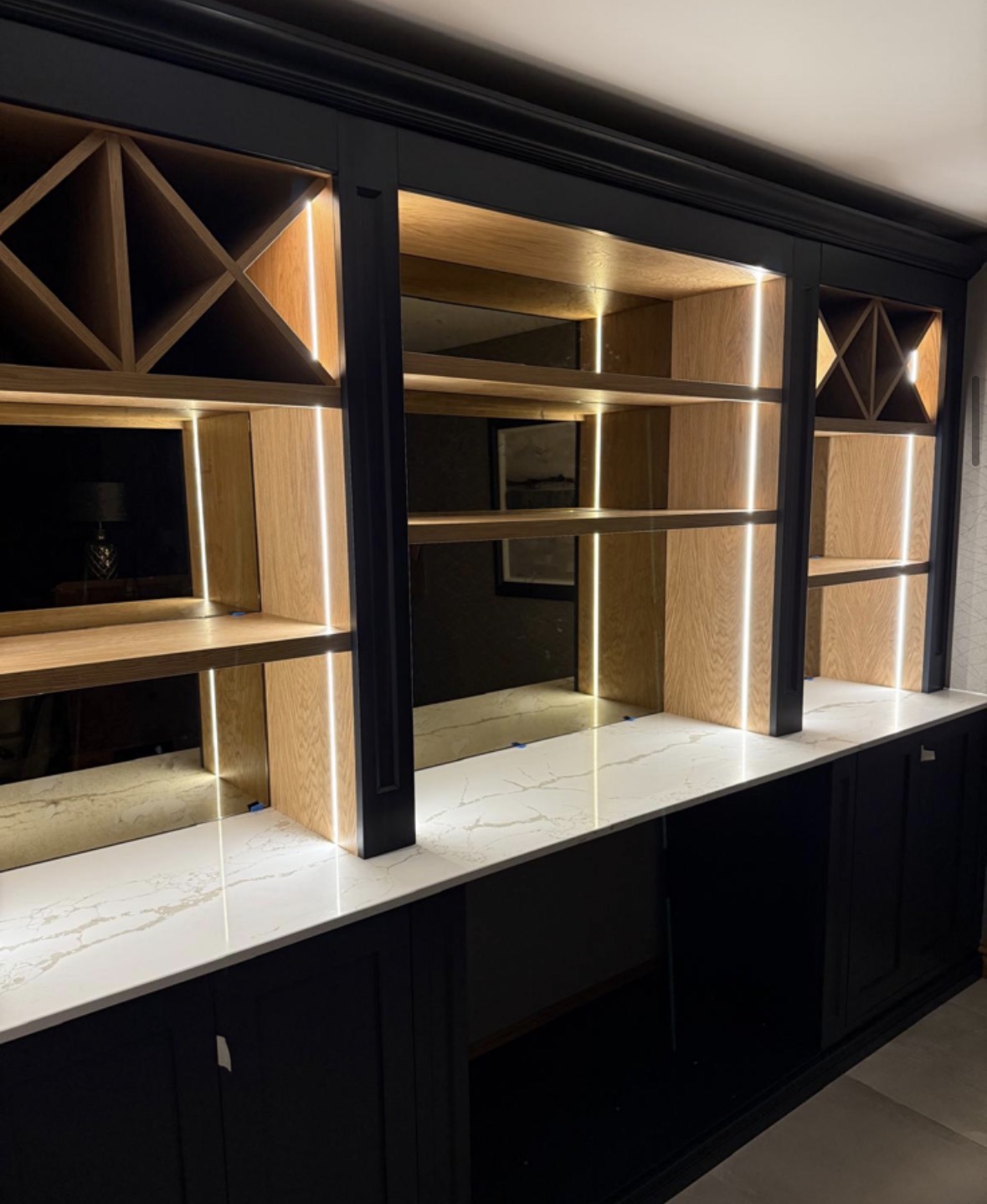
Where display is the priority, whether for books, ceramics or collected objects, open shelving throughout gives the greatest flexibility, and glazed or lit sections can be introduced for particular pieces, an approach detailed on display cabinets. Where tidiness and concealment matter more, an alcove unit's balance of closed and open storage keeps everyday clutter out of view while still allowing some display above.
Neither approach is fixed, and the proportion of open to closed storage in either design is a decision made during layout, based on what needs to be stored and how much of it should be on view.
Which suits your alcoves?
01
Choose alcove units when
You need to accommodate a television or media equipment and want concealed storage for everyday clutter alongside display shelving.
02
Choose built-in bookcases when
Book capacity is the priority and you want the fullest possible run of open shelving across both recesses.
03
Choose alcove units when
The room needs a mix of practical closed storage and considered display, rather than storage built around books alone.
04
Choose built-in bookcases when
You want a strong architectural feature built primarily around an existing or growing book collection.
How we work
Both approaches begin with a survey of the chimney breast and recesses, followed by a proposed layout balancing storage, display and any equipment to be housed, before manufacture in our Derbyshire workshop, as set out on the process page.
Questions we are asked
Terminology
- What is the main difference between an alcove unit and a built-in bookcase?
- An alcove unit typically combines base cabinetry for concealed storage with open shelving above, while a built-in bookcase favours open shelving throughout, often floor to ceiling, prioritising book capacity and display over concealed storage. In practice the two often overlap, and many projects sit somewhere between them once the balance of storage and display is agreed for the room.
Design
- Can a television be built into an alcove unit?
- A television is commonly housed within or above the base cabinetry of an alcove unit, an approach considered as part of the wider design on alcove units and chimney breast cabinetry. Cable routes and ventilation for the equipment are planned into the cabinetry at design stage rather than added afterwards.
Storage
- Do built-in bookcases include any closed storage?
- They can, but closed storage is not central to the design in the way it is for an alcove unit. Where book capacity is the priority, the lower section is often given over to further open shelving instead, though a single closed cupboard can still be introduced at one end for less decorative items if needed.
Design
- Can alcove units and bookcases be combined in the same room?
- One alcove might be designed as an alcove unit with base cabinetry while the other favours open bookcase shelving, depending on what each side of the room needs to accommodate, though this is usually balanced for visual consistency. Matching the shelf spacing, cornice and skirting details across both sides helps the pair read as one considered scheme rather than two unrelated pieces.
Layout
- Do these designs need to bridge over the chimney breast?
- A bridging unit across the top of the chimney breast is common but not compulsory, and ties the two recesses together visually. It can include display shelving, closed storage or simply run the shelving straight across, and its depth is usually kept shallower than the alcove cabinetry so it reads as a lighter feature above.
Design
- Is it safe to build cabinetry close to a working fireplace?
- Clearances around a working fireplace are considered carefully during design so the cabinetry does not compromise safe use of the fireplace below, and any fireplace or flue work itself remains the responsibility of a qualified specialist rather than Chester Thomas.
Storage
- Which holds more books, an alcove unit or a built-in bookcase?
- A built-in bookcase generally holds more books, since its shelving typically runs the full height and depth of the recess rather than surrendering the lower section to base cabinetry. An alcove unit can partly close that gap by taking its upper shelving to the ceiling, but its base cabinetry will always account for some of the available run.
Display
- Can display cabinets be incorporated into either design?
- Glazed or lit display sections can be incorporated into either an alcove unit or a bookcase design, an approach detailed on display cabinets, and are usually reserved for particular objects or a smaller collection of pieces. Positioning them at eye level, rather than at the very top or bottom of the run, tends to give the best result for anything meant to be noticed.
Storage
- Which is better for hiding cables and equipment?
- An alcove unit is generally better suited to this, since its base cabinetry conceals equipment and cabling behind doors, whereas a bookcase design with open shelving throughout leaves less scope for hidden storage. Cable routes between shelves and skirting are planned in at design stage so equipment can be reached for maintenance without exposing the wiring day to day.
General
- Do I need to choose one style for the whole room?
- No, though for visual consistency most projects use the same general approach across both recesses in a single room. Where different rooms in the house have different needs, alcove units and built-in bookcases can both be used in the same property.
Cost
- What does an alcove unit or bookcase installation cost?
- Cost depends on the size of the recesses, the balance of open and closed storage and the finish specified, so there is no general figure across projects. Sharing details of your room through the contact page allows a response against the specifics.
Lighting
- Can lighting be included in either design?
- Lighting can be integrated into the shelving of either an alcove unit or a bookcase, typically to highlight display shelves or books, with any electrical connection carried out by a qualified electrician rather than as part of the joinery itself.
Where to go next
Bespoke alcove units
Base cabinetry and shelving for chimney-breast recesses.
Built-in bookcases
Full-height open shelving for book-led rooms.
Bespoke chimney-breast cabinetry
Cabinetry designed around the chimney breast as a whole.
Bespoke display cabinets
Glazed and lit sections for display pieces.
Bespoke living room cabinetry
The wider cabinetry an alcove design sits within.
Bespoke bookshelves
Open shelving solutions for book storage.
Related guides
Built-in bookcases vs home library
Whether a single run of built-in bookcases or a full room-wide home library best suits your book collection and space.
Media wall vs TV unit
A media wall reworks the whole wall around the television; a TV unit is a single piece of furniture. Scale is the real difference.
Built-in vs floating TV unit
A floor-standing built-in unit and a wall-mounted floating unit solve the same problem in different ways. Wall type and cleaning access often decide it.
Home bar vs drinks cabinet
Whether a dedicated home bar or a fitted drinks cabinet better suits your room and how you entertain.
To talk a decision through, call Chester Thomas on +44 7418 627358, email info@chesterthomas.com or discuss your alcove or bookcase project.
Planning Something Bespoke?
Tell us about your space, what you're looking to create and where the project is located.