
Guides
Home bar vs drinks cabinet
A home bar is a dedicated area, often with a counter and seating, built for preparing and serving drinks, while a drinks cabinet is a single piece of storage furniture, so the decision usually comes down to how much room you have and how you actually entertain.
Home bar vs drinks cabinet
Both are ways of bringing drinks storage and serving into a room with some intention, rather than leaving bottles and glassware scattered across a sideboard, but they sit at very different scales. A home bar treats an area of the room as its own zone, usually with a counter, back bar storage and sometimes stools or seating, built for standing and preparing drinks rather than simply storing them.
A drinks cabinet is a single piece of furniture, whether a standalone cabinet, a fitted unit within existing cabinetry or a dedicated cocktail cabinet, that stores bottles and glassware behind doors and opens out for use. It asks far less of the room, since it occupies the footprint of a single cabinet rather than a working area.
Neither is inherently the better choice. A home bar suits a room that can spare the floor area and where entertaining is a regular, established habit, while a drinks cabinet suits almost any room and gives a considered place for drinks without committing space to a dedicated zone.
Chester Thomas designs both, from full bar installations on home bars to freestanding and fitted storage on drinks cabinets and cocktail cabinets, alongside supporting elements such as back bars and wine storage, and this comparison sets out where each genuinely earns its place.
Home bar vs drinks cabinet
| Consideration | Home bar | Drinks cabinet |
|---|---|---|
| Space required | A dedicated area of the room, often a wall plus standing space | The footprint of a single cabinet or fitted unit |
| Seating | Can include stools or nearby seating for guests | No seating provision, used from wherever guests are already sat |
| Preparation areas | Includes a counter or surface for mixing and pouring drinks | No dedicated preparation surface, drinks are prepared elsewhere |
| Bottle storage | Larger capacity across back bar shelving and undercounter storage | Bounded by the internal capacity of the cabinet |
| Glassware | Dedicated racking or shelving, often on display | Smaller allocation within the cabinet, sometimes on a fitted tray |
| Refrigeration provision | Can include space for undercounter refrigeration | Rarely accommodates refrigeration given its scale |
| Visual impact | A significant feature of the room, often with lighting and a back bar | A single furniture piece, closed when not in use |
| Lighting | Feature lighting across the back bar and counter area | Interior lighting within the cabinet on opening |
| Installation | A more substantial fit-out involving a run of cabinetry | A single delivered and installed piece |
Space and room requirements
A home bar needs an area that can be given over to it, typically a section of wall for a back bar plus enough floor space in front for a counter and, where wanted, stools. This usually rules it out of smaller rooms unless it is designed as a compact corner installation, and it works best in a room already used for entertaining, such as a garden room, basement or larger living space.
A drinks cabinet asks for very little: the footprint of a single piece of furniture, whether freestanding or built into an existing run of cabinetry. It can sit in a dining room, living room, hallway or study without requiring the room to be reorganised around it, making it the more flexible option where space is limited.
Preparation, seating and use
The counter is what distinguishes a home bar functionally: it gives a surface for mixing, pouring and serving drinks, which a drinks cabinet does not provide. Where stools or nearby seating are included, a home bar becomes a genuine gathering point in its own right rather than simply a storage solution.
A drinks cabinet is used briefly, opened to select a bottle or glass and then closed again, with drinks typically prepared elsewhere in the room. This suits occasional entertaining or a household that wants drinks storage without dedicating part of the room to standing and mixing.
Bottle storage, glassware and refrigeration
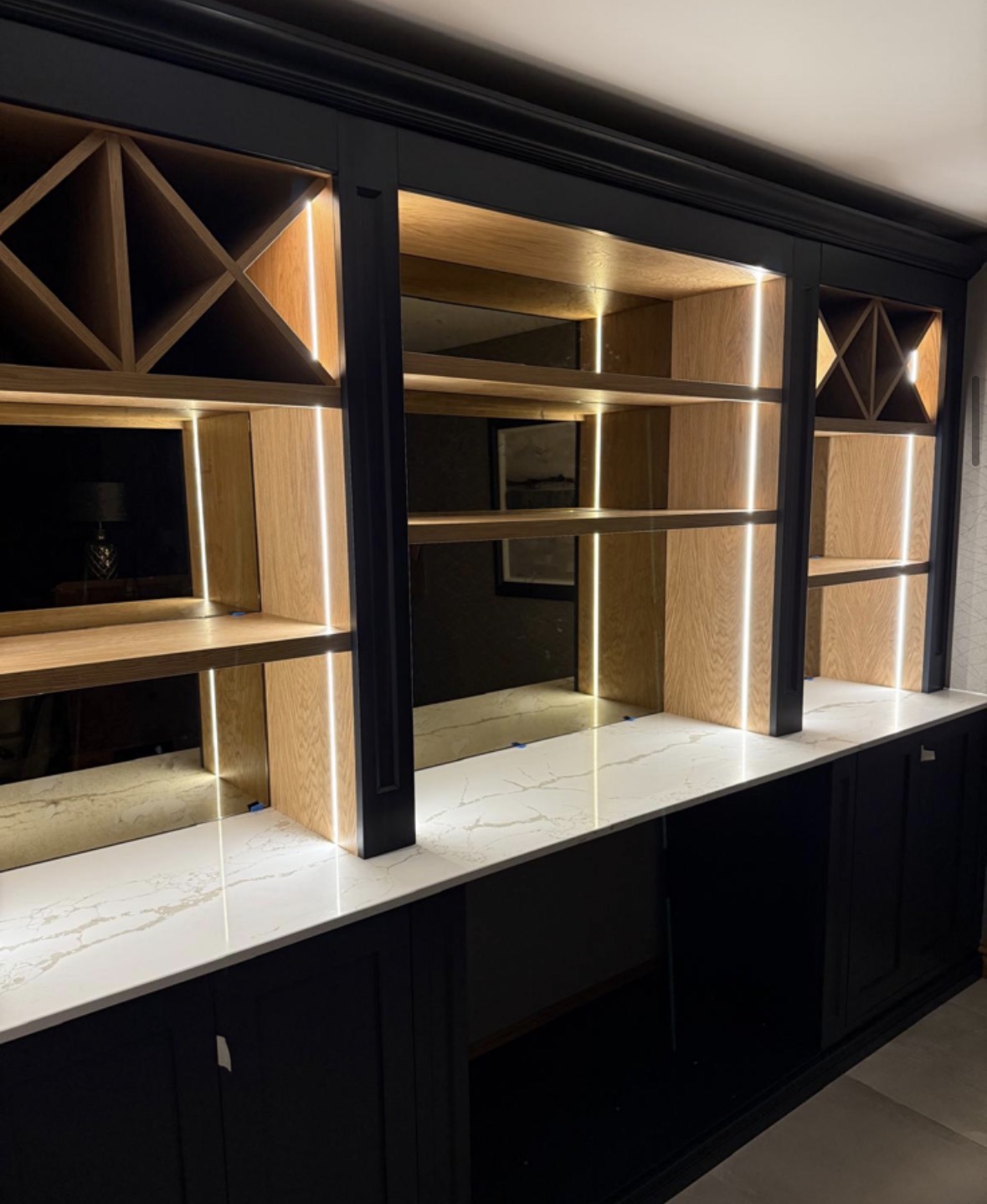
A home bar's back bar storage, often designed alongside back bars, gives considerably more capacity for both bottles and glassware than a single cabinet can, and can include dedicated wine storage detailed on wine storage. Where undercounter refrigeration is wanted, we design the cabinetry to accommodate the appliance, though supply, installation and any electrical or plumbing connection remain with the client's chosen trades.
A drinks cabinet has a fixed, more modest capacity, generally enough for regularly used bottles and a small glassware allocation, and rarely has room for refrigeration given its scale. A cocktail cabinet, covered on cocktail cabinets, is a specific type of drinks cabinet often fitted with mirrored or lit interiors to make a feature of a smaller footprint.
Visual impact and lighting
A home bar tends to become a visual focal point of the room, particularly where the back bar includes glass shelving, mirrored panels or feature lighting, so it is designed with the same attention as any other piece of statement furniture. This visual presence is a deliberate part of the brief for most home bar projects, not an incidental effect.
A drinks cabinet has a much more restrained visual impact, particularly when closed, and its interior lighting is only seen when the doors are open. This makes it a better fit for a room where you want considered drinks storage without a dominant feature.
Which suits your room?
01
Choose a home bar when
You have a room or area that can be dedicated to entertaining and you want a counter, seating and substantial storage in one place.
02
Choose a drinks cabinet when
You want considered drinks storage without giving up floor area, and drinks are usually prepared and served elsewhere in the room.
03
Choose a home bar when
Entertaining is a regular part of how you use the house and you want a genuine gathering point rather than storage alone.
04
Choose a drinks cabinet when
The room already has a defined purpose, such as a dining room or study, and a bar counter would compete with that function.
05
Choose a cocktail cabinet when
You want the visual presence of a feature drinks piece within the footprint of a single cabinet rather than a full bar installation.
How we work
Both formats are designed around the room you have, from a full back bar installation to a single cocktail cabinet, following the same design and manufacture sequence set out on the process page.
Questions we are asked
Room requirements
- Do I need a large room for a home bar?
- A home bar suits a room with a spare section of wall for a back bar and floor space for a counter, but a compact corner installation can also work in a smaller space. It generally needs more room than a drinks cabinet, which fits into almost any footprint.
Appliances
- Can a home bar include a fridge?
- Undercounter refrigeration can be accommodated within a home bar design, with cabinetry built around the appliance, though we do not supply, install or connect the appliance itself, which is arranged through the client's chosen trades. The relevant dimensions and any ventilation gap are agreed at design stage so the cabinetry fits the chosen unit precisely once it is in place.
Terminology
- What is the difference between a drinks cabinet and a cocktail cabinet?
- Both are single pieces of drinks storage furniture, but a cocktail cabinet, described on cocktail cabinets, is often designed with mirrored or lit interiors and a fold-out or opening front intended to make a visual feature of the piece rather than simply store bottles.
Storage
- Can a drinks cabinet hold wine as well as spirits?
- A drinks cabinet can include wine racking or shelving alongside other bottles, though where wine storage is a priority in its own right, a dedicated approach such as wine storage may suit better, particularly for larger collections. Mixing wine and spirits within one cabinet works well for everyday bottles, but a collection intended for laying down is usually better served by purpose-built racking.
Layout
- Does a home bar need seating?
- Seating is optional. Many home bars include stools for guests to sit at the counter, but a bar can also be designed purely as a serving and storage area used by people already seated elsewhere in the room. Where seating is wanted, the counter height and depth are set out early in the design so stools sit comfortably and there is enough clearance to move behind the counter.
Storage
- How much bottle storage does a home bar provide compared with a cabinet?
- A home bar, particularly one with a full back bar, generally provides considerably more storage than a single drinks cabinet, since it can use an entire wall of shelving and undercounter space rather than the interior of one piece of furniture.
Lighting
- Is lighting important for a home bar?
- Lighting is a significant part of a home bar's visual impact, often used across the back bar and counter to highlight bottles, glassware and any mirrored or glazed sections. Electrical connection of any fittings is carried out by a qualified electrician.
Design
- Can a drinks cabinet be built into existing furniture?
- A drinks cabinet can be a standalone piece or fitted into an existing run of cabinetry, such as a sideboard or living room storage wall, which is discussed as part of the wider design covered on drinks cabinets. Building it into a larger piece keeps the room looking coherent, since the drinks storage reads as part of the overall run rather than a separate addition.
Cost
- What does a home bar cost compared with a drinks cabinet?
- A home bar generally involves more cabinetry, worktop and lighting than a single drinks cabinet, so it typically represents a larger project, though the specific cost depends on scale and specification. Sharing your room and requirements through the contact page allows an accurate response.
Installation
- Can a home bar be added to an existing room without major building work?
- A home bar can often be fitted into an existing room using its current walls and floor area, without structural changes, provided there is enough space for the counter and back bar. Any electrical or plumbing work needed is coordinated with the client's own trades.
Application
- Is a drinks cabinet a good option for a dining room?
- A drinks cabinet suits a dining room well, since it provides accessible storage without requiring a counter or standing area that would compete with the dining table and seating already in the room. A sideboard-style cabinet also gives a convenient surface for serving during a meal, positioned close to the table without needing anyone to leave the room to fetch a bottle or glass.
Installation
- Does a home bar need to be near a kitchen or utility supply?
- It helps if a home bar has reasonably convenient access to water or power where refrigeration or ice provision is wanted, though this is a matter for the client's own trades to arrange rather than something Chester Thomas installs or connects.
Where to go next
Home bars
Full bar installations with counter and back bar storage.
Bespoke drinks cabinets
Standalone and fitted drinks storage furniture.
Bespoke cocktail cabinets
Feature cabinets with mirrored or lit interiors.
Bespoke back bars
Shelving and storage behind a home bar counter.
Bespoke wine storage
Dedicated storage for larger wine collections.
Bespoke bar shelving
Open display shelving for bottles and glassware.
Related guides
Built-in bookcases vs home library
Whether a single run of built-in bookcases or a full room-wide home library best suits your book collection and space.
Media wall vs TV unit
A media wall reworks the whole wall around the television; a TV unit is a single piece of furniture. Scale is the real difference.
How to choose materials
How to think through timber, paint, stone, glass and metal choices for a bespoke piece.
To talk a decision through, call Chester Thomas on +44 7418 627358, email info@chesterthomas.com or discuss your entertaining space.
Planning Something Bespoke?
Tell us about your space, what you're looking to create and where the project is located.