
Materials & finishes
Bespoke oak furniture
Oak brings warmth and visible grain to fitted furniture, ageing and reading differently to painted or lacquered surfaces. Depending on the project, designs may incorporate oak across cabinetry, shelving and structural framework.
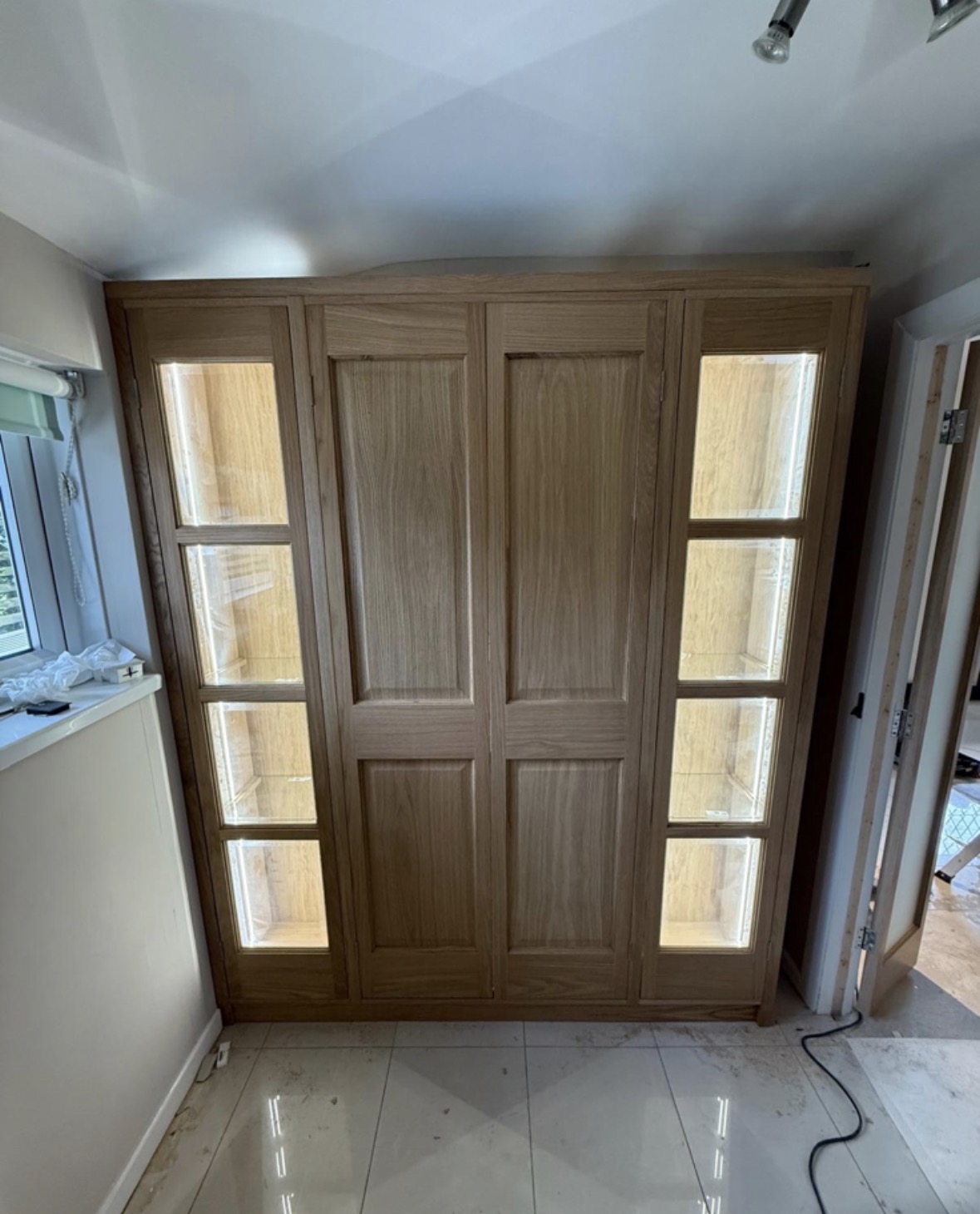
Bespoke oak furniture
Oak is one of the most familiar timbers used in fitted furniture, and much of its appeal lies in what it is not: a flat, uniform surface. Grain runs visibly through doors, panels and shelving, and no two boards read in quite the same way, so a run of oak cabinetry has a texture and depth that a painted equivalent does not attempt to replicate.
That natural variation is not a flaw to be designed around. Board selection and layout are considered at design stage so that grain direction reads consistently across a run of doors or panels, and so that adjoining pieces of timber sit together in a way that looks deliberate rather than accidental. The result is furniture that still shows the timber it is made from, rather than disguising it.
Oak is used across a wide range of Chester Thomas furniture: fitted cabinetry, media walls, home libraries and bookcases, home offices, kitchens and home bars. In each case the timber is worked into the specific piece being designed, from door and drawer fronts to open shelving and structural framework, rather than applied as a single finish across an entire scheme.
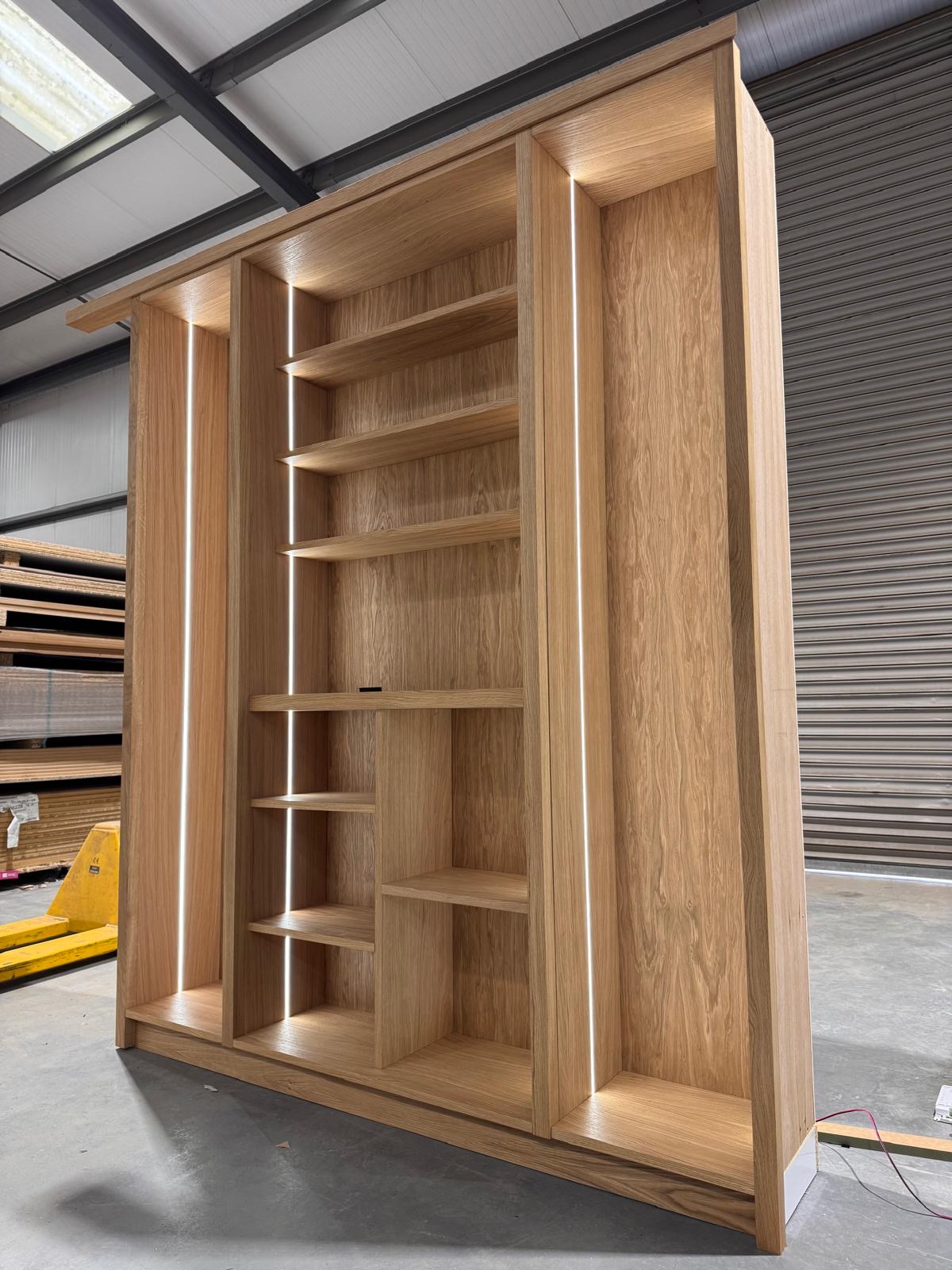
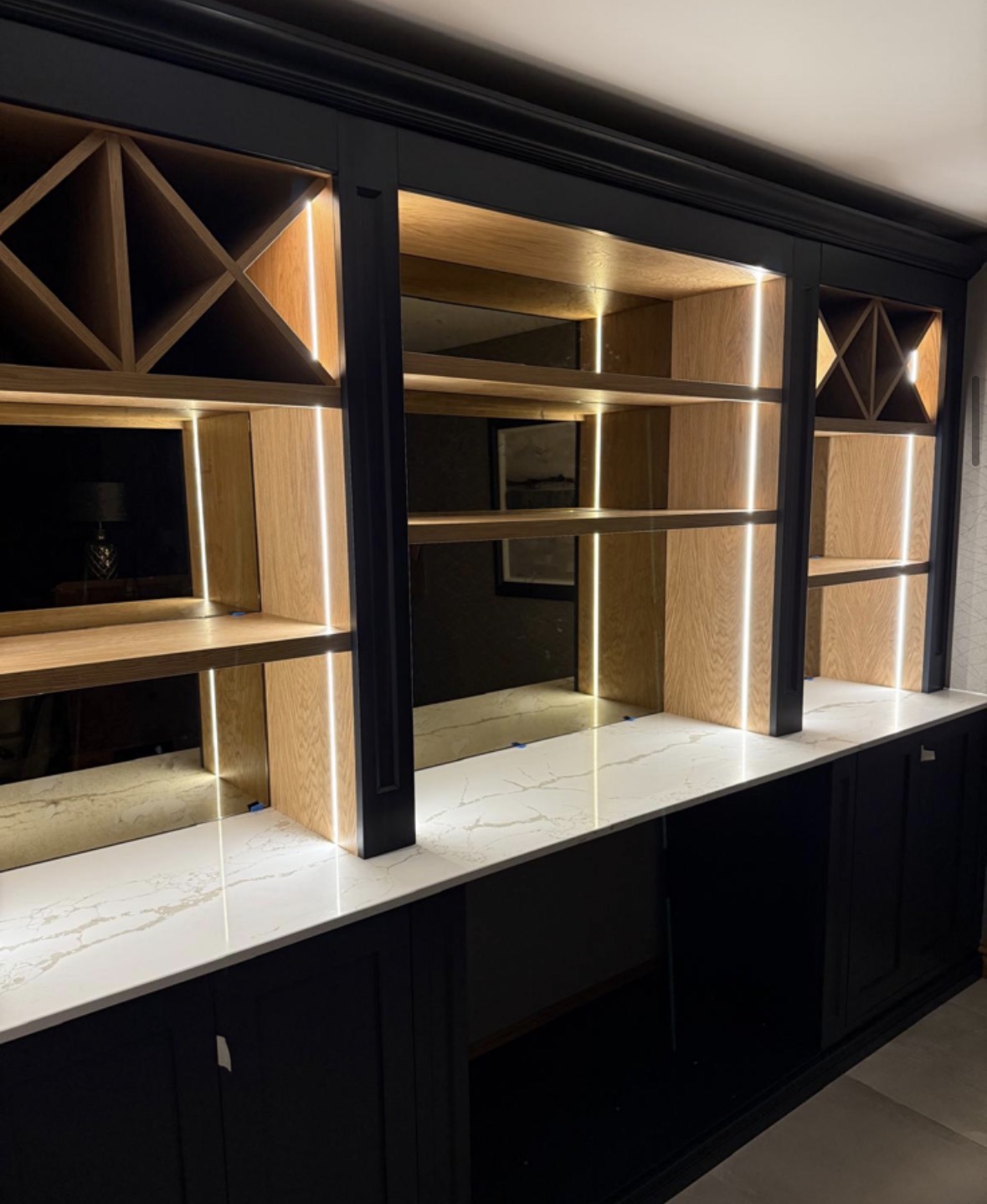
It also works well as one material among several rather than the only one in a room. Oak alongside painted cabinetry, stone or marble surfaces, glass display fronts and metal detailing gives a scheme contrast and visual interest, with the oak providing warmth against harder or cooler materials. Lighting, particularly LED detailing beneath shelving, tends to draw out the grain and depth of the timber rather than flattening it.
As with any natural material, the exact character of the oak used on a project, from its tone to the visibility of its grain, is discussed and agreed at design stage rather than assumed from a swatch, so the finished furniture reflects a considered decision rather than a generic specification.
Where oak works well
01
Media walls and TV units
Oak framework and shelving give a media wall warmth and texture, particularly where it sits alongside a stone or marble surround, as seen on media walls, where timber, stone and lighting are considered together rather than in isolation.
02
Home libraries and bookcases
Grain and natural variation suit the scale of a library or a run of built-in bookcases, where repeated shelving and framework give the timber room to read across a large area, as covered on home libraries and built-in bookcases.
03
Home offices
Desks, shelving and storage in oak bring warmth to a working space without the reflectivity of a high-gloss or lacquered finish, which suits a room used for long periods, as described on home offices & studies.
04
Kitchens
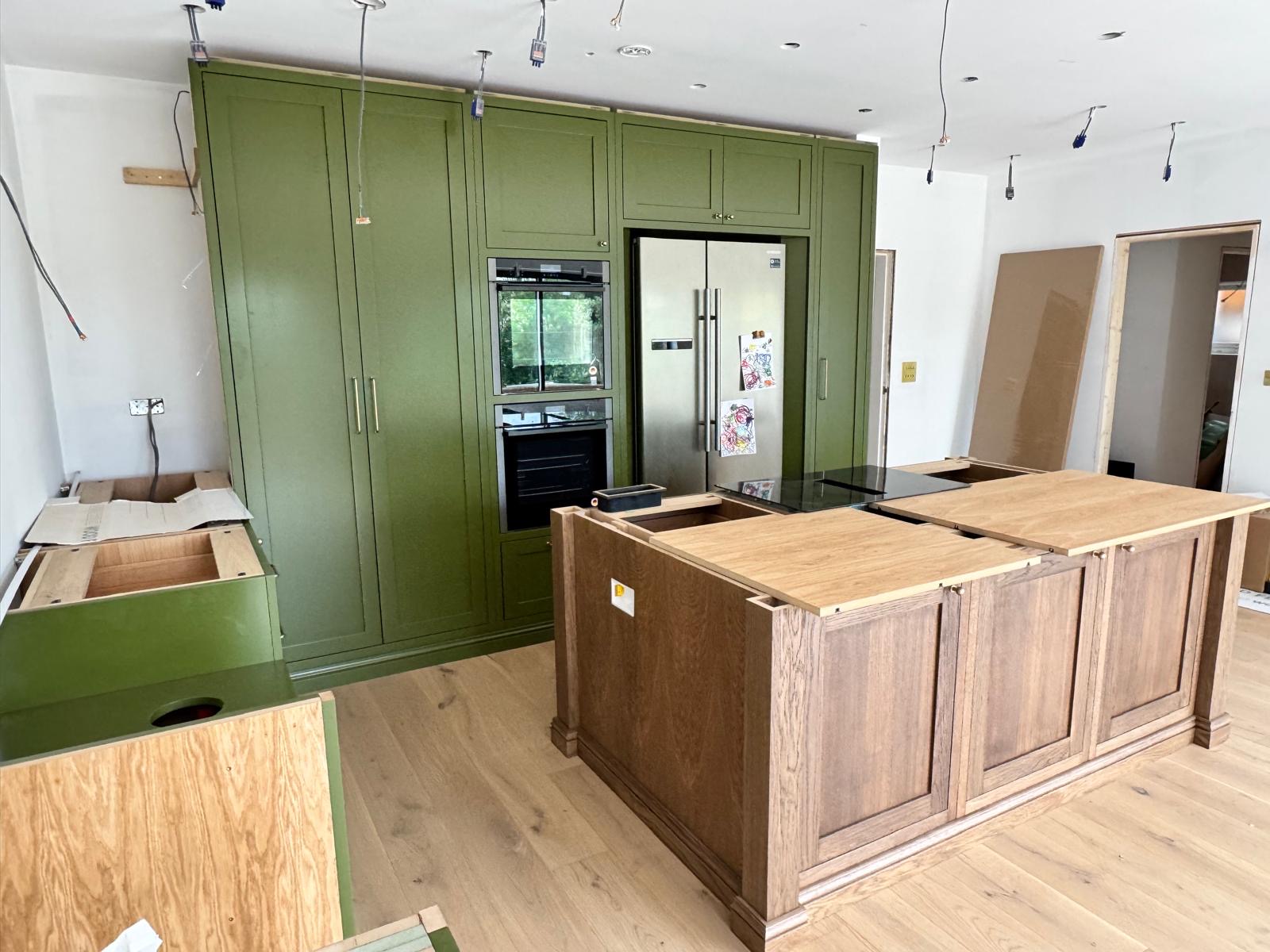
Oak cabinetry can be used across full runs or combined with painted units, giving a kitchen a mix of natural texture and flat colour, an approach covered in more detail on bespoke kitchens.
05
Home bars
Shelving, bottle storage and display sections in oak suit a home bar where warmth and texture are wanted alongside glass and metal detailing, as set out on home bars.
06
General fitted cabinetry
Alcove units, storage walls and general cabinetry in oak work in most rooms of the house, and are considered individually on bespoke cabinetry rather than specified as a single standard finish.
Grain direction and board layout
Grain does not run identically across every board, so its direction and layout across doors, panels and shelving is planned at design stage rather than left to chance during manufacture. This keeps a run of cabinetry reading as a coherent whole rather than a set of mismatched pieces.
Natural variation
Oak varies in tone and figure from board to board, and this variation is part of the material rather than something to be eliminated. Where a very uniform appearance is wanted, this is discussed early, since oak will always show some natural inconsistency compared with a painted or lacquered surface.
Combining oak with other materials
Oak is frequently used alongside painted cabinetry, stone or marble surfaces and metal detailing, and how these materials meet, at edges, reveals and transitions, is worked out during design rather than after manufacture has begun.
Finish and sheen
The sheen level applied to oak affects how strongly the grain reads and how the timber responds to light. Finishes can be developed to coordinate with the wider interior scheme, and this is agreed alongside other material decisions rather than treated as an afterthought. A satin or matt sheen tends to show grain more honestly than a high-gloss lacquer, which can flatten the appearance of oak considerably.
Lighting
LED lighting beneath shelving or within cabinetry tends to draw attention to grain and texture, so where lighting is planned into an oak piece, the two are considered together rather than the lighting being added once the timber has already been specified. Any electrical connection is carried out by a qualified electrician rather than as part of the joinery work itself.
From our work
What oak works well alongside
- Stone and marble
- A stone or marble surface, such as a fireplace surround or worktop, provides a cooler, denser contrast to the warmth of oak, a pairing used on the Solihull media wall described on our completed bespoke media wall project in Solihull.
- Painted cabinetry
- Oak sections combined with painted units, as covered on bespoke painted cabinetry, give a scheme contrast between natural texture and flat colour without the two competing for attention.
- Glass
- Glazed doors or display sections let light through an oak carcass, softening the visual weight of a large run of cabinetry.
- Metal detailing
- Handles, frames or trim in a metal finish add a harder edge against the warmth of oak, useful where a scheme leans toward a more contemporary character.
- Lighting
- Integrated lighting beneath shelves or within recesses picks out grain and depth in oak more effectively than it does on a flat painted surface.
Design, manufacture, installation
Oak, like any material used in Chester Thomas furniture, is discussed at design stage, drawn and specified before manufacture begins in the Derbyshire workshop and the finished piece is installed by the same team. The full sequence is set out on the process page.
Questions we are asked
Material
- Does oak furniture always look the same?
- No. Oak varies in tone and grain from board to board, and how strongly this variation reads depends on board selection, finish and sheen. Two oak pieces designed for different rooms can look quite different from one another once these decisions are made, which is why oak is discussed at design stage rather than specified from a single sample.
Application
- Can oak be used in a kitchen?
- Oak can be used across kitchen cabinetry, either as a full run or combined with painted units, and is considered as part of the wider kitchen design covered on bespoke kitchens. How it is finished depends on the rest of the scheme, including worktops, splashbacks and hardware, so this is worked through during design rather than assumed in advance.
Material
- Will oak cabinetry match across a large project?
- Board layout and grain direction are planned during design so that a run of oak doors, panels or shelving reads as a coherent whole rather than a set of mismatched pieces. Some natural variation between boards will still be visible, since this is part of what oak looks like, but it is arranged deliberately rather than left to chance.
Pairings
- Can oak be combined with stone or marble?
- Oak and stone are frequently paired, with the timber providing warmth against a cooler stone or marble surface such as a fireplace surround. How the two materials meet, including edges and transitions, is worked out at design stage, as on the media wall described on our completed bespoke media wall project in Solihull.
Lighting
- How does lighting affect oak furniture?
- LED lighting beneath shelving or within recesses tends to draw out grain and texture in oak more noticeably than on a flat painted surface. Where lighting is planned, it is considered alongside the timber during design so the two work together, though the electrical connection itself is carried out by a qualified electrician rather than as part of the joinery.
Application
- Is oak suitable for a home office?
- Oak works well in a home office, where desks, shelving and storage in a warm, textured timber suit a room used for long periods without the reflectivity of a high-gloss finish. Specific layouts and storage requirements are discussed as part of the design process described on home offices & studies.
- Can oak be used for open shelving?
- Oak suits open shelving well, since grain and natural variation have room to read across an exposed surface rather than being hidden behind a door. This is a common approach in libraries, bookcases and display shelving on media walls, where the timber itself becomes part of the visual interest.
Material
- Does oak need to be sealed or protected?
- Oak furniture is finished appropriately for its location and use as part of the specification process, though the specific detail of any sealant or protective coating is agreed on a project basis rather than fixed as a standard answer. This is discussed once the piece and its intended use are known.
Pairings
- Can oak be mixed with painted cabinetry in the same room?
- Combining oak with painted cabinetry is a common approach, giving a room contrast between natural texture and flat colour rather than a single uniform material. How the two are balanced, in terms of proportion and placement, is worked through during design, as described on bespoke painted cabinetry.
Application
- Is oak used for wardrobes as well as living spaces?
- Oak can be used in wardrobe and dressing room furniture as well as living spaces, though many wardrobe interiors use a mix of materials depending on storage needs. Where oak is wanted for a wardrobe project, this is discussed as part of the wider design covered on fitted wardrobes.
Process
- How is oak furniture designed before it is made?
- Oak furniture goes through the same design sequence as any Chester Thomas piece: brief, survey, layout, material and drawings, all reviewed and approved before manufacture begins. Grain direction and board layout are considered specifically during this stage. The full process is set out on the process page.
Cost
- What does bespoke oak furniture cost?
- Cost depends on the scale of the piece, the layout, the finish specified and the complexity of installation, among other factors, so there is no general figure that applies across projects. The most useful next step is to share details of the room and what is needed through the contact page, so a response can be given against the specifics of the project.
Application
- Can oak be used for a media wall?
- Oak is commonly used for the framework and shelving of a media wall, often alongside a stone or marble surround and integrated lighting, an approach set out in more detail on media walls and shown in the Solihull project on our completed bespoke media wall project in Solihull.
Design
- Does oak suit a traditional or a contemporary scheme?
- Oak can suit either, depending on how it is detailed. A simpler panel arrangement and handleless doors tend to read as more contemporary, while more traditional framing and profiles suit a period property. This is a design decision made alongside the choice of oak itself rather than something fixed by the timber.
Relevant bespoke services
Media walls
Oak framework and shelving alongside stone and lighting.
Home libraries
Oak shelving and framework across a full room of storage.
Built-in bookcases
Fitted bookcases where oak grain reads across repeated shelving.
Home offices
Desks and storage in oak for a working space.
Bespoke kitchens
Oak cabinetry combined with other kitchen finishes.
Bespoke cabinetry
General fitted cabinetry considered on a room-by-room basis.
Related materials and styles
Stained oak furniture
Oak with its tone adjusted through staining, keeping the grain visible while suiting darker or warmer interior schemes.
Bespoke walnut furniture
Richer, darker grain used within wardrobe interiors, alcove shelving, wine walls and slatted panelling.
Bespoke timber cabinetry
Full-height and wall-to-wall timber cabinetry across libraries, media units, wardrobes, offices and bars.
Fluted cabinetry
A vertical, reeded texture used on drawer fronts, feature panels and furniture fronts to add depth without pattern.
To discuss materials and finishes, call Chester Thomas on +44 7418 627358, email info@chesterthomas.com or start your project.
Planning Something Bespoke?
Tell us about your space, what you're looking to create and where the project is located.