
Materials & finishes
Bespoke walnut furniture
Walnut has a richer, darker grain than oak, and within Chester Thomas furniture it has been used as a detail within larger pieces, such as wardrobe interiors and wine walls. Depending on the project, designs may incorporate walnut in a similar way.
Bespoke walnut furniture
Walnut is a darker, richer timber than oak, with a grain pattern that tends to be tighter and more pronounced. Within Chester Thomas furniture, it has been used less as the primary carcass material and more as a considered detail within a larger piece, chosen specifically for how it contrasts with the surrounding materials.
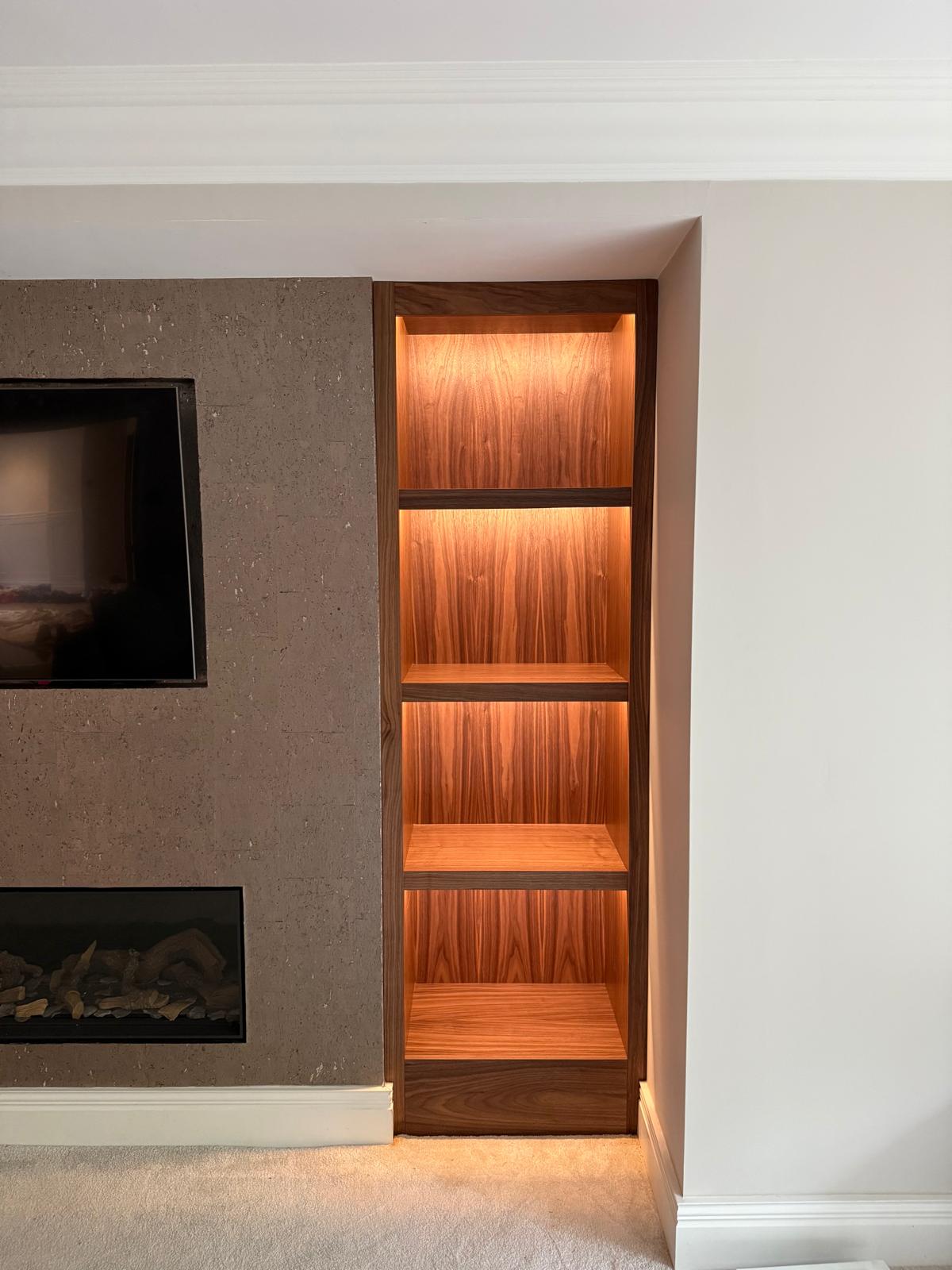
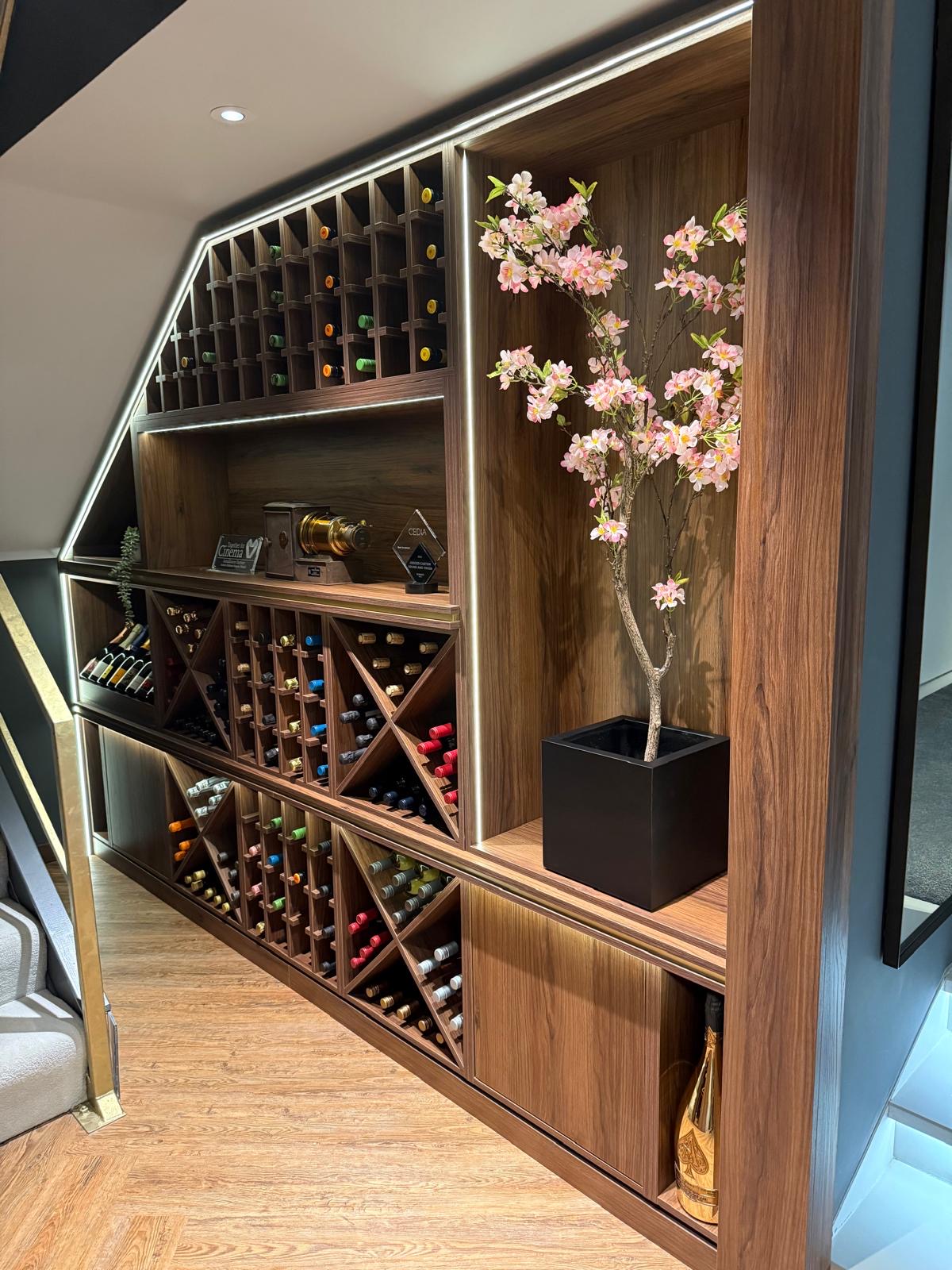
This has included walnut shelving within fitted wardrobe interiors, where the timber gives a warmer, more finished feel to internal storage that is often overlooked, and walnut alcove shelving used beside a stone-effect fireplace, where the darker timber sits against the cooler tone of the stone. A walnut wine wall with bottle racking has also been made, using the timber's depth to suit the more atmospheric lighting typical of wine display. In each case the timber was chosen for how it would read against a specific neighbouring material, whether stone, glass or metal, rather than as a general finish applied without reference to its surroundings.
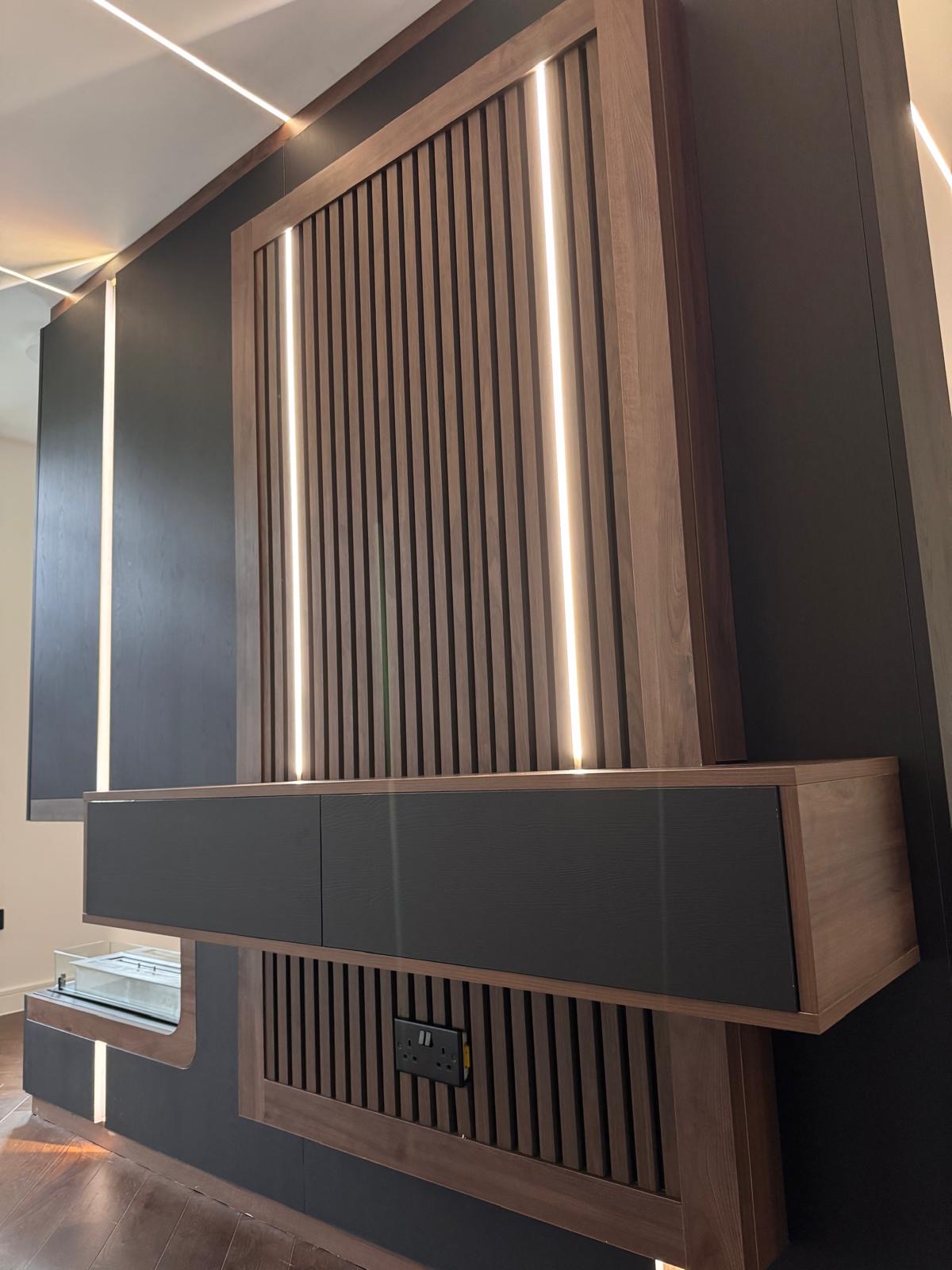
Walnut has also featured as display shelving on a media wall and as slatted panelling with concealed LED strips, an approach that uses narrow, evenly spaced walnut battens to create rhythm and texture across a wall or feature panel, with lighting run behind or between the slats to pick out their edges. This slatted detail suits libraries, home bars, home offices and general cabinetry where a textured feature is wanted alongside flatter surfaces.
Because walnut has been used in this more targeted way rather than across whole rooms of cabinetry, it tends to work best as a considered detail within a scheme, chosen for a specific piece of shelving, panelling or racking, rather than specified as the material for an entire run of furniture. This is discussed and agreed at design stage alongside the other materials in the room, with the walnut positioned so it draws the eye without overwhelming the surfaces around it.
Where walnut works well
01
Wardrobe interiors
Walnut shelving within a fitted wardrobe gives internal storage a warmer, more considered feel than a standard interior finish, an approach relevant to fitted wardrobes.
02
Alcove shelving beside a fireplace
Walnut alcove shelving set beside a stone-effect fireplace surround gives the darker timber a cooler material to contrast against, an arrangement considered within general cabinetry design on bespoke cabinetry.
03
Wine walls and racking
A walnut wine wall with bottle racking uses the timber's depth and grain to suit the more atmospheric lighting typical of wine storage, as covered on wine storage and wine rooms & cellars.
04
Media wall display shelving
Walnut display shelving on a media wall introduces contrast against other timbers or stone used elsewhere in the piece, relevant to media walls and bespoke TV units.
05
Slatted panelling with lighting
Narrow walnut battens arranged as slatted panelling, with concealed LED strips run behind them, create a textured feature suited to libraries, bars and offices, considered alongside integrated lighting for bespoke furniture.
06
Home bars and offices
Walnut shelving or panelling within a home bar or office adds a richer material accent against surrounding cabinetry, as discussed on home bars and home offices & studies.
Walnut as a detail rather than a whole scheme
Walnut has generally been used within Chester Thomas furniture as a considered detail, such as shelving, racking or panelling, rather than as the material for an entire run of cabinetry, and this is a realistic starting point for discussing how it might be used on a project.
Grain and colour depth
Walnut's grain is generally tighter and darker than oak's, and this depth is part of its appeal where a richer, more pronounced texture is wanted within a scheme, rather than the lighter, more open grain of oak.
Slat spacing and lighting
Where walnut is used as slatted panelling, the spacing between battens and the placement of any LED strips behind them are worked out together during design, since both affect how the finished panel reads once lit. Wider gaps let more light spill between slats and give a softer, more diffuse effect, while tighter spacing reads as a more solid, textured surface with light picked out along individual edges. Electrical connection for any lighting is carried out by a qualified electrician.
Combining walnut with other timbers
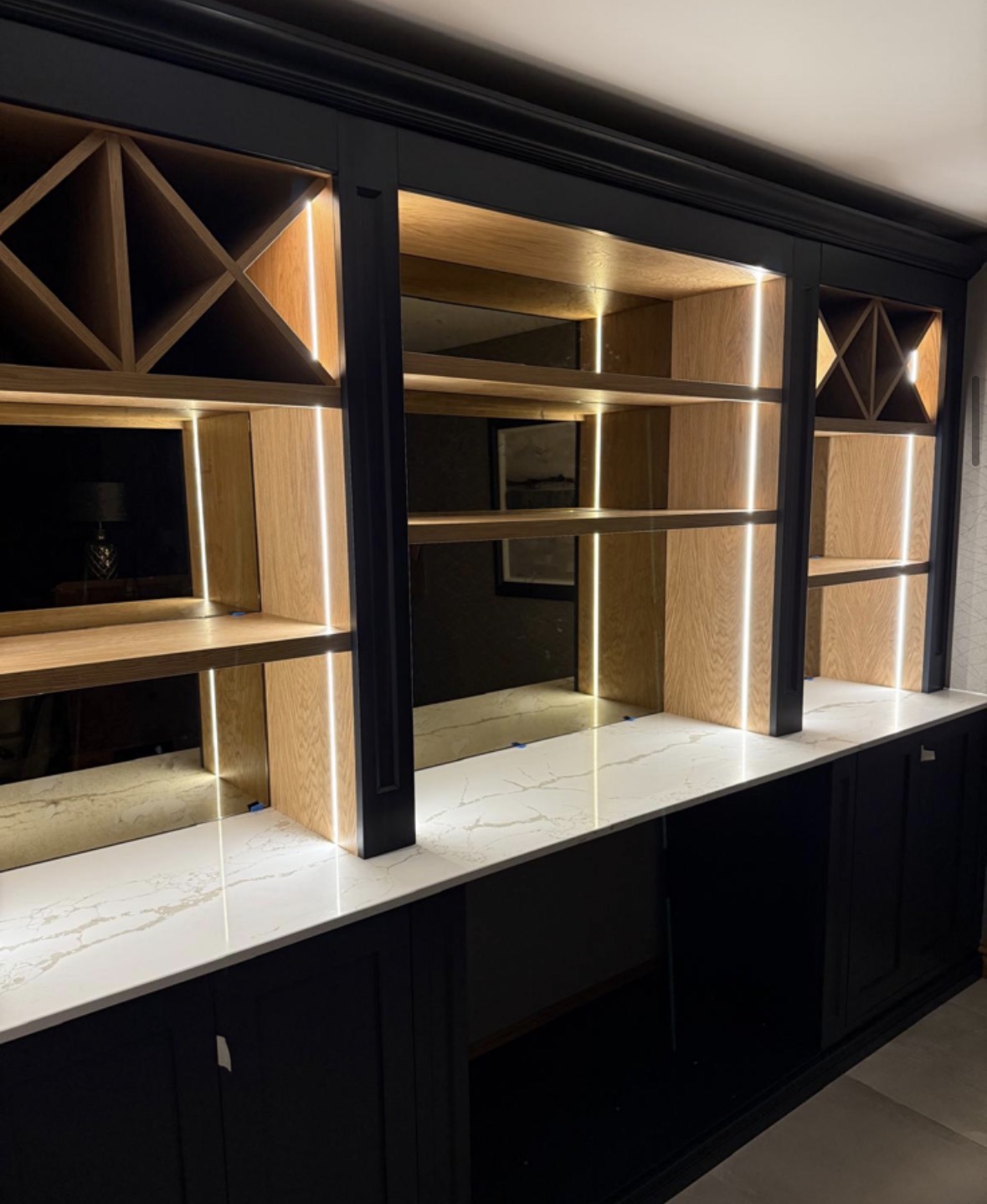
Where walnut is used as a detail within a piece that also includes oak or another timber, such as a media wall with a walnut shelving section, the two timbers are considered together at design stage so the contrast between them looks intentional.
Wine racking specifics
A walnut wine wall involves racking sized to hold bottles securely as well as the visual character of the timber, so the layout of a wine wall is worked through as part of the wider design for the room, described on wine rooms & cellars. Bottle weight and access also affect how deep and how firmly fixed the racking needs to be, which is resolved alongside the visible walnut framework rather than treated as a separate structural exercise.
Quantity and proportion
Because walnut has generally been used as a detail rather than a whole scheme, deciding how much of it to include, and where, is part of the early design discussion for a piece. Too little walnut within a large run of oak or painted cabinetry can look like an afterthought, while too much can shift the balance of a room that was intended to read as lighter or more neutral. Getting this proportion right is a matter of judgement worked through with the design team rather than a fixed rule.
From our work
What walnut works well alongside
- Stone-effect fireplace surrounds
- Walnut alcove shelving set beside a stone-effect fireplace uses the contrast between the darker timber and the cooler surround to give the pairing definition.
- Concealed LED lighting
- Slatted walnut panelling with LED strips run behind the battens creates a lit, textured feature, an approach relevant to lighting detail across furniture more broadly.
- Oak
- Walnut used as a shelving or display detail alongside an oak carcass gives a piece two distinct timber tones without introducing a painted or stone material.
- Glass
- Glass shelving or display fronts let walnut detailing read clearly through an otherwise enclosed section of cabinetry.
- Metal racking or trim
- Metal wine racking or trim detail against walnut shelving adds a harder material contrast within a wine wall or display feature.
- Painted cabinetry
- A walnut shelving or panelling detail set against painted cabinetry gives a scheme a clear focal point, with the darker timber standing out precisely because the surrounding surfaces are flat and pale.
Design, manufacture, installation
Where walnut is being considered for a project, it is discussed at design stage alongside the other materials in the room, drawn and specified before manufacture in the Derbyshire workshop and installation by the same team. The full sequence is set out on the process page.
Questions we are asked
Material
- Is walnut used across whole rooms of furniture?
- Within Chester Thomas furniture, walnut has generally been used as a considered detail within a larger piece, such as wardrobe shelving, alcove shelving or a wine wall, rather than across an entire run of cabinetry. This is a realistic starting point for discussing how it might feature on a new project.
- What has walnut been used for previously?
- Walnut has featured as shelving within fitted wardrobe interiors, alcove shelving beside a stone-effect fireplace, a wine wall with bottle racking, display shelving on a media wall, and slatted panelling with concealed LED strips. Each was a specific detail within a larger piece rather than a whole scheme in walnut.
- How does walnut differ from oak?
- Walnut is generally darker and richer than oak, with a tighter, more pronounced grain pattern. Where oak tends to be used across larger areas of cabinetry, walnut has more often been used as a targeted detail, such as shelving or panelling, chosen specifically for its contrast with surrounding materials. This is partly a matter of character, since a whole room in walnut can read as heavy, and partly practical, as a smaller quantity of a richer timber gives more contrast per piece than the same amount of oak.
Application
- Can walnut be used for wardrobe interiors?
- Walnut shelving within a fitted wardrobe interior gives internal storage a warmer, more finished feel than a standard interior finish, an approach used where a client wants the inside of a wardrobe to feel as considered as the exterior doors. This is discussed as part of the wider wardrobe design covered on fitted wardrobes, alongside decisions on hanging space, drawers and lighting.
- What is a walnut wine wall?
- A walnut wine wall combines bottle racking with walnut framework or panelling, giving wine storage a richer material character than a simple metal or painted rack. Racking is sized to hold bottles securely as well as to suit the room, and this is worked through as part of the design covered on wine rooms & cellars.
Detail
- What is slatted walnut panelling?
- Slatted walnut panelling uses narrow, evenly spaced walnut battens to create rhythm and texture across a wall or feature panel, often with LED strips run behind or between the slats to pick out their edges once lit. It suits libraries, bars, offices and general cabinetry as a feature detail.
Application
- Can walnut alcove shelving be used beside a fireplace?
- Walnut alcove shelving has been used beside a stone-effect fireplace surround, with the darker timber providing contrast against the cooler stone. This kind of pairing is considered as part of the wider cabinetry design for the room, covered on bespoke cabinetry.
- Is walnut used on media walls?
- Walnut has been used as display shelving on a media wall, giving a section of the piece a different timber tone to the rest of the framework. Media wall design more broadly is described on media walls, with the published Solihull project available on our completed bespoke media wall project in Solihull.
Lighting
- How is lighting used with walnut panelling?
- LED strips can be concealed behind or between slatted walnut battens to pick out their edges once lit, an approach used in slatted panelling detail. The placement of the lighting is planned alongside the slat spacing during design, though electrical connection is carried out by a qualified electrician.
Pairings
- Can walnut and oak be combined in the same piece?
- Walnut is often used as a shelving or display detail within a piece that otherwise uses oak, giving two distinct timber tones without introducing a painted or stone material. This contrast is planned deliberately at design stage rather than left to appear by accident.
Application
- Is walnut suitable for a home office or bar?
- Walnut shelving or panelling can be used within a home office or bar as a material accent against surrounding cabinetry, giving a section of otherwise plain storage a richer, more distinct character. This is discussed as part of the wider design for the room, alongside how much walnut to use and where, covered on home offices & studies and home bars.
Material
- Does walnut need a different finish to oak?
- The finish applied to walnut is agreed as part of the specification process for the piece, in the same way as any other timber, and depends on where it sits and how it is used. Its naturally darker tone means less is usually needed to achieve a rich colour compared with oak.
Cost
- What does walnut furniture cost compared with oak?
- Cost depends on the scale and complexity of the piece, the amount of walnut specified and the installation involved, rather than a fixed comparison between timbers. The most useful next step is to share project details through the contact page so a response can be given against the specifics involved.
Relevant bespoke services
Fitted wardrobes
Walnut shelving used within a wardrobe interior.
Wine rooms and cellars
Walnut wine walls and bottle racking.
Bespoke wine storage
Racking and display detail for wine bottles.
Media walls
Walnut used as a display shelving detail.
Home bars
Walnut shelving and panelling within a bar setting.
Bespoke cabinetry
Alcove shelving detail beside a fireplace.
Related materials and styles
Bespoke oak furniture
Oak furniture with visible grain and natural variation, designed to sit alongside stone, metal, glass and painted finishes.
Stone feature cabinetry
Fitted joinery designed to meet and support stone, in media walls, bars, kitchens, sideboards and feature walls.
Integrated lighting
LED shelf, display and wardrobe lighting designed into cabinetry from the outset, with connection carried out by a qualified electrician.
To discuss materials and finishes, call Chester Thomas on +44 7418 627358, email info@chesterthomas.com or start your project.
Planning Something Bespoke?
Tell us about your space, what you're looking to create and where the project is located.