
Materials & finishes
Fluted cabinetry for bespoke furniture
Fluting brings a vertical, reeded texture to a drawer front or panel, catching light along its length rather than across a flat surface, and used with restraint it reads as detail rather than decoration.
Fluted cabinetry
Fluting is a series of shallow, evenly spaced vertical grooves run along a door or drawer front. Rather than sitting flat and uniform, the surface picks up light differently along each groove, so the same piece of furniture can look subtly different through the day as light in the room changes. It is one of the more considered ways of adding texture to cabinetry without introducing pattern, colour or additional hardware.
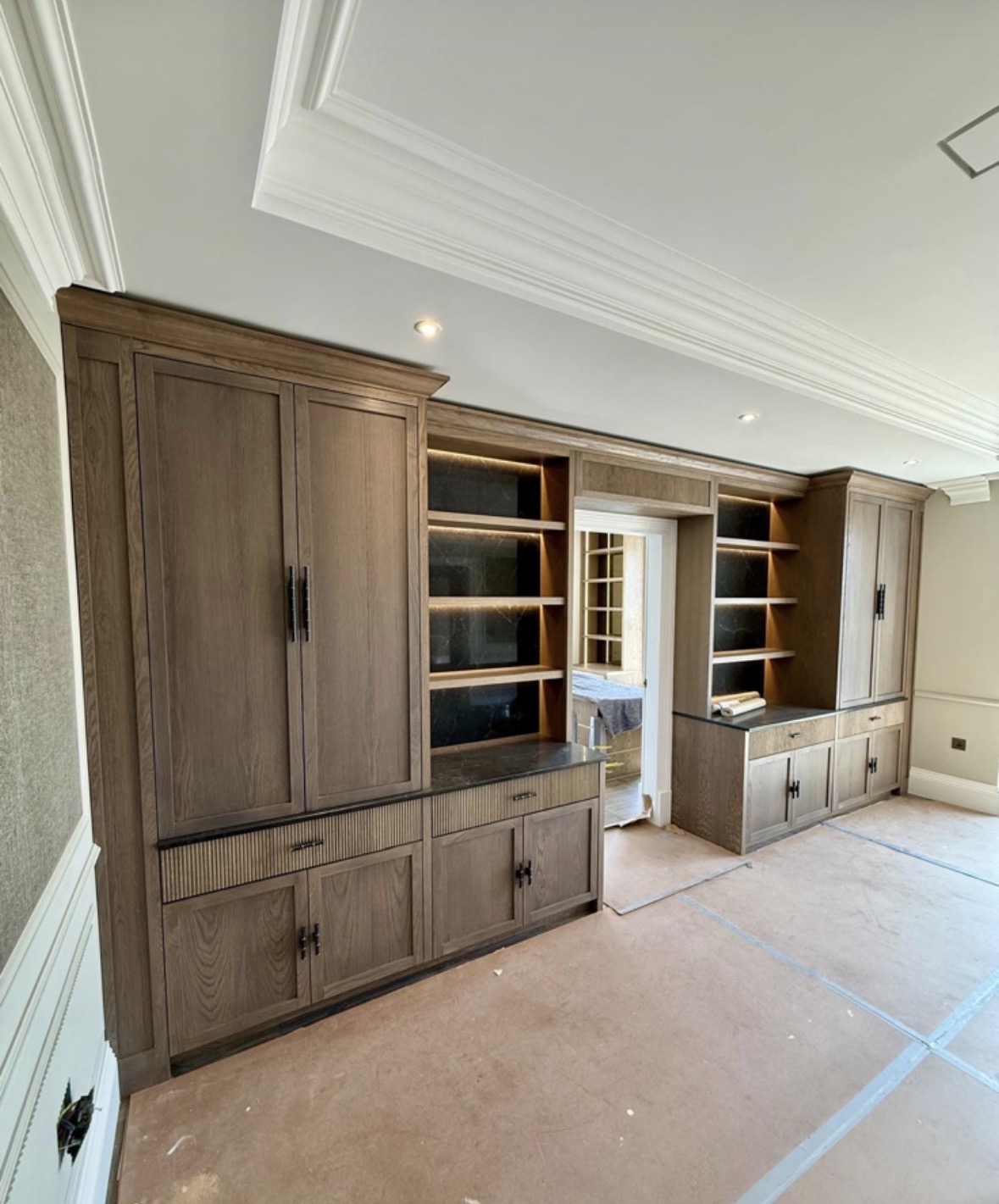
In our own work this has shown up on the fluted drawer fronts within a full-wall run of smoked oak living-room cabinetry, where the reeded texture sits alongside plain flanking sections rather than covering the whole run. That contrast is deliberate. Fluting reads best as a feature within a larger piece, drawing the eye to a particular bank of drawers or a defined panel, rather than being applied indiscriminately across every front in a room.
The proportion of the reeds matters more than most clients expect before seeing samples side by side. Narrow, tightly spaced grooves give a fine, almost fabric-like texture that reads calmly from across a room and rewards closer inspection. Wider, more widely spaced reeds are bolder and more architectural, and tend to suit larger fronts or feature panels where there is enough surface for the rhythm of the grooves to establish itself properly. We discuss reed width and spacing against the actual dimensions of the piece being designed, since the same profile can look right on one front and wrong on another simply because of scale.
Fluting can be worked in painted timber or left in a natural or stained finish. A painted flute softens the shadow line slightly and reads as a more contemporary, uniform texture, while timber fluting, particularly in an oak or walnut, lets grain run through the grooves themselves and adds warmth to the light-catching effect. Neither is inherently better; the choice depends on the rest of the room's material palette and on the bespoke cabinetry it is being designed alongside.
Where fluted cabinetry works well
01
Feature drawer fronts
A defined bank of drawers within a larger cabinetry run, fluted to draw attention without requiring a change of colour or material, as seen in the smoked oak living-room drawers that informed this page.
02
Kitchen island fronts
An island end panel or a run of island drawers can carry fluting as a focal point, distinct from the flat doors used elsewhere in the kitchen, giving the island its own identity within the wider layout.
03
Home bar fronts
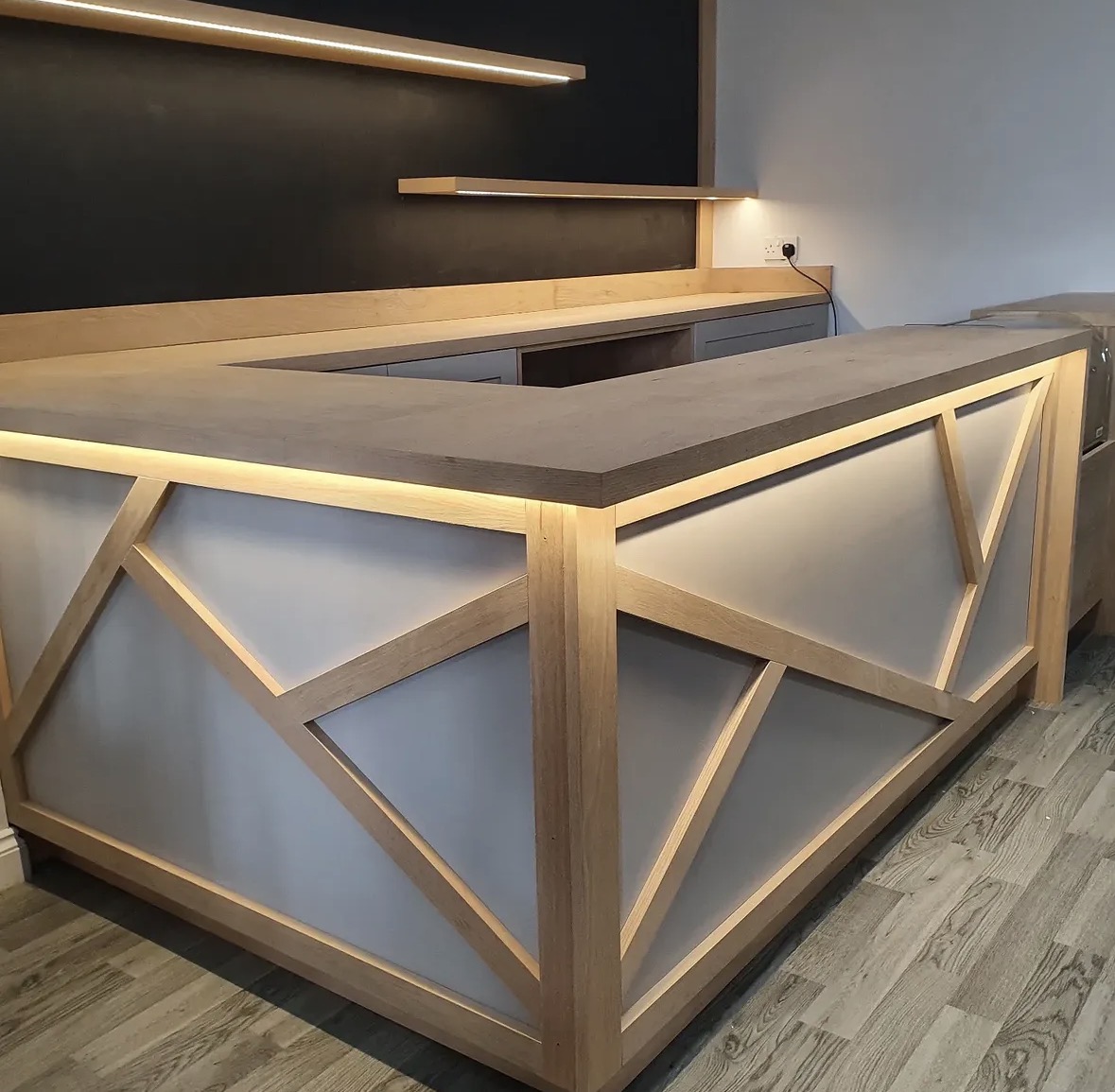
Fluted panels bring texture to a bar front in a way that reads well under low, warm lighting, and they pair naturally with the criss-cross panelled bar fronts we have also produced, offering a further textural option for the same brief.
04
Media cabinetry feature panels
A fluted panel behind or beside a television, or on the end of a media unit, adds depth to what can otherwise be a flat run of storage, without competing with the screen itself.
05
Wardrobe and dressing room fronts
Used sparingly on a single bank of drawers or a feature end panel within fitted wardrobes, fluting adds interest to a run of otherwise plain doors, described further on bespoke wardrobe doors.
06
Freestanding and occasional furniture
Smaller pieces such as a sideboard or console designed alongside a fitted scheme can carry fluting across their full width, since the smaller scale suits a more concentrated texture than a full wall run would.
Proportion and reed spacing
Reed width and spacing are set relative to the size of the front being fluted. Fine, closely spaced reeds suit smaller fronts and drawer faces, where a bolder profile would look heavy, while wider reeds need a larger surface to read properly and can look thin or fussy on a small panel.
We work through this in drawings and samples before committing to a profile, since it is difficult to judge reed proportion from a small offcut alone.
Painted or timber fluting
A painted flute gives a soft, consistent shadow line and reads as a contemporary texture that will sit comfortably in a room with painted cabinetry elsewhere, discussed on bespoke cabinetry.
Timber fluting, left natural or stained, carries grain through the grooves themselves, giving a warmer, more varied result. This suits rooms already built around a timber palette, such as those described on bespoke oak furniture or bespoke stained oak furniture.
Using fluting sparingly
Fluting is most effective as a feature within a larger scheme rather than a treatment applied across every front in a room. Flanking a fluted bank of drawers with plain doors, as in the smoked oak living-room run, lets the texture stand out rather than becoming the default finish and losing its impact.
We advise clients on where fluting will earn its place within a design, and where a flat or panelled front will serve the room better.
Cleaning and day-to-day care
The grooves in a fluted front collect dust in the same way any moulded or profiled surface does, and benefit from a soft brush or cloth run along the length of the reeds rather than across them. This is worth factoring in on pieces that will see frequent handling, such as kitchen drawer fronts.
Light and orientation
Because fluting relies on light catching the grooves, its effect changes with the direction and intensity of light falling on it. We consider the orientation of the room and the position of any task or feature lighting when proposing where a fluted panel should sit, so the texture reads as intended rather than falling flat in shadow.
From our work
What fluted cabinetry pairs well with
- Smoked and stained oak
- The living-room run that informs this page combines fluted drawer fronts with smoked oak, letting grain and reed texture work together rather than one dominating.
- Plain, flat cabinetry
- Flanking a fluted feature with flat, unadorned fronts is the surest way to let the texture read as a deliberate detail rather than a repeated pattern.
- Brass and warm metal hardware
- Warm hardware finishes complement the shadow lines fluting creates, particularly where a recessed brass handle rail is used elsewhere in the same room.
- Integrated lighting
- Concealed lighting positioned to graze across a fluted panel emphasises its texture after dark, discussed in more detail on integrated lighting for bespoke furniture.
Design, manufacture, installation
Fluted panels are drawn and specified during design, sampled before manufacture, and produced and installed as part of the sequence described on the process page.
Questions we are asked
About fluting
- What is fluted cabinetry?
- Fluted cabinetry has shallow, evenly spaced vertical grooves worked into a door or drawer front, giving the surface texture and a changing play of light and shadow rather than a flat finish. It is used as a feature within a design rather than a wholesale replacement for flat or panelled fronts.
- Where has Chester Thomas used fluting before?
- Fluted drawer fronts have been used within a full-wall run of smoked oak living-room cabinetry, sitting alongside plain flanking sections. That project is the genuine basis for how we describe fluting on this page, and any new use is designed specifically for the room in question rather than copied directly from it.
Materials & finish
- Can fluting be painted?
- Fluted fronts can be finished in paint as well as natural or stained timber. A painted flute gives a softer, more consistent shadow line, while timber fluting lets grain run through the grooves and adds warmth. The choice depends on the wider material palette of the room and the other cabinetry it sits alongside.
Where it works
- Does fluting work in a kitchen?
- It can, most successfully on a defined feature such as an island front or a single bank of drawers rather than across every door in the kitchen. Fluted fronts are still practical surfaces and are specified with day-to-day handling in mind, but the texture is best kept as an accent within the wider design.
- Is fluting only for contemporary schemes?
- No. Fluting has a long history in traditional joinery and can suit both a contemporary run of cabinetry and a more classical scheme, depending on the reed proportion, spacing and whether it is painted or left in timber. We discuss the right approach against the room rather than assuming one style automatically fits.
Design & specification
- How wide should the reeds be?
- Reed width and spacing are set in proportion to the size of the front being fluted, with finer reeds suiting smaller drawer fronts and bolder reeds needing a larger surface to read properly. We work through options in drawings and samples before a profile is agreed, rather than applying a single standard width to every project.
Care & maintenance
- Is fluting harder to keep clean than a flat front?
- It requires slightly different care. Dust can settle in the grooves, so a soft brush or cloth run along the length of the reeds keeps a fluted front looking sharp. This is a minor consideration rather than a reason to avoid fluting on frequently used surfaces such as kitchen drawers.
Design & specification
- Can fluting be added to existing cabinetry?
- We design and manufacture fluted fronts as part of new bespoke furniture rather than retrofitting them to cabinetry made elsewhere, since matching material, proportion and finish to an existing piece reliably is difficult. A new project gives us full control over the fit and finish involved.
- How much of a room should be fluted?
- Generally, only a defined feature, such as a bank of drawers, an island end or a single panel, rather than the whole scheme. Fluting used sparingly within a larger run of flat or panelled cabinetry, as in our own smoked oak living-room project, keeps the texture reading as a deliberate detail. If you would like an opinion on how much of a particular room might suit fluting, send details through the contact page and we can respond against the specific layout.
Where it works
- Does fluting suit media cabinetry?
- A fluted feature panel beside or beneath a television, or on the end of a media unit, adds texture to a wall of storage without competing with the screen. It sits well alongside the flat, handleless fronts often used elsewhere in the same piece.
Lighting
- Can fluted panels be lit?
- Concealed lighting positioned to graze across a fluted surface emphasises its texture, particularly after dark, picking out each groove in a way flat ambient light does not. This is discussed in more detail, along with the point that final electrical connection is carried out by an appropriately qualified trade, on integrated lighting for bespoke furniture.
Cost
- Is fluting more expensive than a flat front?
- Fluted fronts generally involve more machining time than a flat or simple panelled front, which is reflected in overall project cost. The specifics depend on the scope of the piece, the reed profile chosen and the material involved, so this is confirmed against an actual brief rather than quoted as a general figure.
- What does fluted cabinetry cost?
- Cost depends on the extent of fluting within a project, the material and finish chosen, and the wider scope of the cabinetry it sits within, so we cannot give a general figure here. The most useful next step is to send project details through the contact page so a response can be given against the specifics involved.
About fluting
- Will fluting date?
- Fluting is a long-established joinery technique rather than a passing trend, and its appearance depends heavily on proportion, material and how sparingly it is used. A well-judged, restrained application within a considered scheme is designed to remain comfortable in the room for as long as any other well-made cabinetry detail.
Design & specification
- Can I see fluting before committing to it?
- We provide samples of proposed reed profiles and finishes during design, so a decision on fluting is made having seen and handled the actual detail rather than from a drawing alone. This forms part of the wider design process described on the chester thomas bespoke furniture design service.
Relevant bespoke services
Bespoke kitchens
Kitchens where fluted fronts can be used as a feature detail.
Home bars
Bar fronts that can carry fluted panels alongside criss-cross detailing.
Media walls
Media cabinetry where a fluted feature panel can add texture.
Fitted wardrobes
Wardrobe fronts where fluting can be used sparingly on a feature bank of drawers.
Bespoke cabinetry
General cabinetry across the home where fluted detail can feature.
Related materials and styles
Panelled cabinetry
Shaker, flat and decorative panel doors, and wall panelling integrated with fitted cabinetry, made in our Derbyshire workshop.
Stained oak furniture
Oak with its tone adjusted through staining, keeping the grain visible while suiting darker or warmer interior schemes.
Integrated lighting
LED shelf, display and wardrobe lighting designed into cabinetry from the outset, with connection carried out by a qualified electrician.
To discuss materials and finishes, call Chester Thomas on +44 7418 627358, email info@chesterthomas.com or start your project.
Planning Something Bespoke?
Tell us about your space, what you're looking to create and where the project is located.