
Materials & finishes
Bespoke stained oak furniture
Staining changes the tone of oak without hiding the grain running through it, giving a darker or warmer result than the raw timber. Depending on the project, designs may incorporate stained oak framework, shelving and cabinetry.

Stained oak furniture
Staining oak is a way of adjusting its tone, from a warmer mid-brown through to something considerably darker, while the grain of the timber continues to show through the finish. This distinguishes it from a painted or lacquered surface, which sits on top of the timber and obscures the material beneath it, and from an opaque stain, which can flatten grain almost entirely if taken too far.
The appeal of stained oak lies in this combination: a controlled tone that suits the wider scheme, alongside grain and natural variation that remain visible on close inspection. This is a genuinely useful middle ground for clients who want the character of oak without its lighter, more golden natural colour, or who are working within a darker overall interior palette.
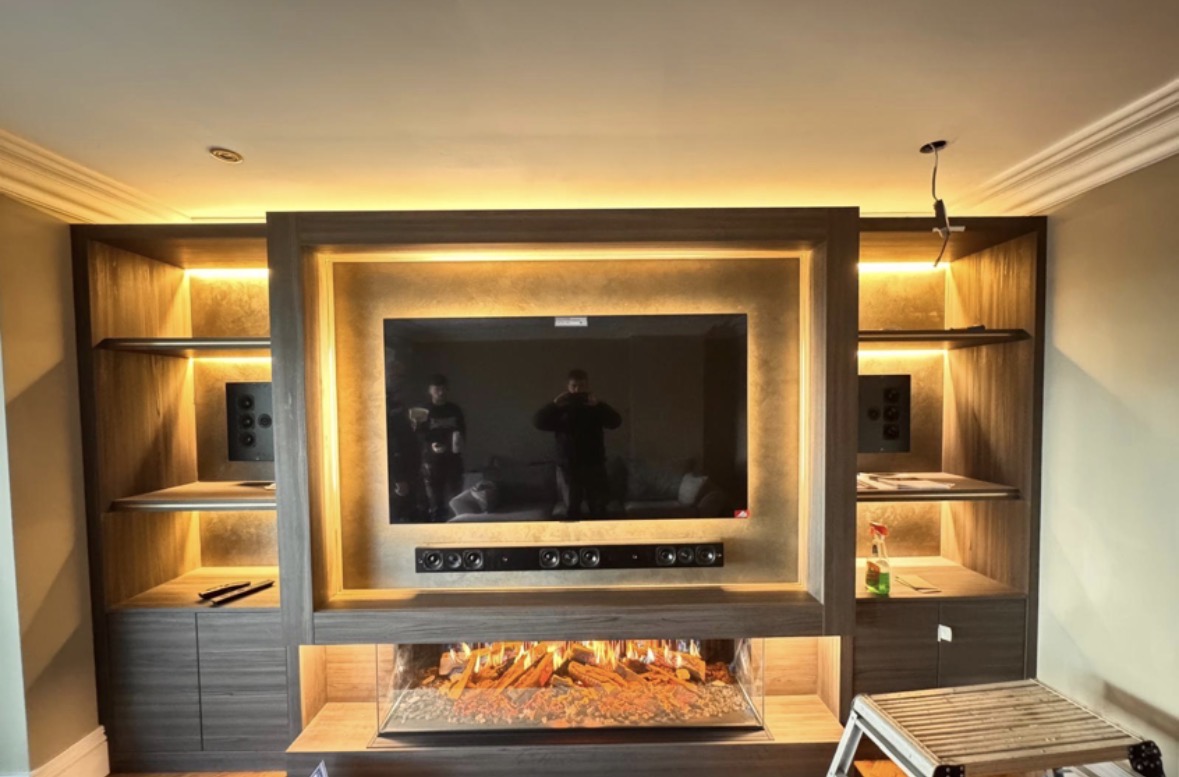
This approach was used on the Chester Thomas media wall installed in Solihull, where the oak framework and shelving surrounding the television and fireplace were stained rather than left in its natural tone, described in more detail on our completed bespoke media wall project in Solihull. The stained timber sat alongside a book-matched marble surround, giving the piece a contrast between the depth of the stained oak and the pattern of the stone.
Stained oak works particularly well against stone and marble, where the darker or warmer timber tone provides a grounding contrast to the coolness of the stone, and against metal detailing, which reads more distinctly against a darker timber than against pale, natural oak. It also suits interiors that lean toward a darker overall palette, where the depth of a stained finish sits comfortably rather than standing out against lighter surroundings.
Lighting has a particular effect on stained oak. LED lighting beneath shelves or within recesses picks out the grain and any variation in tone across the timber, an effect used beneath every shelf on the Solihull media wall, giving the piece depth in a way that a flat, unlit surface would not achieve.
Where stained oak works well
01
Media walls
Stained oak framework and shelving suit a media wall built around a stone or marble television surround, as on our completed bespoke media wall project in Solihull, described in more detail on media walls.
02
Cabinetry in darker schemes
Where a room is decorated with a darker overall palette, stained oak cabinetry sits comfortably within it rather than standing out as a pale contrast, an approach considered as part of general cabinetry design on bespoke cabinetry.
03
Home bars
A darker, richer timber tone suits the more atmospheric character often wanted for a home bar, particularly alongside metal detailing and glass, as covered on home bars.
04
Home offices
Stained oak can give a home office a more grounded, formal character than the lighter natural timber, useful where the room adjoins other darker joinery, as discussed on home offices & studies.
05
Libraries and bookcases
A darker stained finish across a run of bookcases or library shelving reads with weight and depth, an approach relevant to home libraries and built-in bookcases.
06
Wine storage and display
Stained oak shelving and framework suit the more atmospheric lighting typically used around wine storage and display, as covered on wine rooms & cellars.
How much stains change grain visibility
A stain darkens or warms the timber's tone while leaving its grain visible, but the strength of that effect depends on how the stain is applied and how dark the target tone is. This is agreed at design stage, using samples, so the client understands what the finished timber will look like before manufacture proceeds. Boards with more pronounced natural figure tend to hold their character even under a darker stain, whereas plainer boards can start to look flatter once stained heavily.
Consistency across a run
As with any oak finish, consistency across a run of doors, panels or shelving depends on board selection and layout as well as on the stain itself, and this is planned during design so a large area of stained oak reads as a coherent whole.
Working alongside stone and marble
Stained oak is frequently specified alongside a stone or marble surface, and the exact tone chosen is often influenced by the colour and pattern of that stone, so the two are discussed together rather than the timber being finished in isolation.
Lighting and shadow
Darker timber tends to show more contrast under lighting than pale oak, so where LED lighting is planned beneath shelving or within recesses, its placement is considered alongside the stain to make the most of this effect. Electrical connection for any lighting is carried out by a qualified electrician.
Sheen level
The sheen applied over a stain affects how strongly light reflects off the surface and how visible the grain remains. Finishes can be developed to coordinate with the wider interior scheme, and this is agreed alongside the stain itself. A satin or matt sheen tends to keep the depth of a darker stain readable under normal room lighting, while a higher gloss can create reflections that compete with the grain rather than showing it off.
From our work
What stained oak works well alongside
- Book-matched marble
- As on the Solihull media wall at our completed bespoke media wall project in Solihull, a book-matched marble surround gives stained oak a pattern to contrast against, with the timber providing depth and the stone providing symmetry.
- Metal detailing
- Handles, trims and frames in a metal finish read more distinctly against darker stained oak than against pale natural timber, suiting a more contemporary or formal character.
- Fireplaces
- A stained oak surround or flanking cabinetry works well around a fireplace, an arrangement seen on the Solihull project alongside a British Fires New Forest 1900 fireplace.
- Dark or neutral interiors
- Stained oak sits comfortably within a darker or more neutral decorating scheme, rather than introducing the paler contrast that natural oak would bring into the same room.
- Integrated lighting
- LED lighting beneath shelves or within recesses draws out grain and tone in stained oak, an effect used throughout the shelving on the Solihull media wall.
Related project
A 5.58 metre media wall built around a book-matched marble television surround, with stained oak framework and shelving, an inset fireplace and LED lighting beneath every shelf.
Bespoke media wall, Solihull →Design, manufacture, installation
The stain applied to oak is agreed at design stage, using samples reviewed alongside other materials in the scheme, before manufacture begins in the Derbyshire workshop and installation is carried out by the same team. The full sequence is set out on the process page.
Questions we are asked
Material
- What is the difference between stained oak and painted oak?
- A stain changes the tone of the timber while its grain remains visible through the finish, whereas paint sits on the surface and obscures the timber beneath it. Stained oak is chosen specifically because it keeps the character of the grain while adjusting the colour, which is a different outcome to the flat, uniform surface of a painted finish.
- How dark can oak be stained?
- Stains can be developed across a range of tones from a warmer mid-brown through to a considerably darker finish, though taking a stain very dark can begin to reduce how visible the grain remains. The intended tone is agreed using samples at design stage, so the client can see the effect before it is applied to the finished piece.
Projects
- Was stained oak used on the Solihull media wall?
- The framework and shelving on the Solihull media wall were stained oak, set alongside a book-matched marble television surround and LED lighting beneath every shelf. The stained tone was chosen to sit against the pattern of the marble rather than compete with it, giving the piece depth without drawing attention away from the stone. More detail on the project is available on our completed bespoke media wall project in Solihull.
Material
- Does staining oak affect how it should be finished afterward?
- Stained oak is generally finished with a sheen appropriate to the room and its use, agreed as part of the wider specification process rather than fixed as a standard answer for every project. The exact detail depends on the piece and where it is installed.
Pairings
- Can stained oak be combined with marble or stone?
- Combining stained oak with stone or marble is a common approach, and the two materials are usually chosen together, since the tone of the stain is often influenced by the colour and pattern of the stone being used alongside it, as on the Solihull project.
Application
- Is stained oak suitable for a home bar?
- Stained oak suits the more atmospheric character often wanted for a home bar, particularly alongside metal detailing and glass shelving, where a darker timber tone tends to read as more formal and considered than pale, natural oak. Bottle storage, display shelving and lighting layout are all worked through as part of the wider design covered on home bars.
Material
- Will stained oak look consistent across a large media wall?
- Board selection and layout are planned during design so that a run of stained oak panels or shelving reads consistently, in the same way as with natural oak. Some variation between boards will remain visible, since this is part of what timber looks like, but it is arranged deliberately.
Lighting
- Does lighting change how stained oak looks?
- LED lighting beneath shelving or within recesses tends to bring out the grain and depth of stained oak more noticeably than it does with pale, natural timber, an effect used beneath every shelf on the Solihull media wall. The lighting itself is connected by a qualified electrician.
Application
- Can stained oak be used for a home office?
- Stained oak can give a home office a more formal, grounded character than natural oak, particularly where the room adjoins other darker joinery elsewhere in the property, and this is discussed as part of the design process described on home offices & studies.
- Is stained oak suitable for wine storage?
- Stained oak shelving and framework suit the more atmospheric lighting typically used around wine storage and display, with the darker timber tone reading well against dim or accent lighting rather than washing out under it. It can be designed alongside bottle racking, glass display sections and integrated lighting as covered on wine rooms & cellars.
Process
- How is the right stain tone chosen?
- The stain tone is chosen through samples reviewed against other materials in the room, such as stone, metal or paint colours, so the finished timber sits correctly within the wider scheme rather than being decided in isolation. This happens as part of the design stage described on the process page.
Material
- Can I see stained oak alongside oak in its natural tone?
- Samples of stained and natural oak can be reviewed together during design, alongside other materials being considered for the project, such as stone, paint colours or metal finishes, so a decision can be made with a clear sense of how each option will look once installed. This side-by-side comparison is often more useful than judging either finish in isolation.
Cost
- What does stained oak furniture cost compared with natural oak?
- Cost depends on the scale of the piece, the finish specified, hardware and installation rather than the stain alone, so there is no general figure that can be quoted without seeing the project. The best next step is to send details through the contact page for a response against the specifics involved.
Design
- Does stained oak suit both traditional and contemporary rooms?
- Stained oak can suit either, depending on how the piece is detailed and what it sits alongside. A darker stain with handleless doors and simple panelling tends to read as more contemporary, while more traditional profiles and framing suit a period property.
Relevant bespoke services
Media walls
Stained oak framework and shelving alongside stone surrounds.
Bespoke cabinetry
General cabinetry finished to suit a darker interior scheme.
Home bars
Stained oak shelving and display alongside glass and metal.
Wine rooms and cellars
Stained oak framework suited to atmospheric wine storage.
Home libraries
Darker stained shelving across a run of library storage.
Related materials and styles
Bespoke oak furniture
Oak furniture with visible grain and natural variation, designed to sit alongside stone, metal, glass and painted finishes.
Dark cabinetry
Deep painted tones and dark stained timber, used with lighting and contrast considered from the outset.
Marble media walls
Book-matched marble media walls, with television and fireplace surrounds set into stained oak joinery and lighting.
To discuss materials and finishes, call Chester Thomas on +44 7418 627358, email info@chesterthomas.com or start your project.
Planning Something Bespoke?
Tell us about your space, what you're looking to create and where the project is located.