
Materials & finishes
Handleless cabinetry for bespoke furniture
Handleless cabinetry removes visible handles from doors and drawers, relying instead on integrated pulls, recessed rails or shadow gaps, and it suits far more than kitchens alone.
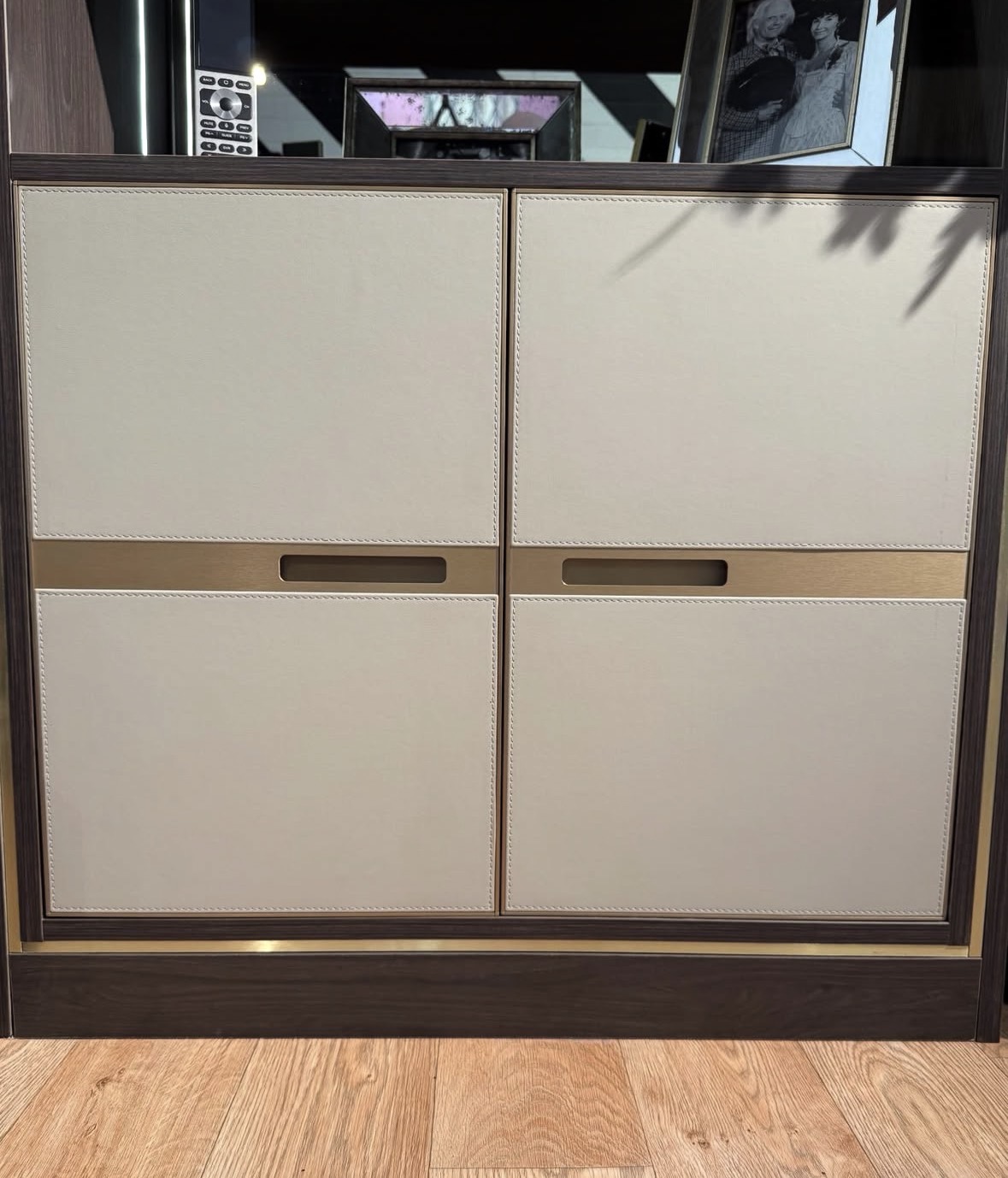
Handleless cabinetry
Handleless cabinetry is defined by what it leaves out rather than what it adds: no protruding knob or handle interrupting the line of a door or drawer front. The result is a calmer, more continuous surface, whether that surface is painted, timber or a darker graphite finish, and it is one of the more versatile approaches available across almost any category of fitted furniture we make.
This page looks at handleless detailing more broadly than the kitchen alone, which is covered in full on handleless kitchens. The same principles apply to media furniture, home-office cabinetry, general storage, drawer units and floating cabinetry, where a continuous, unbroken front is often just as valuable as it is in a kitchen, if not more so, since these pieces are frequently viewed as a single large surface rather than a run of individual units.
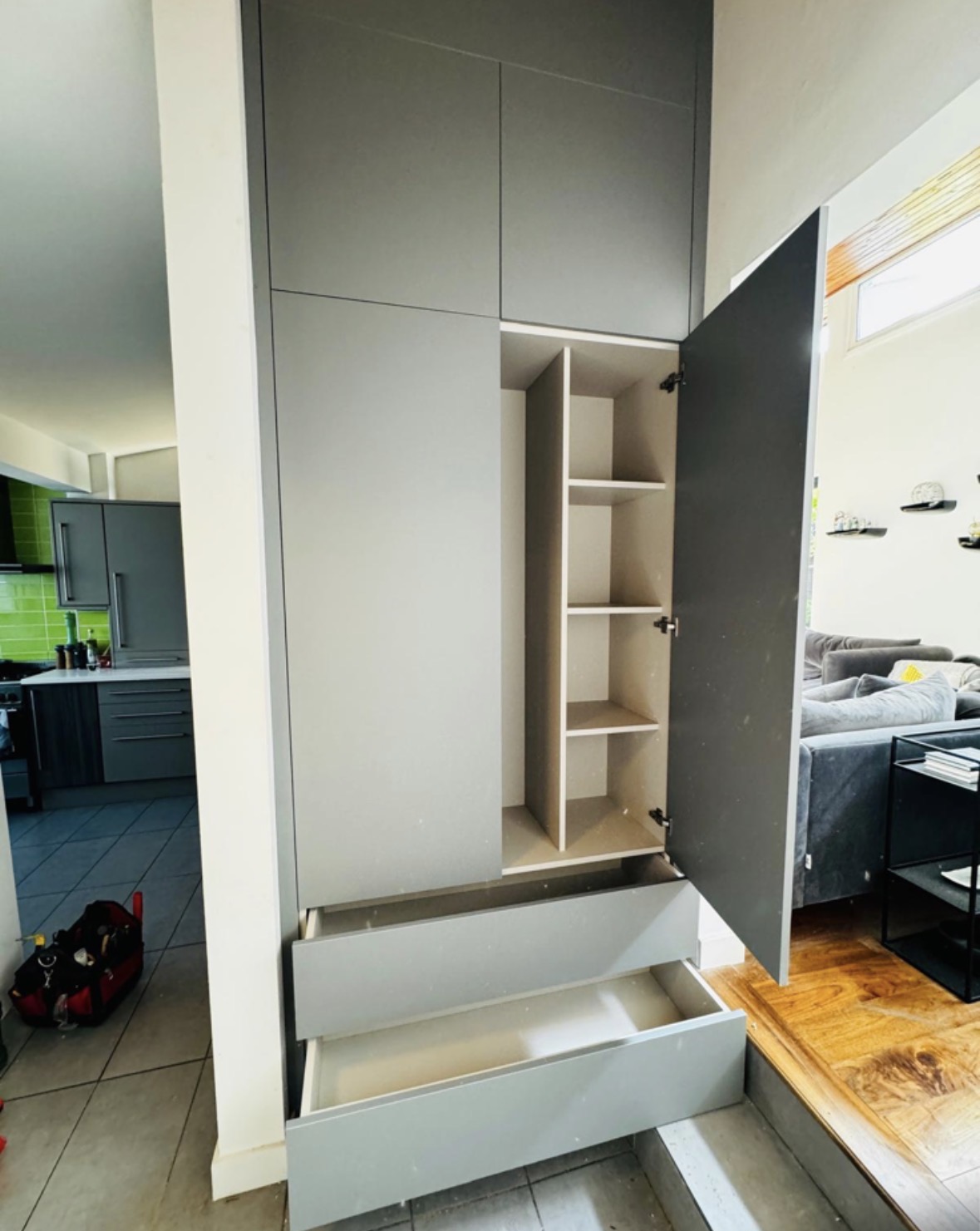
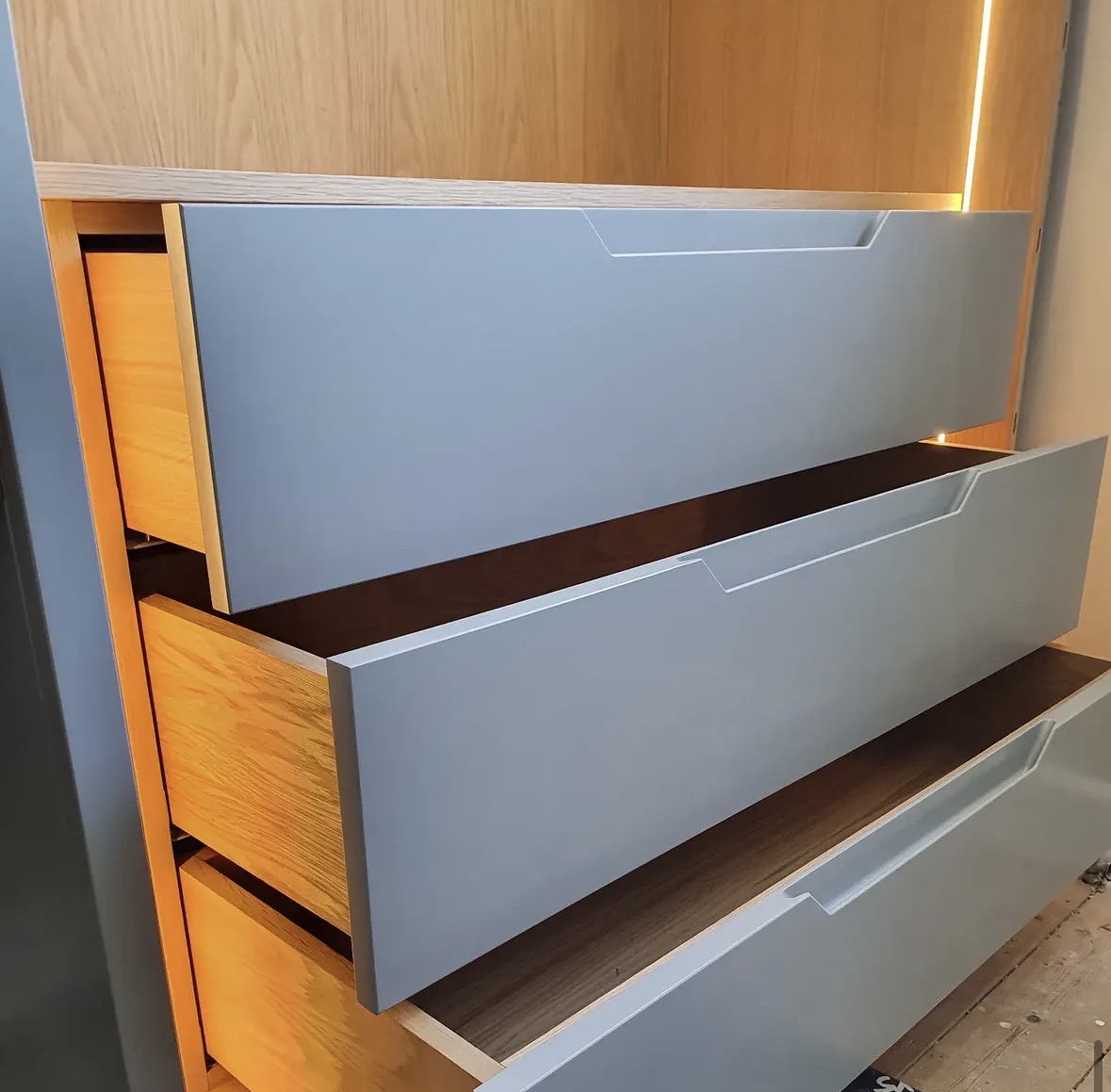
We have produced handleless painted drawers with a fine recessed pull along the top edge, recessed brass handle rails set into a run of drawers as a visible but restrained detail, and graphite handleless tall storage where the flat, dark front is left completely uninterrupted. Each of these achieves a handleless result in a different way, and the choice between them depends on the finish, the household using the piece and how much visual quietness is wanted.
Floating drawer units and wall-mounted media cabinetry particularly benefit from a handleless approach, since the absence of visible hardware reinforces the sense of a single, continuous volume rather than a stack of separate units. This is discussed further on floating cabinetry for bespoke furniture, where handleless detailing and floating construction are frequently specified together.
A handleless result is achieved in more than one way, and the method chosen affects both cost and how the finished piece feels to use. An integrated pull keeps the front entirely flat and relies on precise machining of the door or drawer edge, while a recessed handle rail introduces a deliberate, visible channel that still avoids a conventional protruding handle. We agree the approach with the client for each piece rather than applying a single method across an entire project by default.
Where handleless cabinetry works well
01
Kitchens
Handleless kitchen cabinetry is covered in full on handleless kitchens, where integrated pulls and recessed rails are discussed in the context of everyday kitchen use.
02
Media furniture
A handleless media unit reads as a single continuous surface beneath a television, keeping the focus on the screen and any lit shelving rather than on hardware.
03
Home-office cabinetry
Storage and drawer units in a home office benefit from the calm, uninterrupted fronts a handleless approach provides, discussed further on home offices & studies.
04
General storage and drawer units
Handleless drawers, whether painted or in a graphite finish, suit any run of storage where a quiet, contemporary front is wanted.
05
Floating cabinetry
Floating drawer units and wall-mounted cabinetry are frequently detailed as handleless, reinforcing the sense of a single volume rather than a stack of separate boxes.
06
Tall storage and wardrobes
Graphite handleless tall storage shows how the approach extends comfortably to full-height cabinetry, giving a room a consistent, uncluttered visual line from floor to ceiling.
Integrated pulls and recessed rails
There are two broad routes to a handleless result. An integrated pull is machined into the edge of the door or drawer itself, keeping the front completely flat and the hardware invisible. A recessed handle rail, by contrast, is a visible but restrained horizontal detail set into the run, offering something to grip while still reading as a considered design feature rather than a conventional handle.
We help clients decide between these based on how the drawers will be used day to day and the overall character of the room, since a recessed brass rail carries a different tone to a fully concealed integrated pull.
Push-to-open as an option
Push-to-open mechanisms, which release a door or drawer with a light push rather than a pull, are available as an option to discuss for specific pieces, most often where an integrated pull is not practical or wanted. This is not our default approach and is considered against the piece in question rather than assumed for every handleless front.
Finish and shadow detail
A handleless front relies on shadow gaps and clean junctions between doors and drawers to read well, since there is no hardware to draw the eye instead. This makes the quality of the finish, whether painted or a graphite lacquer, more visible than on a front with a handle, and we take particular care over these details during manufacture.
Household use
Handleless drawers and doors are opened slightly differently to those with a handle, and this is worth thinking through for a busy household or where hands are frequently full. We discuss this during design so the practical experience of the finished piece matches expectations, rather than the visual result alone.
Where a handle still makes sense
Not every piece in a scheme needs to be handleless. Panelled doors, for example, are often paired with a visible handle or knob rather than a concealed pull, and mixing handleless and handled elements within the same room can work well when planned together, rather than applying one approach uniformly regardless of the piece involved.
From our work
What handleless cabinetry pairs well with
- Graphite and dark finishes
- A flat, dark graphite front with no visible hardware gives tall storage and media cabinetry a particularly quiet, uninterrupted presence.
- Painted drawer fronts
- Handleless painted drawers with a fine integrated pull suit kitchens, bedrooms and offices alike, keeping the surface calm without sacrificing a soft, considered colour.
- Recessed brass rails
- A recessed brass handle rail set into a run of drawers gives a warm, tactile detail while keeping the overall front largely uninterrupted.
- Floating construction
- Handleless fronts and floating cabinetry are frequently specified together, reinforcing the sense of a single suspended volume, discussed on floating cabinetry for bespoke furniture.
Design, manufacture, installation
The method used to achieve a handleless result, whether integrated pull, recessed rail or an optional push-to-open mechanism, is agreed during design and confirmed before manufacture, as part of the sequence described on the process page.
Questions we are asked
About handleless cabinetry
- What is handleless cabinetry?
- Handleless cabinetry is furniture designed without visible protruding handles or knobs, relying instead on integrated pulls, recessed handle rails or, on some pieces, a push-to-open mechanism. The result is a calmer, more continuous front, whether the piece is a kitchen, a media unit or a run of storage.
- Is this page only about kitchens?
- No. Handleless kitchens are covered in full on handleless kitchens, while this page looks at handleless detailing more broadly across media furniture, home-office cabinetry, general storage and floating units, where the same principles apply just as readily. Whether a project starts as a kitchen enquiry or a media unit, the same integrated pulls, recessed rails and finish options are available, and we discuss the right approach for the piece in question during design.
Design & specification
- What is an integrated pull?
- An integrated pull is a shaped recess machined into the edge of a door or drawer front, giving a place to grip without any additional hardware fitted to the surface. It keeps the front completely flat and is one of the most common ways we achieve a handleless result.
- What is a recessed handle rail?
- A recessed handle rail is a horizontal channel set into a run of drawers or doors, giving a visible but restrained detail to grip rather than a fully concealed pull. We have used recessed brass rails on projects wanting a warmer, more tactile version of a handleless front.
- Does push-to-open cost extra?
- Push-to-open mechanisms are an option to discuss for specific pieces rather than a standard fitting on every handleless project, and any additional cost depends on the scope of the piece involved. This is confirmed during specification once the approach has been agreed, and project details sent through the contact page will get a response set against your particular brief.
Care & maintenance
- Is handleless cabinetry harder to keep clean?
- A handleless front is cleaned in the same way as any other painted or lacquered surface, using a soft cloth and a suitable non-abrasive product. Because there is no handle to mark first, fingermarks around an integrated pull can be slightly more visible on darker finishes, which is worth considering for a busy household.
Where it works
- Does handleless cabinetry suit a home office?
- Handleless storage and drawer units give a home office a calm, uncluttered appearance, which many clients prefer for a working space with a desk and screen already competing for attention. This is discussed further on home offices & studies, where cabinetry and desk storage are designed together.
Design & specification
- Can handleless and handled cabinetry be mixed in the same room?
- This is a common approach where, for example, panelled doors with a visible handle sit alongside a handleless run of drawers. We plan the two together during design so the overall scheme reads as a considered choice rather than an inconsistency.
Where it works
- Does handleless detailing suit floating cabinetry?
- Very well. Floating drawer units and wall-mounted media cabinetry are frequently specified with a handleless front, reinforcing the sense of a single suspended volume rather than a stack of separate units, discussed on floating cabinetry for bespoke furniture. The absence of protruding hardware also keeps the underside of a floating piece uncluttered where concealed lighting is used, letting the light itself read as the detail rather than a handle catching a shadow.
Materials & finish
- Is graphite a common handleless finish?
- We have produced graphite handleless tall storage, where the flat, dark front is left completely uninterrupted, and it is a finish that suits the calm, contemporary character handleless detailing generally aims for. A dark, uninterrupted surface tends to show fingermarks slightly more readily than a lighter painted finish, which is worth discussing at specification stage for a busy household.
Design & specification
- Is handleless cabinetry only for contemporary rooms?
- Handleless detailing tends to suit a contemporary or restrained scheme most naturally, since it relies on plain, continuous surfaces rather than moulding or panel detail. It can still sit within a broader traditional house if the rest of the room's materials and proportions are considered alongside it.
- How is a handleless drawer opened if hands are full?
- This depends on the method used. An integrated pull still requires a hand or fingers to grip, while a push-to-open mechanism, where specified, can be released with a light push from an elbow or hip. We discuss this during design where it is a genuine consideration for the household.
- Can existing kitchen units be converted to handleless?
- We design and manufacture new handleless cabinetry rather than converting or retrofitting units made by another company, since achieving a consistent, well-finished handleless result depends on how the doors and carcasses were built in the first place. A new project also gives us control over the carcass construction needed for an integrated pull or recessed rail, which is difficult to add reliably to existing units.
Cost
- What does handleless cabinetry cost?
- Cost depends on the pieces involved, the method used to achieve a handleless result, the finish chosen and the overall scope of the project, so we cannot give a general figure here. The best next step is to send project details through the contact page so a response can be given against the specifics involved.
Programme
- How long does handleless cabinetry take to make?
- This depends on the number and type of pieces involved and the finish specified. We follow the same design, drawing, manufacture and installation sequence described on the process page regardless of whether a project is handleless or not, so timings are set against the specific brief rather than a general rule.
Relevant bespoke services
Handleless kitchens
Handleless detailing specifically for kitchen cabinetry.
Media walls
Media cabinetry frequently detailed with handleless fronts.
Home offices
Fitted office storage using integrated pulls and recessed rails.
Floating TV units
Wall-mounted media units often paired with handleless fronts.
Bespoke cabinetry
General storage and cabinetry designed with a handleless approach.
Fitted wardrobes
Wardrobe storage where handleless doors and drawers can be specified.
Related materials and styles
Floating cabinetry
Wall-mounted television units, display shelving and storage, designed to appear to float clear of the floor.
Dark cabinetry
Deep painted tones and dark stained timber, used with lighting and contrast considered from the outset.
Painted cabinetry
Hand-painted cabinetry in shaker and flat-panel styles, designed to sit correctly within the room it furnishes.
Fluted cabinetry
A vertical, reeded texture used on drawer fronts, feature panels and furniture fronts to add depth without pattern.
To discuss materials and finishes, call Chester Thomas on +44 7418 627358, email info@chesterthomas.com or start your project.
Planning Something Bespoke?
Tell us about your space, what you're looking to create and where the project is located.