
Guides
Painted vs timber cabinetry
Painted cabinetry gives flat, consistent colour across a run of furniture, while timber cabinetry shows the natural grain and variation of the wood itself. Which suits a room better depends on the colour scheme, the other materials present and how much natural texture you want on show.
Painted vs timber cabinetry
Painted and timber cabinetry answer different questions. A painted finish gives complete control over colour, from a pale neutral to a deep, saturated tone, reading as a flat, even surface across doors and drawer fronts. Timber cabinetry, whether natural or stained oak, keeps the wood's grain visible, so no two runs look quite identical, with depth coming from the material itself rather than the finish applied to it.
Neither is more premium than the other; they are simply different starting points. Painted cabinetry suits a scheme built around colour, coordinating precisely with walls, worktops or a wider palette. Timber cabinetry suits a scheme built around texture and warmth, where the material's character is meant to be part of what you notice about the room.
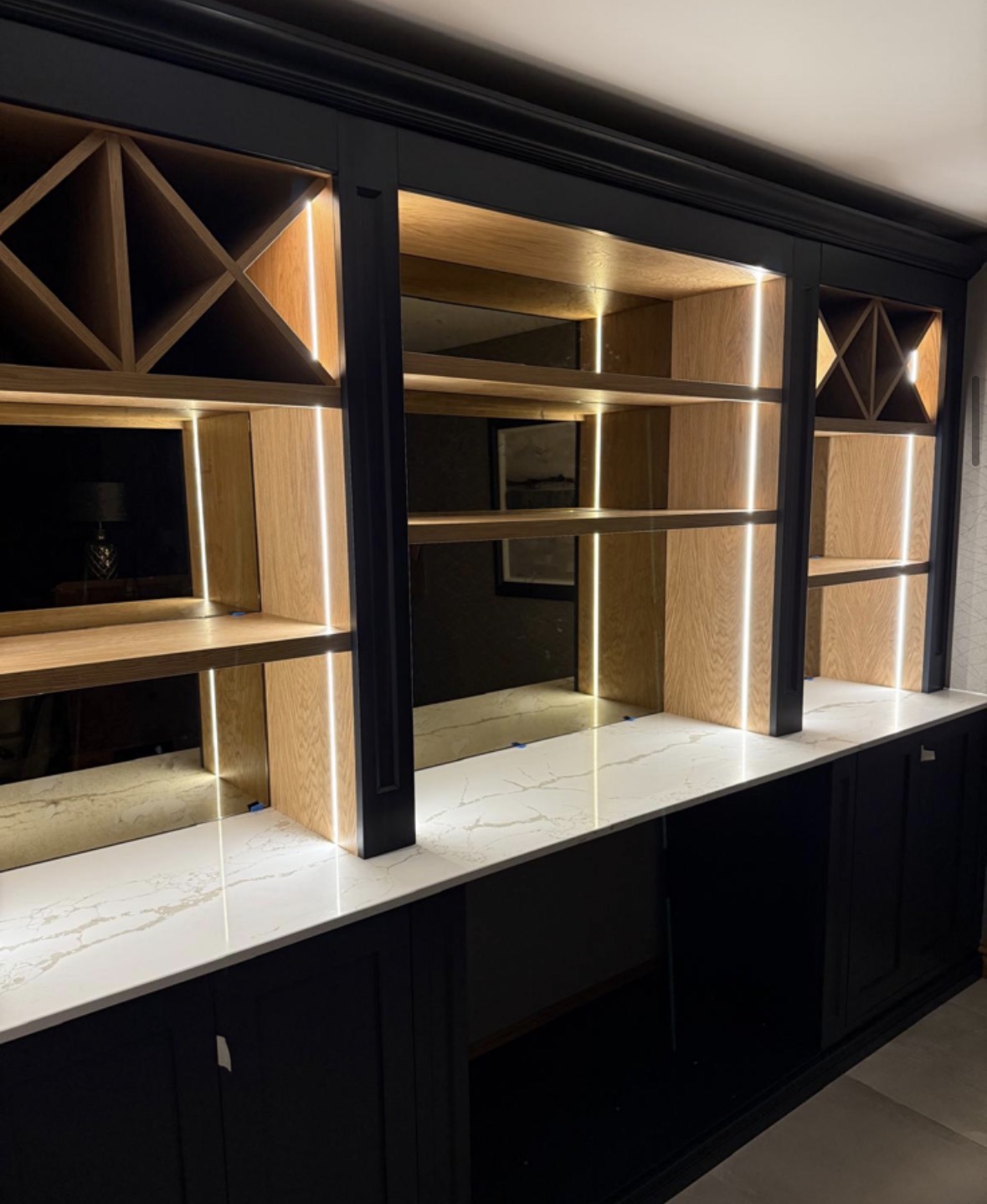
Many rooms use both. A painted perimeter with a timber island gives a kitchen contrast between flat colour and natural texture, without either material competing for attention.
This guide compares the two on colour, grain, texture and maintenance, and where each is used across Chester Thomas cabinetry, before pointing you to the relevant material pages.
Painted vs timber cabinetry
| Consideration | Painted cabinetry | Timber cabinetry |
|---|---|---|
| Colour | Full control, from pale neutrals to deep saturated tones | Governed by the timber's natural tone or a chosen stain |
| Grain and texture | Grain is concealed beneath the painted finish | Grain and natural variation remain visible across the surface |
| Natural variation | Consistent, even appearance across a full run | Board-to-board variation is part of the material's character |
| Coordination with the room | Coordinates precisely with a specific colour scheme | Coordinates through warmth and tone rather than exact colour matching |
| Visual warmth | Depends entirely on the colour chosen | Brings inherent warmth regardless of the finish applied |
| Maintenance | Marks and chips can show against a flat colour | Grain pattern helps disguise minor surface marks |
| Traditional application | Common on Shaker doors in period and transitional interiors | Common in libraries, studies and traditional kitchen cabinetry |
| Contemporary application | Common on flat, handleless fronts for a clean, minimal look | Common on flat fronts or open shelving to show grain in a modern setting |
| Combining both | Often used on a perimeter alongside a timber island or feature run | Often used on an island or feature run alongside painted perimeter units |
Colour and how it drives the decision
Painted cabinetry exists because a room sometimes needs a specific colour rather than a natural material tone, whether matching an existing scheme or introducing a deep, characterful shade such as olive, navy or graphite that no timber could achieve. This control is the main reason painted cabinetry is chosen over timber, covered in detail on bespoke painted cabinetry.
Timber cabinetry works differently: the starting colour comes from the wood itself, whether left natural or adjusted through staining, within the range that timber can do. Oak ranges from a pale, golden natural tone through to a considerably darker stained finish, as set out on bespoke oak furniture and bespoke stained oak furniture, but it will never match a bright, saturated colour the way paint can.
Grain, texture and natural variation
The defining feature of timber cabinetry is that it shows the material it is made from. Grain runs visibly through doors and panels, and no two boards look identical, so a run has genuine depth that changes subtly as light moves across it. Board layout is planned at design stage so a run reads as a coherent whole, but the variation itself is never eliminated.
Painted cabinetry removes this variation by design. The surface is flat and consistent across an entire run, which some rooms benefit from, particularly where a calm backdrop is wanted for other materials, such as a patterned worktop, to stand out against.
Maintenance considerations
A painted surface shows marks, scuffs and chips more readily than a timber one, particularly in a lighter colour, because there is nothing to break up the flat plane of colour. A timber surface, by contrast, has grain that helps disguise minor marks, though it still needs appropriate care depending on where it is used.
Neither is difficult to live with day to day, though it is worth being realistic about a household's habits: a busy family kitchen shows marks on pale paint sooner than on timber, while a lightly used study suits either.
Traditional and modern applications
Both finishes work in traditional and contemporary settings, though they lean in slightly different directions. Painted cabinetry on a Shaker door is familiar in period and transitional interiors, while a flat, handleless painted front suits a more contemporary room. Timber cabinetry appears just as often in a traditional library or study, where grain and warmth suit built-in shelving, as it does in a modern kitchen with a flat timber front used to bring texture into an otherwise minimal room.
The distinction is less about era than about what each material is asked to do: paint leads with colour, timber with texture and warmth.
Coordinating with the rest of the room
Painted cabinetry is usually chosen once the wider scheme of walls, flooring and feature materials is broadly settled, since the colour must sit correctly within it. Timber coordinates differently, through warmth and tone rather than precise colour matching, a more forgiving choice where the room's palette is still developing.
Both are considered alongside stone, marble, glass and metal detailing as part of a wider material specification, discussed in full on bespoke furniture materials and finishes rather than decided in isolation.
Combining painted and timber cabinetry
It is common, and often most effective, to combine both within one scheme: a painted perimeter with a timber island, or painted wall cabinetry alongside a timber open-shelving section. This gives a room the calm consistency of paint alongside the warmth of timber. Proportion, placement and how the two materials meet at edges are worked out during design.
Which is right for your room?
01
Choose painted when colour is the priority
Where a scheme is built around a specific colour, whether a deep, saturated shade or a pale neutral, a painted finish gives the control that a natural timber tone cannot match.
02
Choose timber when warmth and texture matter most
A study, library or kitchen that wants natural depth and grain, rather than flat colour, suits timber cabinetry across the main runs.
03
Choose painted for a busy, high-use room needing a calm backdrop
A flat, consistent painted surface lets other materials, such as a patterned worktop or stone surround, stand out against it.
04
Choose timber where the room's colour scheme is still developing
Timber coordinates through tone and warmth rather than exact colour matching, which suits a scheme that has not fully settled on its palette.
05
Combine both where the room has distinct zones
A painted perimeter with a timber island, or the reverse, works well where a kitchen or fitted room has a clear focal piece to differentiate from the rest of the cabinetry.
How we work
Colour, timber and finish are agreed at design stage before manufacture begins in the Derbyshire workshop, so painted and timber elements are planned together rather than decided separately. The full sequence is set out on the process page.
Questions we are asked
Cost
- Is timber cabinetry more expensive than painted cabinetry?
- Cost depends on the scale of the piece, the finish chosen and the complexity of the design, rather than material type alone. The clearest way to understand cost for a specific project is through the contact page, since a general figure would not reflect your room's details.
Design
- Can painted and timber cabinetry be used in the same room?
- This is a common and effective approach, often using a painted perimeter with a timber island or feature run, giving a scheme contrast between flat colour and natural texture. The proportion and placement is worked through during design so the two complement rather than compete.
Material
- Does timber cabinetry always look different from piece to piece?
- Some natural variation between boards is inherent to timber and is part of its appeal rather than a flaw, though board selection is planned at design stage so a run reads as a coherent whole. Painted cabinetry, by contrast, is consistent by design across a run.
Design
- Which finish suits a period property better?
- Both suit a period property, depending on detailing. A painted Shaker door is familiar in traditional interiors, while timber, particularly oak, has long been used in libraries, studies and kitchens in older houses. The choice often comes down to the room's existing colour scheme and how much texture is wanted.
Maintenance
- Is timber cabinetry harder to maintain than painted cabinetry?
- Neither is significantly harder to live with. Painted surfaces tend to show scuffs and marks more visibly, particularly in strong colours and in hard-working rooms such as kitchens and boot rooms, while grain and natural variation help timber disguise the same wear. Timber, in turn, responds more to light and use over time, which some people welcome as part of its character. Both are specified for the room they are going into, and the practical implications of each are worth talking through at design stage rather than after installation.
Material
- Can I get a painted finish that still shows some grain?
- A painted finish sits on top of the timber and conceals most of the grain, though some open-grained timbers show subtle texture through a matt paint. If grain visibility matters, a stained finish is usually the better route, as covered on bespoke stained oak furniture.
Maintenance
- Does painted cabinetry fade or change colour over time?
- Painted finishes are specified appropriately for their location and expected use, and how a colour behaves over time depends on light exposure and the room itself, so this is discussed on a project basis rather than treated as a fixed answer. This is one of the details worked through during the material conversation.
Material
- What timbers are available alongside painted cabinetry?
- Oak, in both natural and stained form, is the timber most often paired with painted cabinetry, giving a scheme contrast between flat colour and visible grain. Walnut and other timbers can also be discussed depending on the project, and the pairing itself is set out in more detail on bespoke timber cabinetry.
Design
- Does a painted kitchen island work with timber perimeter cabinetry?
- This is simply the reverse of the more common painted-perimeter, timber-island combination, and works equally well where the island is meant to stand out as a focal point in a room otherwise finished in timber. Either direction is a genuine option depending on which element you want to draw attention to.
Process
- How is a colour chosen for painted cabinetry?
- Colour is chosen alongside the rest of the room's materials, including walls, flooring and any stone or metal detailing, rather than in isolation, so the cabinetry sits correctly within the wider scheme. This is worked through during the design stage described on the process page.
Material
- Can timber cabinetry be stained to match a specific tone?
- Staining adjusts the tone of timber, typically from a warmer mid-brown through to a considerably darker finish, while keeping the grain visible, though it works within the range that staining can achieve rather than matching any colour precisely. Where an exact colour match is essential, a painted finish is usually more reliable.
Application
- Is timber cabinetry suitable for a bathroom or high-moisture room?
- Timber can be used in a range of rooms, though moisture exposure is one of the factors discussed and specified for at design stage, alongside finish and sealant considerations appropriate to the room. This is agreed on a project basis once the specific room and its conditions are known.
Material
- Where can I see the full range of materials and finishes available?
- The full range of colours, timbers and finishes used across Chester Thomas furniture, including how they pair with stone, glass and metal detailing, is set out on bespoke furniture materials and finishes, which is a useful starting point before a design conversation about a specific room.
Where to go next
Materials & finishes
The full range of colours, timbers and finishes used across projects.
Bespoke oak furniture
Natural oak cabinetry showing visible grain and texture.
Stained oak furniture
Oak with an adjusted tone while keeping the grain visible.
Bespoke cabinetry
General fitted cabinetry considered room by room.
Bespoke kitchens
Painted and timber cabinetry combined within kitchen design.
Related guides
Shaker vs handleless kitchen
A framed door against a flat front: how detailing and hardware shape a kitchen's character.
How to choose materials
How to think through timber, paint, stone, glass and metal choices for a bespoke piece.
Bespoke vs fitted furniture
Fitted describes how furniture sits in a room. Bespoke describes how specifically it was designed. The two are not the same question.
Pantry vs larder cupboard
The difference between a pantry and a larder cupboard, and how each fits into a bespoke kitchen layout.
To talk a decision through, call Chester Thomas on +44 7418 627358, email info@chesterthomas.com or discuss materials and finishes.
Planning Something Bespoke?
Tell us about your space, what you're looking to create and where the project is located.