
Materials & finishes
Contemporary bespoke furniture
Contemporary bespoke furniture is defined less by the age of the house it sits in than by a consistent design language: clean lines, uninterrupted surfaces, integrated handles and a restrained material palette.
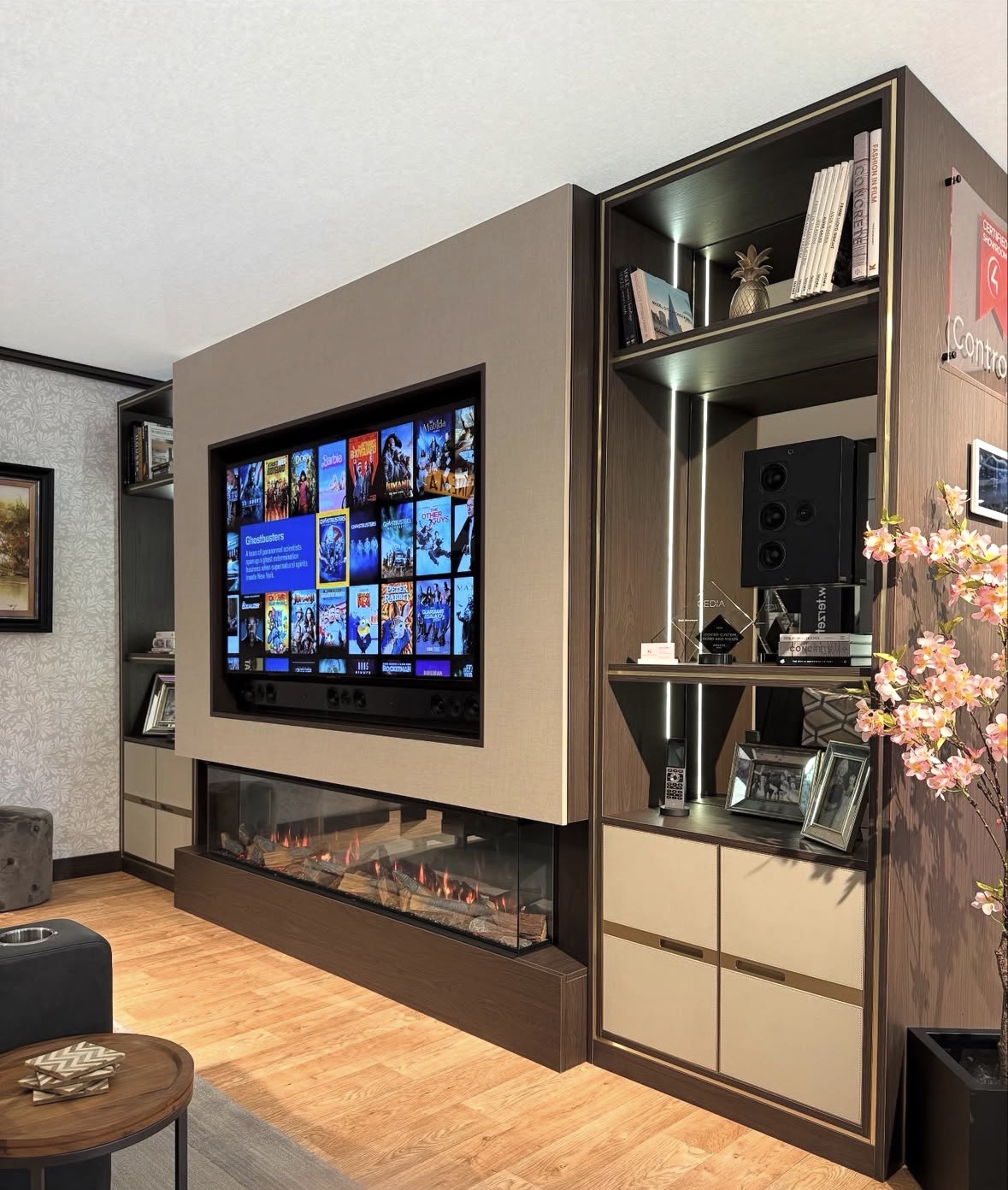
Contemporary bespoke furniture
Contemporary furniture design is a way of composing a room rather than a category of building. It favours clean lines over ornament, large uninterrupted surfaces over broken-up panels, and a restrained material palette carried consistently through a space. It can be applied in a Victorian terrace as readily as in a new-build, which is precisely what separates it from a discussion about the age or architecture of a house.
At Chester Thomas, contemporary work most often means handleless cabinetry with integrated pulls or push-catch openings, dark or muted colourways in graphite, charcoal and matt black, and cabinetry that reads as a single volume rather than a run of individual units. Timber, stone and lighting are used deliberately, as part of the composition, rather than added as decoration once the layout is settled.
This is a distinct conversation from designing furniture for a particular type of building. Our bespoke furniture for modern homes page addresses the practical questions that come with newer properties, such as service runs, glazing and open-plan structure. This page is about the design language itself, and it applies whether the room in question is a new-build living space or a period reception room being brought up to date.
The common thread across contemporary projects is control: control of sightlines, control of joints and reveals, and control of how light falls across a surface. Storage is planned so that it disappears into the architecture of the room rather than announcing itself, and detailing such as shadow gaps, flush skirting and floating volumes is used to reinforce a sense of quiet, considered order.
Where a contemporary approach works well
01
Open-plan living and kitchen spaces
Large, open rooms benefit from furniture that reads as a single composition rather than a series of separate cabinets, giving the eye fewer places to stop and the room a calmer overall feel.
02
Media walls and entertaining spaces
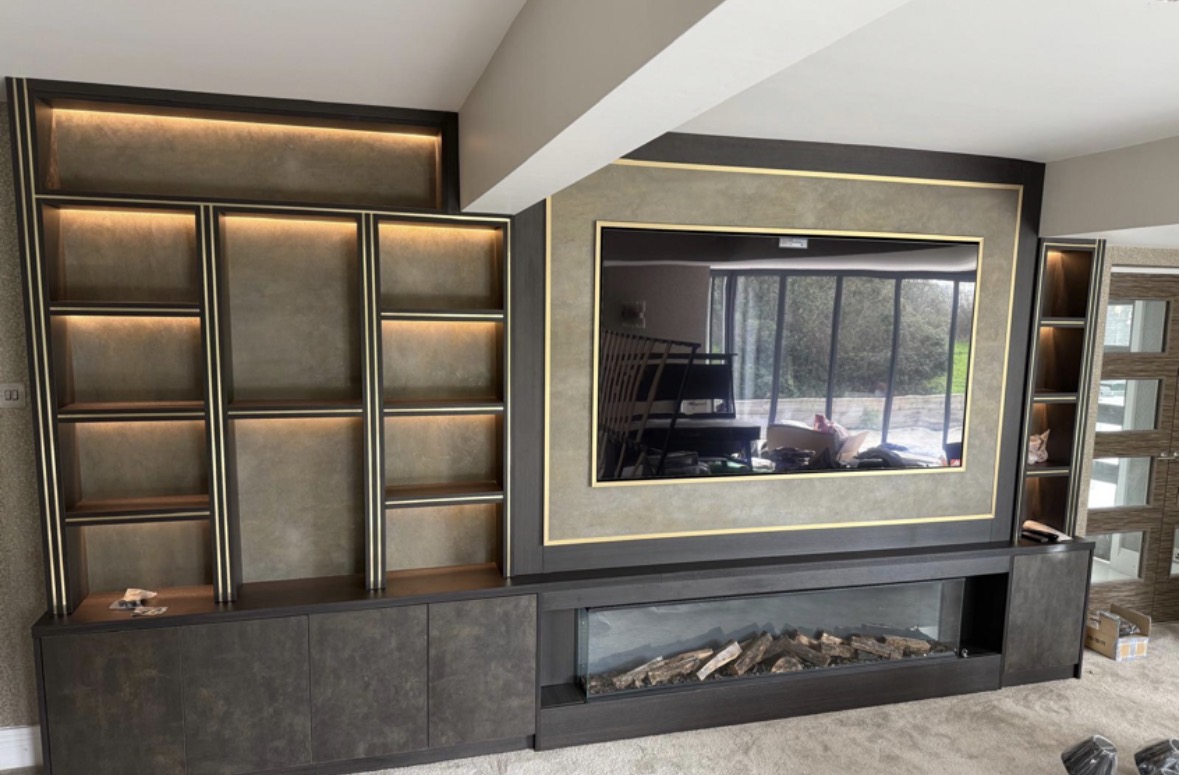
A media wall built around clean lines, a stone-clad centre panel and integrated lighting gives a room a clear focal point without relying on applied decoration or busy detailing.
03
Handleless kitchens
Integrated or push-catch handles keep worktops and runs of cabinetry uninterrupted, which matters most where a kitchen opens directly onto a dining or living area.
04
Dressing rooms and wardrobes
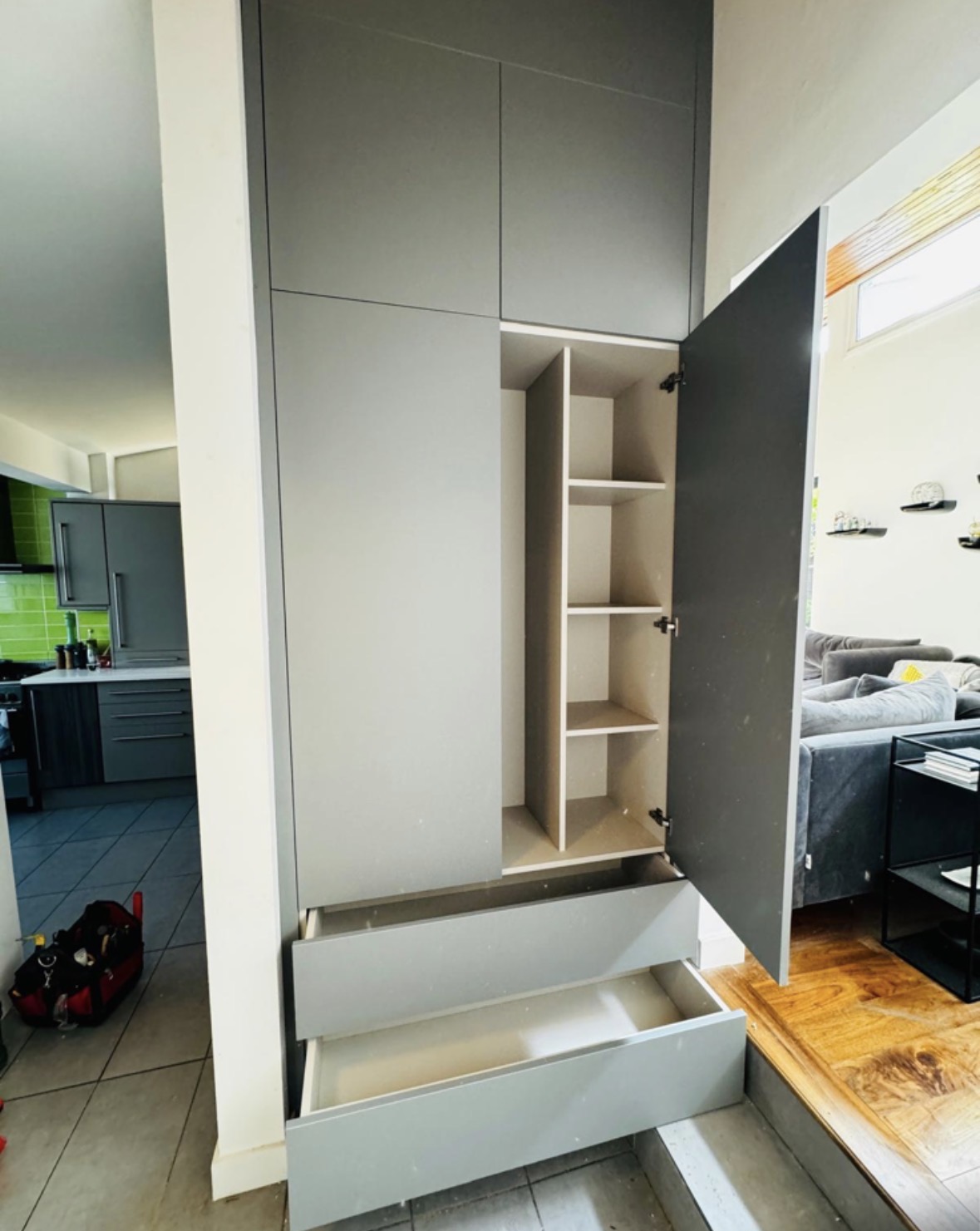
Floor-to-ceiling handleless wardrobes and dressing room cabinetry make efficient use of storage while keeping the room's visual language consistent with the rest of the house.
05
Home offices and studies
A contemporary study benefits from concealed storage and a restrained palette, so the working surface stays the focus rather than the furniture surrounding it.
06
Homes being updated rather than rebuilt
A period property can be given a contemporary reception room or kitchen without altering its architecture, simply by choosing furniture with this design language over a more traditional one.
Uninterrupted surfaces
Achieving a genuinely flat, joint-free run of cabinetry takes careful setting-out at the design stage, since panel sizes, grain direction and the position of any unavoidable joints all need to be resolved before manufacture rather than adjusted on site.
This is one of the reasons contemporary work relies so heavily on accurate drawings: a small discrepancy that would be forgiven in a more detailed, panelled design becomes far more visible across a large plain surface.
Handles and hardware
Handleless designs depend on hardware doing its job quietly, whether that is an integrated aluminium pull, a routed finger-edge, or a push-catch mechanism. The choice affects both the look of a run of cabinetry and how it feels to use day to day.
Softer opening actions and consistent gaps between doors matter more in a handleless design than in a traditional one, since there is nowhere for small inconsistencies to hide.
Dark and graphite cabinetry
Matt black and graphite finishes read as confident and grounded but show dust, fingerprints and light scratching more readily than paler colourways, which is worth discussing honestly before a whole run of cabinetry is committed to a dark finish.
Dark cabinetry is often paired with lighter timber, stone or a lit recess to stop a room feeling heavy, and that balance is worth resolving at the design stage rather than after manufacture.
Integrated lighting
LED-lit shelving, plinth lighting and lit recesses are a genuine part of a contemporary design language, but the electrical connection itself is carried out by a qualified electrician rather than by Chester Thomas, and needs to be planned into the wider project alongside the cabinetry.
We route cabinetry to take cabling cleanly and agree the position of switches and transformers early, so the finished piece looks resolved rather than having lighting added as an afterthought once the cabinetry is already installed.
Floating and wall-hung furniture
Cabinetry that appears to float off the floor, whether a vanity unit, a media wall or a run of storage, relies on concealed fixing back into the wall structure, which needs to be assessed at survey stage rather than assumed once the design is drawn.
Where a wall cannot take the required fixing on its own, we discuss reinforcement or an alternative approach with the client before manufacture, so the finished piece is genuinely secure rather than only appearing to float.
From our work
Materials that suit contemporary work
- Smoked and stained oak
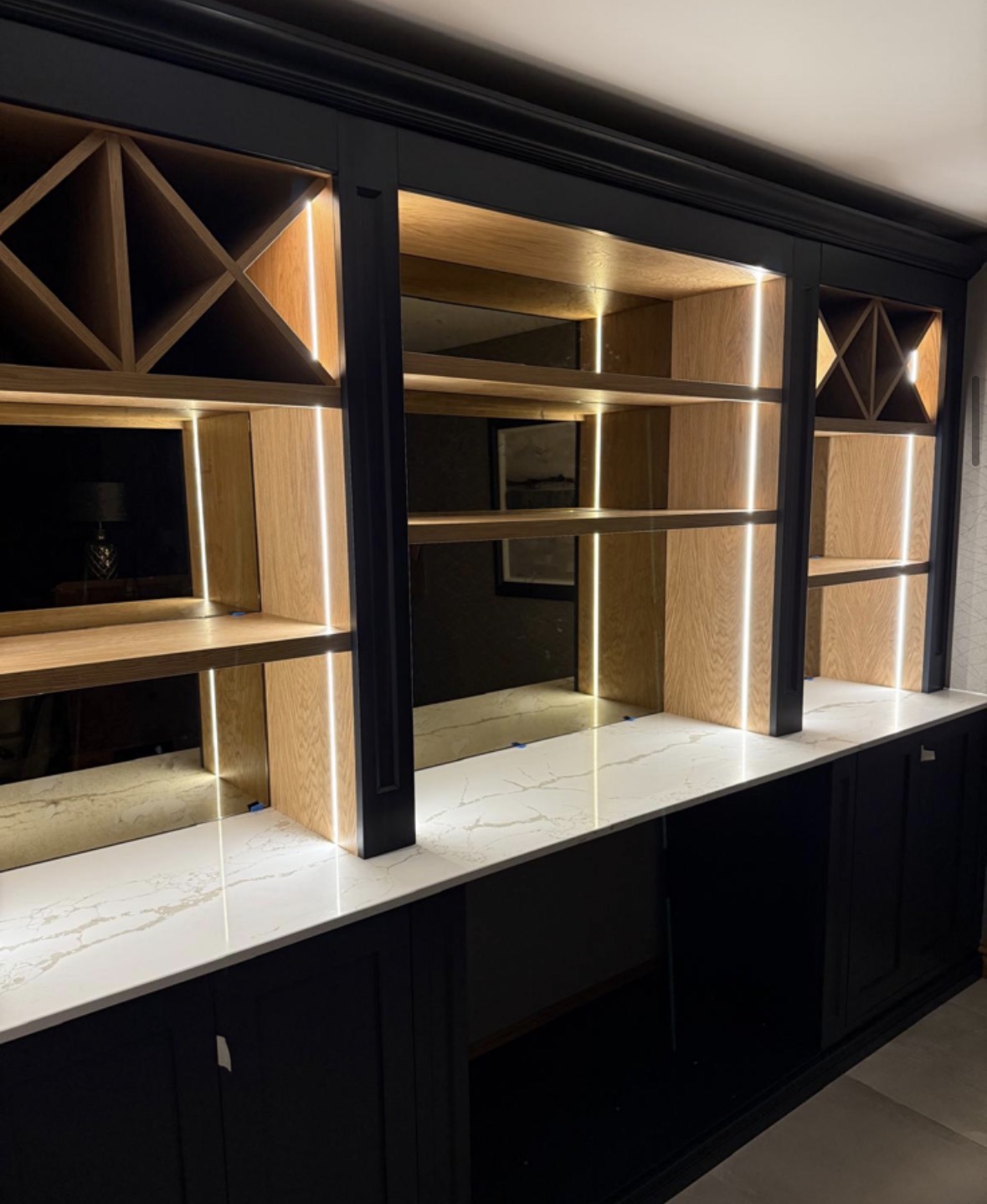
- A darker timber gives contemporary cabinetry warmth without departing from the restrained palette that defines the style, and pairs well against matt black or graphite runs.
- Stone-clad centre panels
- A stone panel set into a media wall or fireplace surround gives a contemporary composition a natural material focus alongside the cabinetry either side of it.
- Matt black and graphite finishes
- Painted finishes in near-black or graphite tones are among the most requested for handleless kitchens, media walls and dressing rooms, and hold their character well over a large run.
- Glass and mirrored inserts
- Glazed or mirrored panels break up an otherwise solid run of cabinetry and add a sense of depth, particularly useful in dressing rooms and display storage.
Design, manufacture, installation
Contemporary furniture still follows the same sequence as any other project: design, specification, manufacture in the Derbyshire workshop and installation by the team who made it, explained in full on the process page.
Questions we are asked
Design
- Is contemporary bespoke furniture only for new-build houses?
- No. Contemporary design is a language of clean lines, integrated hardware and a restrained palette, and it can be used in any property. Many of our contemporary projects sit within older houses, where a single room, such as a kitchen or media wall, is given this treatment while the rest of the building keeps its original character.
- How is this different from furniture for modern homes?
- Bespoke furniture for modern homes, covered on bespoke furniture for modern homes, addresses the practical demands of newer buildings, such as open-plan layouts, exposed services and larger glazing. This page is about a design style that can be applied regardless of the property it sits within, whether the house itself is new or old.
- What makes cabinetry read as contemporary?
- Contemporary cabinetry generally favours flat, uninterrupted door and panel fronts, integrated or minimal handles, and a restrained palette rather than applied moulding or period detailing. Proportion, consistent gaps and careful setting-out do most of the work, rather than any single material or colour choice on its own.
- Can a handleless kitchen still be practical day to day?
- A handleless kitchen can be entirely practical, provided the opening mechanism, whether an integrated pull or a push-catch, is specified with how the kitchen is actually used in mind. We discuss this at design stage, including which cabinets are used most often, so the mechanism chosen suits the household rather than only the overall look of the run.
Materials & finishes
- Does dark cabinetry need more maintenance?
- Matt black and graphite finishes tend to show fingerprints, dust and light marks more readily than paler colourways, simply because of the contrast involved. Regular cleaning with a soft cloth is generally enough, and we can talk through finish options and their practical differences before a colour is confirmed.
Manufacture & installation
- Do you supply and fit the lighting in a media wall?
- We design the recesses, shelving and cabinetry to accommodate lighting and build in the necessary routing, but the electrical connection itself is carried out by a qualified electrician. This is coordinated as part of the wider project so the lighting and cabinetry are installed to work together.
- Can floating furniture be fitted to any wall?
- It depends on the construction of the wall and what lies behind it, which is assessed during our site survey. Where a wall cannot take the fixing a floating design requires, we discuss alternatives, such as a low plinth, rather than compromising the piece once it has already been designed.
Materials & finishes
- What timbers work with a contemporary scheme?
- Smoked and stained oak are the most common choices for contemporary work, giving warmth alongside painted or graphite cabinetry without introducing a heavily grained or traditional character. Lighter oak can also work well where a scheme is intended to feel warmer and less monochrome overall.
- Is stone used in contemporary furniture the same as a kitchen worktop?
- Stone-clad panels used in media walls and fireplace surrounds are usually a feature material rather than a worktop, chosen for appearance alongside cabinetry either side of it. As with worktops, stone fabrication and fitting are carried out by a specialist stone fabricator rather than by Chester Thomas directly.
Design
- Can a contemporary media wall include a fireplace?
- A media wall is often designed around an existing or new fireplace, with cabinetry either side and a stone or timber surround tying the composition together. Any fire itself is supplied and installed by a specialist, with the surrounding cabinetry designed to work with its requirements.
Manufacture & installation
- How do you keep large cabinetry runs looking uninterrupted?
- This comes down to careful setting-out at design stage, including panel sizing, grain matching and the position of any unavoidable joints, followed by precise manufacture in the workshop. Installation is then carried out by the same team, so the finished run reflects the drawings as closely as possible.
Design
- Will contemporary furniture suit a period property?
- It can, particularly in a single room such as a kitchen or media wall being brought up to date, though the wider architecture of a period house is a separate consideration covered on bespoke fitted furniture for period homes. Many clients choose to apply a contemporary language selectively rather than throughout the whole house.
Materials & finishes
- Do you offer sample finishes before committing to a colour?
- We discuss finish samples as part of the design and specification process, so a graphite, black or stained timber finish can be seen against the actual materials and lighting of the room before it is confirmed, rather than judged from a small chip alone.
Design
- What rooms most commonly get this treatment?
- Kitchens, media walls, dressing rooms and home offices are where we see contemporary design most often, largely because these are the rooms where a large, uninterrupted run of cabinetry has the greatest visual impact. Smaller pieces of furniture can carry the same language too, on a smaller scale.
Cost
- What does contemporary bespoke furniture cost?
- Cost depends on the scope of the project, the rooms involved, the materials and hardware specified, and the installation required, so we cannot give a general figure here. The most useful next step is to send details of the room and your requirements through the contact page, so we can respond against the specifics of the project.
Working together
- How do I start a contemporary furniture project?
- We begin with a conversation about the room, how it is used and the design language you have in mind, followed by a site survey and initial layouts. The full sequence, from brief to drawings to manufacture, is described on the chester thomas bespoke furniture design service.
Relevant bespoke services
Bespoke kitchens
Handleless and contemporary kitchen cabinetry designed and made to order.
Media walls
Media wall design incorporating stone, timber and integrated lighting.
Fitted wardrobes
Floor-to-ceiling handleless wardrobes for contemporary bedrooms and dressing rooms.
Home bars
Bar cabinetry designed with a clean, uninterrupted contemporary finish.
Home offices
Concealed storage and clean lines for a contemporary study.
Furniture for modern homes
The practical demands of newer properties, distinct from the design language covered here.
Our process
How a contemporary project moves from design through to installation.
Related materials and styles
Handleless cabinetry
Clean, handle-free fronts across kitchens, media furniture, storage and offices, with integrated pulls and recessed handle rails.
Dark cabinetry
Deep painted tones and dark stained timber, used with lighting and contrast considered from the outset.
Floating cabinetry
Wall-mounted television units, display shelving and storage, designed to appear to float clear of the floor.
Integrated lighting
LED shelf, display and wardrobe lighting designed into cabinetry from the outset, with connection carried out by a qualified electrician.
To discuss materials and finishes, call Chester Thomas on 07542 822456, email info@chesterthomas.com or start your project.
Planning Something Bespoke?
Tell us about your space, what you're looking to create and where the project is located.