
Materials & finishes
Mirrored cabinetry, bar backs and reflective detail
Mirror changes how a piece of furniture reads, adding depth and reflected light rather than simply covering a surface, and it suits some settings far more than others.
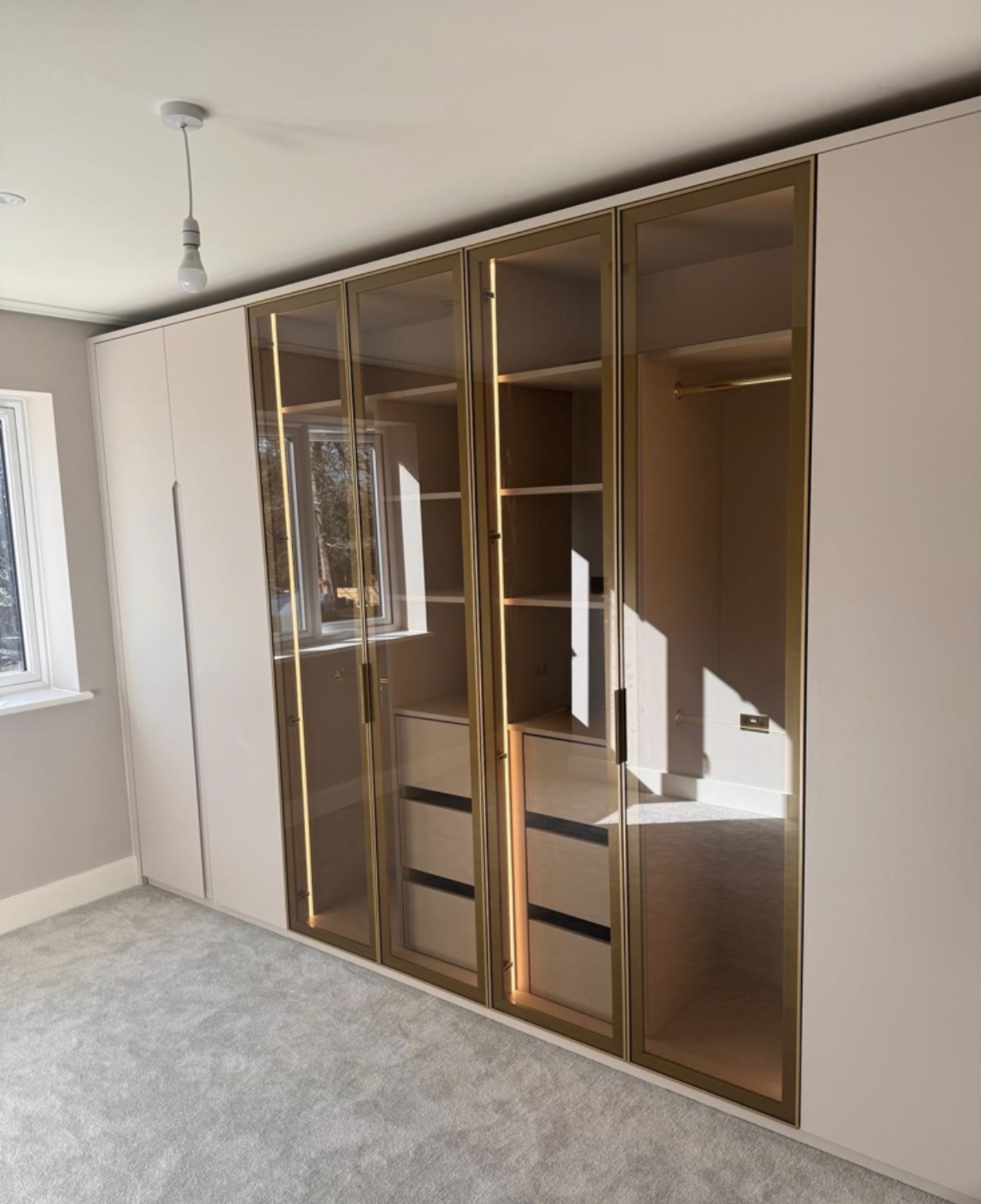
Mirrored cabinetry
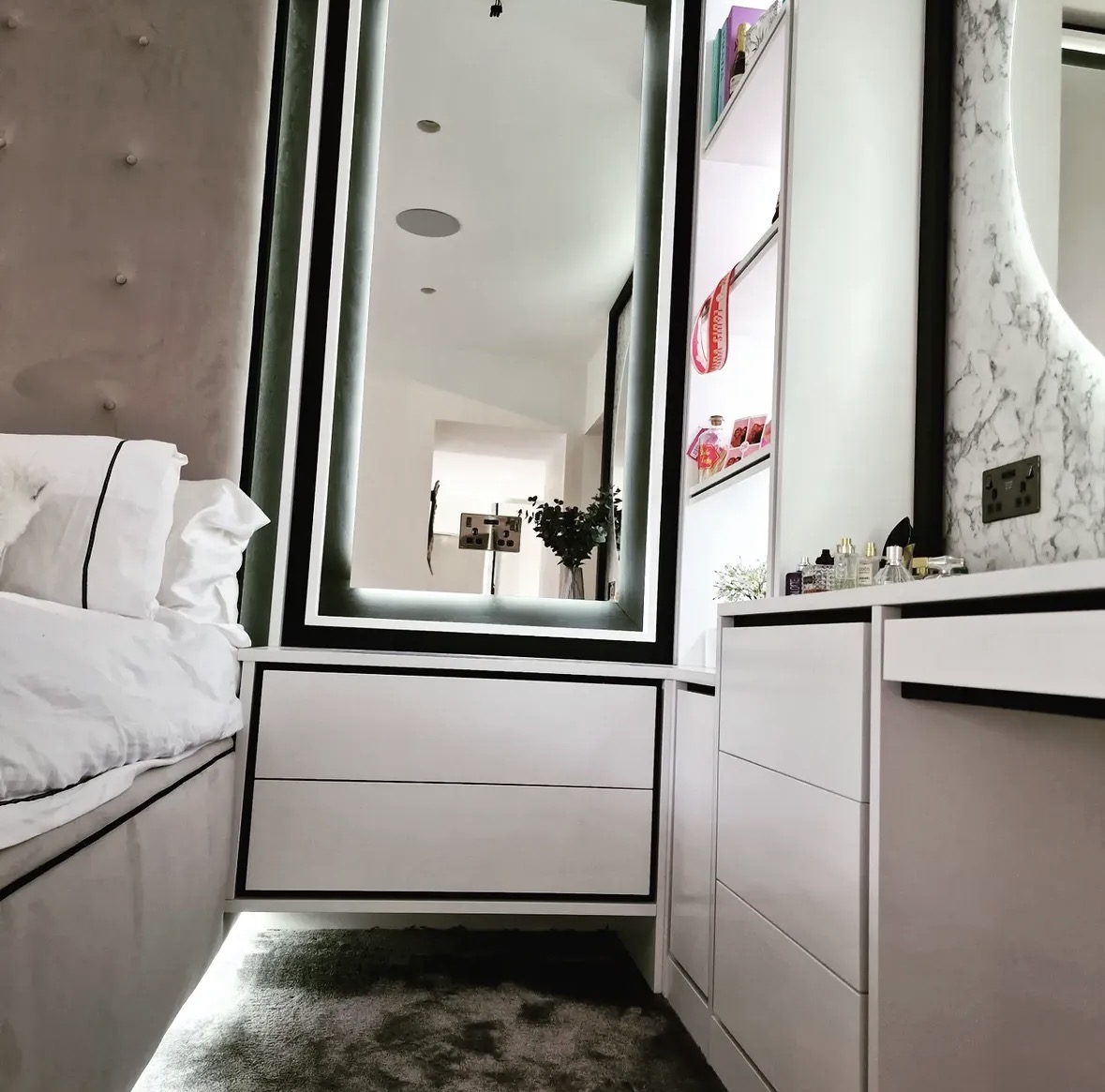
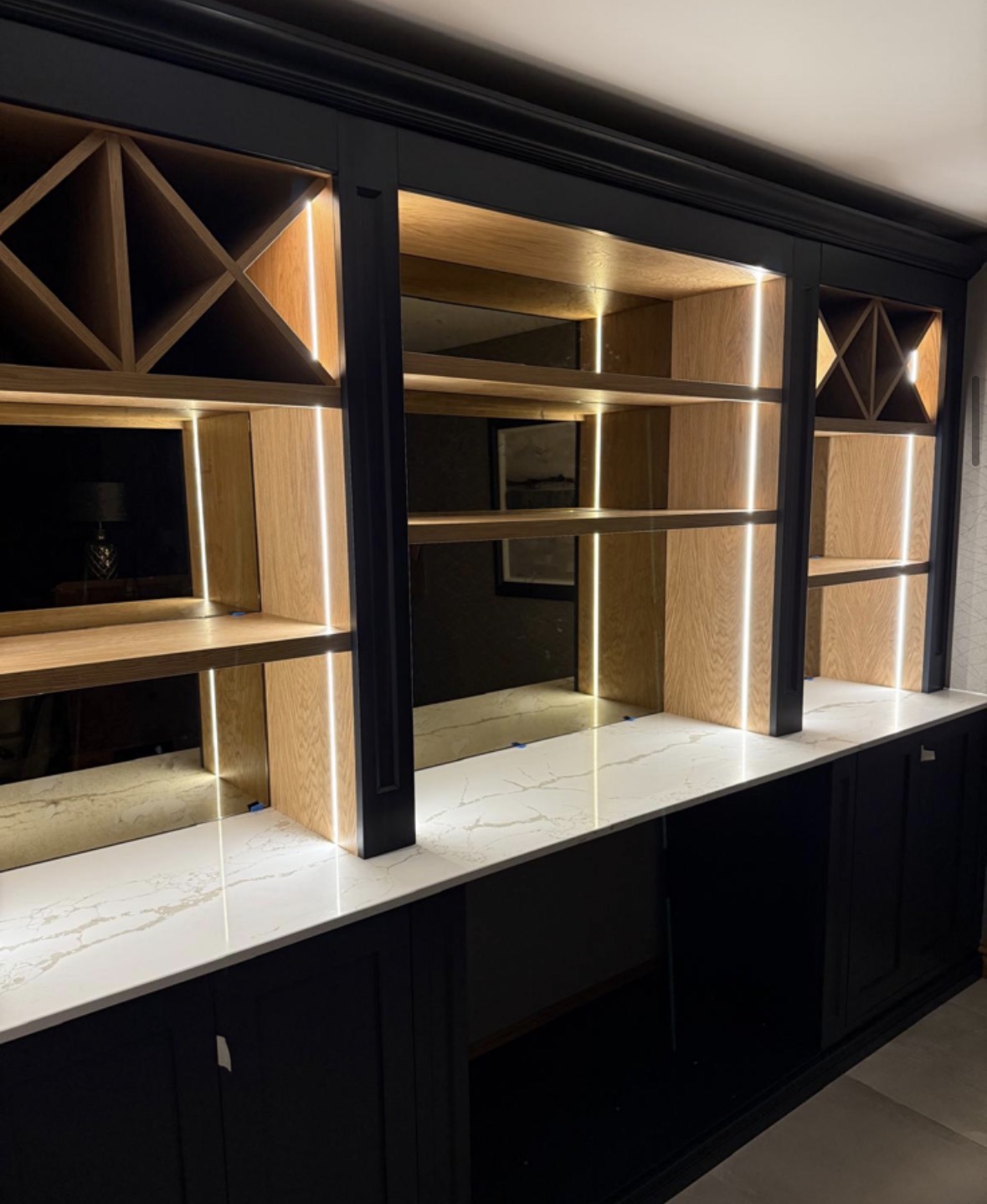
Mirrored cabinetry does a particular job: it reflects light and space back into a room, making a fitted piece feel less solid than an equivalent run in timber or a painted finish. We have used it in several forms, including antique diamond-lattice mirrored bar backs, LED-lit mirrored bar shelving, backlit mirrors above fitted drawers, and a mirrored back panel to media wall display shelving.
Chester Thomas designs, manufactures and installs the cabinetry that mirror is set within, whether a bar back, a wardrobe door or a run of drawers, in our Derbyshire workshop. The mirror itself is fabricated to the sizes and finishes specified in our drawings, and antique mirror in particular, with its aged, foxed appearance, is a specific product used where that character genuinely suits the setting, most often the bar-back work described below.
Antique mirror is worth distinguishing clearly from plain mirror glass. It carries a deliberately aged finish, with foxing and patina built in rather than acquired over time, and works well behind a bar or as a decorative panel where that character is wanted. It is not part of every mirrored piece we make, and it should not be assumed present on any project unless it is specifically part of that piece's brief and finish.
This page sets out where mirrored cabinetry works well, the design decisions involved in using it successfully, and where antique mirror specifically has a place in our work, as distinct from plain mirrored glass used elsewhere.
Where mirrored cabinetry works well
01
Home bar backs
A mirrored bar back, whether plain or in antique diamond-lattice form, reflects bottles and glassware and makes a bar feel deeper and more considered than a solid backdrop.
02
Wardrobe doors
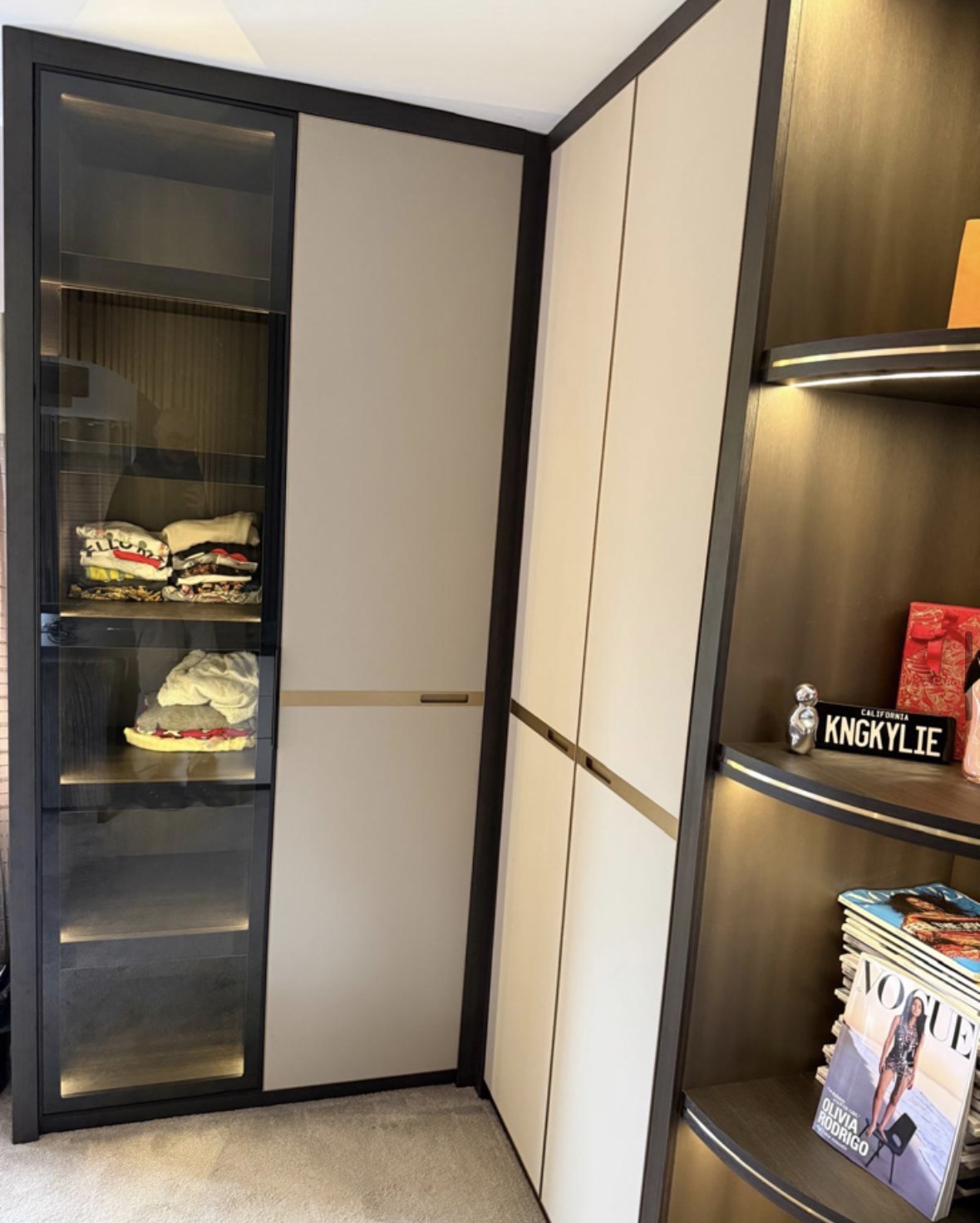
Mirrored wardrobe doors add practical value as a dressing mirror while making a run of storage feel less imposing in a bedroom or dressing room.
03
Above fitted drawers
A backlit mirror set above a run of drawers, such as in a dressing area, combines a practical dressing mirror with a soft, ambient light source.
04
Display shelving backgrounds
A mirrored back panel behind display shelving, as used on some media wall cabinetry, adds depth and reflects light through the objects displayed.
05
Smaller or darker rooms
Because mirror reflects both light and space, it can help a smaller or naturally darker room feel more open than an equivalent run of solid cabinetry.
06
Rooms wanting a period or characterful finish
Antique mirror's aged, foxed appearance suits a bar or feature intended to feel established and characterful rather than crisp and contemporary.
Antique mirror versus plain mirror
Antique mirror is a distinct product, manufactured with a deliberately aged, foxed finish rather than clear reflective glass. It has a specific character that suits particular settings, most notably the diamond-lattice bar backs we have built, and is chosen deliberately for the atmosphere it brings rather than used as a general substitute for plain mirror.
We describe antique mirror only where it genuinely forms part of a piece's specified finish. It should not be assumed to feature on a project, such as a media wall's mirrored back panel, unless that panel has specifically been finished in antique rather than plain mirror.
Backing and support
Mirror is a rigid, unforgiving material similar to glass, so the panel or door it forms has to be dimensioned accurately before fabrication, in the same way as glazed cabinetry. Backing boards, frames and any fixing points are designed to support the mirror securely within the cabinetry, whether it forms a full door, a fixed panel or a lattice of smaller antique mirror pieces.
Where mirror is fitted as a bar-back lattice, the individual pieces are set within a supporting frame built as part of the joinery, so the finished panel reads as a single considered feature rather than a collection of separately fixed tiles.
Lighting with mirror
Mirror reflects light particularly effectively, which is why several of our mirrored features are also lit, including LED-lit mirrored bar shelving and backlit mirrors above fitted drawers. Lighting position matters here: light aimed directly at a mirror can create glare rather than a soft glow, so fittings are usually positioned to graze or backlight the mirror rather than shine straight onto its surface.
As with all integrated lighting, the recesses and wiring routes are built into the cabinetry at manufacture, with the electrical connection carried out separately by a qualified electrician.
Where mirror suits the setting and where it does not
Mirror works well where reflected light and a sense of depth are wanted, but it is not a universal finish. A media wall's mirrored back panel sits behind display shelving rather than facing directly into the seating area, where a large mirrored surface might reflect a screen or create glare rather than add atmosphere.
We discuss where mirror genuinely adds to a design and where a different reflective or plain finish would suit the room better, rather than defaulting to mirror wherever glazing or a reflective surface is being considered.
From our work
What mirrored cabinetry is typically paired with
- Brass trims and fixtures
- Brass framing or trim around a mirrored panel, as used alongside antique mirror bar backs, gives the reflective surface a warm metal edge rather than a plain, unframed border.
- LED lighting
- Mirrored bar shelving and backlit mirrors above drawers both rely on lighting built into the surrounding joinery to bring out the reflective surface fully.
- Dark or richly finished cabinetry
- Mirror reads particularly well against darker surrounding joinery, where the reflected light provides contrast rather than blending into a lighter scheme.
- Glazed display cabinetry
- Mirrored back panels are sometimes used behind glazed or open display shelving to add depth to the objects shown, discussed further on glass display cabinets for glassware, books, wine and collections.
- Fitted wardrobe and dressing furniture
- Mirrored doors and backlit mirrors above drawers both suit a dressing room or bedroom setting, combining practical use with the reflective quality of the finish.
Design, manufacture, installation
Mirrored cabinetry is designed, drawn, manufactured in our Derbyshire workshop and installed following the sequence set out on the process page, with any lighting connected by a qualified electrician.
Questions we are asked
Materials
- What is antique mirror?
- Antique mirror is glass finished with a deliberately aged, foxed appearance, used where a piece is intended to feel established and characterful rather than crisp and contemporary. We have used it specifically in diamond-lattice bar-back work, chosen for that character rather than as a general substitute for plain mirror.
- Is antique mirror used throughout your mirrored cabinetry?
- No. Antique mirror is used deliberately where its aged character suits the piece, most notably in bar-back work, and we do not claim it features on projects where plain mirror has actually been used. Each piece's finish is described accurately to what was specified for it.
Examples
- Was antique mirror used on the Solihull media wall?
- The Solihull media wall's mirrored back panel to its display shelving is a genuine feature of that project, but antique mirror specifically is not part of its finished installation. Antique mirror in our work is associated with bar-back projects rather than that media wall.
Design
- Can wardrobe doors be mirrored?
- Mirrored doors are a common choice for fitted wardrobes, giving a practical dressing mirror while making a run of storage feel less imposing in the room, since the reflective surface reads as more open than a solid painted or timber front of the same size. A full mirrored run, a mirrored panel within a framed door, or mirror on only some doors within a run are all options, and this is discussed as part of door and finish selection during wardrobe design.
- How does a mirrored bar back work?
- A mirrored bar back sits behind bottle and glassware storage, reflecting the display and adding depth to the bar as a whole. It can be a single panel or, in antique diamond-lattice form, a pattern of smaller framed pieces set within the surrounding joinery.
Lighting
- Can lighting be combined with mirrored cabinetry?
- LED-lit mirrored bar shelving and backlit mirrors above fitted drawers are both features we have built, with lighting positioned to graze or backlight the mirror rather than shine directly onto it, avoiding glare. Electrical connection is carried out by a qualified electrician.
Design
- Is mirrored cabinetry fragile?
- Mirror is a rigid material similar to glass, so it is dimensioned and backed carefully within the surrounding joinery to support it securely, whether as a full door, a fixed panel or a lattice of smaller pieces. Properly supported, it performs reliably as part of daily fitted furniture use.
- Does mirror make a small room look bigger?
- Mirror reflects light and the room around it, which can make a smaller or darker space feel more open than an equivalent run of solid cabinetry. Whether it suits a specific room depends on layout and what the mirror would reflect, which is worth discussing at design stage.
- Can a mirrored panel be added behind display shelving?
- A mirrored back panel is one option for display shelving, adding depth and reflecting light through the objects shown, as used on some of our media wall cabinetry. A painted or timber-lined interior is an alternative where a different background suits the display better.
Maintenance
- Does mirrored cabinetry need special cleaning?
- Mirror generally shows fingerprints and marks more readily than a solid finish, so it needs fairly regular cleaning to keep its reflective quality clear, in the same way as glazed cabinetry. This is worth factoring into the choice for a heavily used piece such as a wardrobe door.
Design
- Can antique mirror be used somewhere other than a bar?
- It can, where its character genuinely suits the setting, though our own experience with it centres on bar-back work, where antique mirror's aged, foxed finish reads well against brass fittings and bottle display. The same qualities could suit a dressing room, hallway or feature wall, but the effect depends heavily on lighting, scale and the surrounding materials. Any proposal to use it elsewhere would be discussed and specified individually, rather than assumed to work in the same way it does behind a bar.
- How is a mirrored panel fitted into a wardrobe door?
- The mirror is set within a door frame built as part of the wardrobe's joinery, with backing and fixings designed to support it securely within daily use. The frame material and finish match the surrounding cabinetry, so the mirrored door reads as part of the same run of furniture.
Cost
- What does mirrored cabinetry cost?
- Cost depends on the scale of mirrored panelling, whether antique mirror is specified, and whether lighting is included, so there are no general figures we can quote without seeing the project. The best next step is to send details through the contact page.
Relevant bespoke services
Home bars
Mirrored and antique mirror bar backs designed alongside bottle and glassware storage.
Fitted wardrobes
Mirrored wardrobe doors designed as part of a fitted storage run.
Walk-in wardrobes and dressing rooms
Backlit mirrors above fitted drawers within a dressing area.
Media walls
Mirrored back panels used behind media wall display shelving.
Bespoke cabinetry
General cabinetry incorporating mirrored panels or doors.
Related materials and styles
Glass display cabinets
Glazed and LED-lit display cabinetry designed around what is being shown, from glassware and books to wine and collections.
Integrated lighting
LED shelf, display and wardrobe lighting designed into cabinetry from the outset, with connection carried out by a qualified electrician.
Dark cabinetry
Deep painted tones and dark stained timber, used with lighting and contrast considered from the outset.
To discuss materials and finishes, call Chester Thomas on +44 7418 627358, email info@chesterthomas.com or start your project.
Planning Something Bespoke?
Tell us about your space, what you're looking to create and where the project is located.