
Design & specification
Materials and finishes for bespoke furniture
Materials and finishes are chosen project by project rather than from a fixed range, but most bespoke furniture draws on the same broad categories of surface, hardware and detail.
Materials & finishes
The look and feel of a finished piece of furniture comes as much from its materials and finishes as from its layout. Two pieces built to the same dimensions can read completely differently once paint, timber, stone, glass or metal detailing is applied.
This page sets out the categories of material and finish that recur across Chester Thomas projects: painted finishes, natural and stained timber, veneers, stone and marble, glass, mirror, metal accents, fabric and leather, hardware, and integrated lighting. It is a guide to what is typically specified, not a fixed list of options.
Which categories are relevant to a given project depends on the room and the piece being made. A wine room draws heavily on stone, glass and metal detail; a home office may lean more on natural timber and hardware. The specification for each project, described on specifying bespoke furniture, room by room, records the exact choices made.
Nothing described here is held as stock. Materials and finishes are sourced and specified for each project as decisions are made with the client, so the range available is broader than any single list could show.
How materials are chosen
01
Chosen per project
There is no fixed range of materials or finishes. Each category described here covers a broad set of possible choices, and the exact material used is agreed for the individual project during specification.
02
Matched to the room
Materials are chosen to suit how a room is used and what already exists in it, so a kitchen worktop, a home bar surface and a media wall panel are considered on their own terms rather than treated the same.
03
Considered together
Finishes are rarely specified in isolation. A painted door, a metal handle and a stone surface are considered as a set, so the finished piece feels coordinated rather than assembled from unrelated parts.
04
Durability and use
How a surface will be used, whether it will see daily wear, moisture or heat, is part of choosing a material, alongside its appearance, so the finish specified suits the demands of the room.
05
Lighting as a finish
Integrated lighting is treated as part of the material and finish specification, since how a surface is lit affects how its colour, texture and reflectivity read in the room.
06
No standard stock
Materials and finishes are sourced for each project rather than held in stock, which allows a wider range of options than a fixed catalogue but means choices are made and specified in advance of manufacture.
Painted and timber finishes
Painted finishes remain one of the most flexible ways to specify colour and sheen across cabinetry, and are commonly chosen for kitchens, wardrobes and cabinetry where a consistent, coordinated colour is wanted across a run of furniture.
Natural timber and stained timber finishes bring the grain and character of the wood itself into the piece, whether left close to its natural colour or stained to sit alongside other materials in the room. These finishes suit projects such as home libraries, home offices & studies and bespoke cabinetry, where a warmer, more traditional character is often wanted.
Veneers allow a timber appearance to be applied consistently across larger surfaces, such as tall wardrobe doors or long runs of cabinetry, where solid timber would be impractical or prone to movement.
Stone, marble and glass
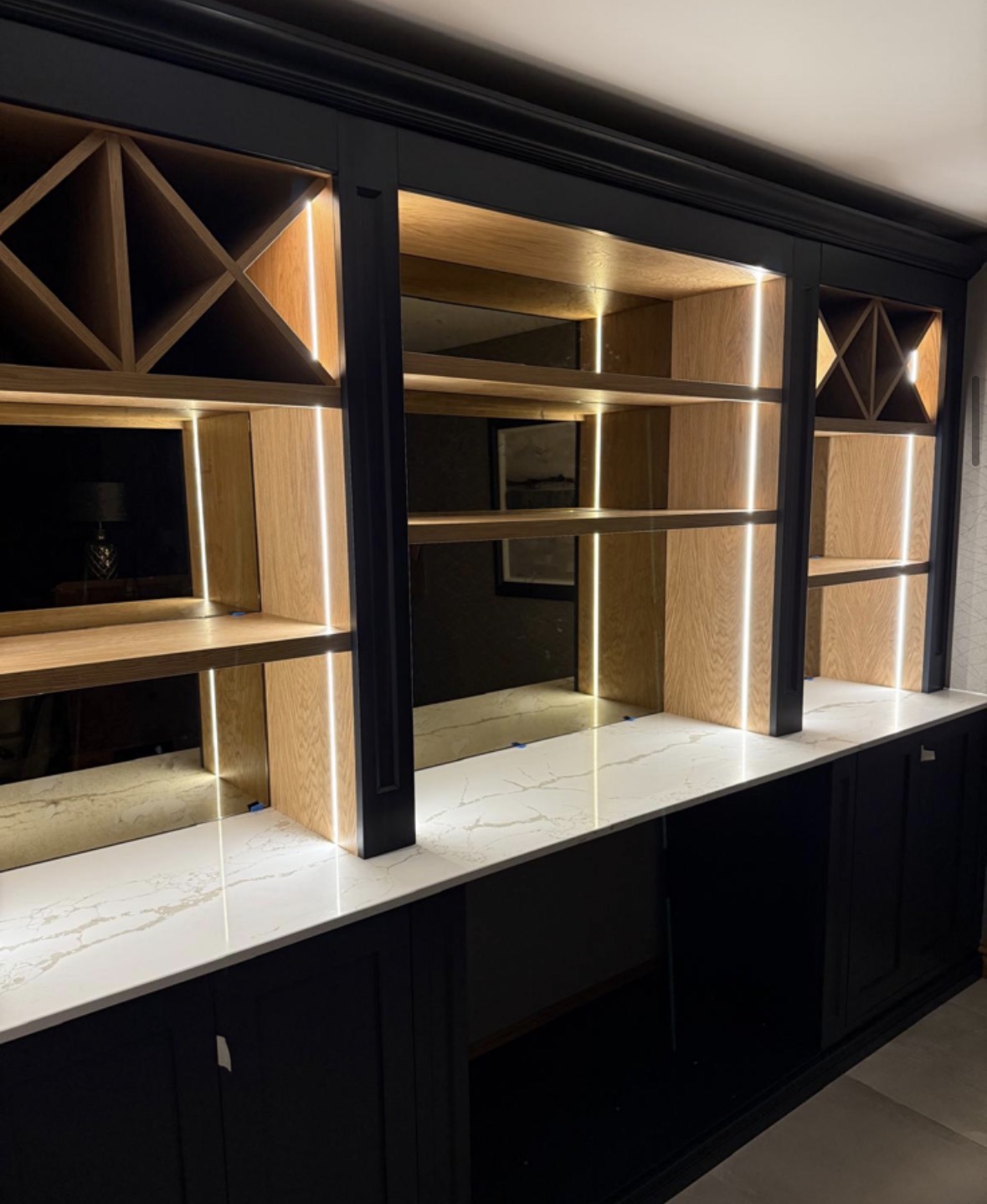
Stone and marble surfaces are specified where a project calls for a solid, substantial worktop or feature surface, commonly seen on projects such as media walls, home bars and wine rooms & cellars, where a stone surface can anchor the design of the whole piece.
Glass is used both structurally, as shelving, and decoratively, as splashbacks or cabinet fronts, and is specified for thickness and edge treatment to suit its position and how it will be used.
Mirror is specified where a project calls for reflectivity, whether to open up a smaller room or as a deliberate finish within cabinetry, and is treated with the same care over edge and fixing detail as glass.
Metal, fabric and leather
Metal accents, such as trims, brackets and inlays, are specified where a piece calls for a harder, more defined detail against timber, painted or stone surfaces, often used sparingly rather than across an entire piece.
Fabric and leather are specified for upholstered elements within bespoke furniture, such as seating built into a bar or media wall, and are chosen alongside the surrounding materials so the finished piece feels considered as a whole.
Handles, hardware and lighting
Handles and hardware are specified for both appearance and function, covering everything from visible handle styles to handle-free opening systems, hinges and drawer runners, and are chosen to suit how a piece will be used day to day.
Integrated lighting is specified alongside the surrounding materials, since the way a surface is lit affects how its finish is perceived. Where new electrical circuits are needed, this work is coordinated with an electrician, as Chester Thomas does not carry out electrical work itself.
How categories combine across a project
Most projects draw on several of these categories together. A kitchen might combine a painted finish on cabinetry, a stone worktop, metal handles and integrated lighting under wall units, while a media wall might combine timber veneer, stone cladding and glass shelving.
The materials and finishes agreed for one room in a multi-room project are often considered against those chosen for other rooms, so the house reads consistently even where different services, such as bespoke kitchens and home offices & studies, are being fitted at different times.
Material and finish categories
- Painted finishes
- Coloured finishes applied to cabinetry doors and panels, commonly specified for kitchens, wardrobes and cabinetry needing a consistent colour across a run.
- Natural timber
- Timber left close to its natural colour and grain, often chosen for home libraries, home offices & studies and bespoke cabinetry projects.
- Stained timber
- Timber finished with a stain to adjust its colour while retaining visible grain, used where a warmer or darker character is wanted.
- Veneers
- A timber surface applied to larger panels such as tall wardrobe doors, giving a consistent timber appearance across a run of cabinetry.
- Stone and marble
- Solid surfaces specified for worktops and feature surfaces, frequently used on media walls, home bars and wine rooms & cellars projects.
- Glass and mirror
- Used structurally as shelving and decoratively as splashbacks, cabinet fronts or reflective panels, specified for thickness and edge treatment.
- Metal accents
- Trims, brackets and inlays used sparingly against timber, painted or stone surfaces to add a defined, harder detail.
- Fabric and leather
- Used for upholstered elements built into bespoke furniture, such as seating within a bar or media wall.
- Handles and hardware
- Handle styles, handle-free systems, hinges and drawer runners specified for both appearance and daily function.
- Integrated lighting
- Lighting built into furniture, coordinated with an electrician where new circuits are needed, specified alongside the surrounding finishes.
Send us the drawings, the rooms involved and where the project has reached, and we will tell you what we can design, make and fit.
Design, manufacture, installation
Materials and finishes are agreed as part of the wider design-to-installation sequence described on the process page, following the specification stage and feeding directly into manufacture.
Questions we are asked
Materials & finishes
- Is there a fixed range of materials and finishes to choose from?
- Chester Thomas does not hold a fixed catalogue or stock range. Materials and finishes are sourced and specified for each project according to the room, the client's preferences and the rest of the specification. This page describes the broad categories most often used, not a complete or fixed list, and the actual options considered will vary between projects.
- Which materials suit a wine room or home bar?
- Wine rooms and home bars often draw on stone or marble surfaces, glass shelving and metal detailing, since these materials suit the display and lighting typical of those spaces. The exact combination is specified for the individual project, taking into account the room's size, lighting, existing finishes and how the space will be used day to day.
- What is the difference between veneer and solid timber?
- Veneer applies a thin layer of real timber over a stable board, allowing a consistent timber appearance across large or tall surfaces such as wardrobe doors without the movement solid timber can show over time. Solid timber is used where its full thickness and character are wanted, typically on smaller elements or where a more traditional finish is preferred.
- Can painted and timber finishes be combined in the same piece?
- Combining painted and timber finishes in the same piece is a common approach. A piece might combine painted cabinetry with a natural or stained timber worktop or feature panel, giving contrast between a flat colour and visible grain. Combinations like this are agreed during specification, alongside hardware and any stone or metal detail chosen for the project.
- How is stone specified for a worktop or surface?
- Stone is specified by type, thickness and edge treatment, chosen to suit the surface it will be used for and how it will be used day to day. Samples are typically reviewed as part of agreeing the specification, so the finished appearance is understood and agreed with the client before manufacture begins in the workshop.
- Does Chester Thomas fit glass and mirror as part of furniture?
- Glass and mirror are specified and fitted as part of bespoke furniture at Chester Thomas, used for shelving, cabinet fronts, splashbacks or reflective panels within a room. Thickness and edge treatment are specified to suit the position and expected use of each piece of glass or mirror within the finished piece of furniture, and toughening or safety treatment is specified where the position of the glass or mirror calls for it. Fixings are agreed as part of the same specification so glass and mirror elements sit securely alongside the surrounding carcass, hardware and lighting rather than being treated as a separate addition once the rest of the piece is complete.
- What kind of hardware is used on bespoke furniture?
- Hardware covers handles, handle-free opening systems, hinges, drawer runners and any locking or soft-close mechanisms. These are specified individually for each project, chosen for how the furniture will actually be used as much as for its appearance, and recorded in the specification for future reference, servicing or replacement of parts. A drawer used daily for cutlery is specified differently from one holding linen, and a wardrobe door opened many times a day may call for a different hinge or runner from a rarely used cupboard. Recording the exact type chosen means it can be matched consistently if a room is extended or a fitting later needs replacing.
- Is integrated lighting available across all furniture types?
- Integrated lighting can be considered for most bespoke furniture, from kitchen cabinetry to media walls and wine rooms, where it usually adds most to how materials and finishes are perceived in the finished room. Where new circuits are needed, this is coordinated with an electrician, since Chester Thomas does not carry out electrical work itself.
- Can fabric or leather be included in fitted furniture?
- Where a project includes upholstered elements, such as seating built into a home bar or media wall, fabric or leather can be specified alongside the surrounding materials chosen for that piece. These choices are made together so the upholstery feels part of the same piece rather than added as an afterthought once the furniture is complete.
Working together
- How do I know which materials will suit my project?
- This is discussed during design and specification, taking into account the room, how it is used, and the client's preferences for colour and texture. Reviewing samples alongside the drawings for the project is the usual way to test how different materials will look and work together before anything is ordered from the workshop. Practical factors matter as much as appearance: a worktop used for daily food preparation is specified differently from a display surface in a wine room, and a heavily used wardrobe door calls for a more durable finish than a rarely opened cupboard. These conversations happen alongside the technical drawings, so material choices are grounded in how the room will actually be lived in.
- Does changing a material affect the rest of the specification?
- Changing a material can affect the rest of the specification. Materials and finishes are often specified together, so changing one, such as swapping a painted finish for a timber veneer, may affect hardware choices or how the piece is lit within the room, since a handle or light fitting chosen against one finish does not always suit another. Any change is reflected across the whole specification before manufacture proceeds, so the workshop always orders materials and components against a single, current version of the document rather than an earlier draft that no longer matches the client's decision.
- Are materials matched across different rooms in a house?
- Where several rooms are being fitted as part of the same project, materials and finishes are often considered together so the house reads consistently, even where the rooms themselves, such as a kitchen and a home office, use quite different furniture types, layouts and everyday functions. This does not mean identical materials throughout; a hallway bookcase and a kitchen run of cabinetry can use different timbers or finishes while still sharing a family of colours, hardware or detailing that ties the rooms together. Coordinating these choices across a multi-room project is agreed during specification, so each room's furniture is specified with the others in mind rather than in isolation.
Programme
- How long does it take to agree materials and finishes?
- This depends on how many decisions are still open and how many rooms are involved in the project. Reviewing samples and confirming choices can take longer where several materials need to be coordinated and matched across a multi-room project, particularly where stone, timber veneer and hardware are all being chosen together for more than one room. A single piece with clear preferences from the outset is generally quicker to agree than a whole-house project with many surfaces and finishes to bring into line. Specific timescales are best discussed for your own project through the contact page.
Cost
- How do material choices affect the cost of a project?
- Cost depends on the scope of the project, the number of rooms, dimensions, the materials and finishes chosen, hardware, complexity and installation. Materials such as stone or specialist veneers can affect cost differently from painted or natural timber finishes, which is why they are confirmed during specification. Discuss your project through the contact page for a considered quotation.
Chester Thomas
- Why does Chester Thomas describe finishes in categories rather than a fixed list?
- Describing broad categories rather than a fixed list reflects how the business actually works: materials are sourced for each individual project rather than drawn from stock. This keeps every project genuinely bespoke, but it means the categories here are a guide to what is typically specified rather than an exhaustive catalogue of options. A client's preferred timber, stone or hardware may not appear on this page at all, and that does not rule it out; it simply has not yet been discussed for a specific project. The categories are a starting point for conversation during design and specification, not a menu that limits what Chester Thomas is willing to consider for a room.
Related pages
Working with professionals
How Chester Thomas works alongside architects, designers and other trades on a project.
Specification
How chosen materials and finishes are recorded alongside dimensions and hardware.
Manufacturing
How specified materials and finishes are worked in the Derbyshire workshop.
Bespoke kitchens
A project type where painted, timber and stone finishes are frequently combined.
Bespoke home libraries
A project type where natural and stained timber finishes are often specified.
Home offices
Furniture where timber finishes and hardware are chosen to suit daily working use.
Bespoke cabinetry
General cabinetry drawing on the same material and finish categories described here.
Media walls
A project type combining stone, timber veneer and glass detail.
Home bars
Furniture where stone surfaces and metal accents are commonly specified together.
Wine rooms & cellars
Furniture where stone, glass and integrated lighting are specified to suit display and storage.
Contact
Talk to Chester Thomas about the materials and finishes suited to your project.
Talk to Chester Thomas on +44 7418 627358, email info@chesterthomas.com or send project details.
Planning Something Bespoke?
Tell us about your space, what you're looking to create and where the project is located.