
Manufacture & installation
How your furniture is made
Once a design and specification are approved, your furniture moves into the Chester Thomas workshop in Derbyshire, where it is set out, cut, assembled and finished as a single project before installation.
Manufacturing
Manufacturing is the point at which drawings and specification become an actual piece of furniture. At Chester Thomas this happens in our own workshop in Derbyshire, not through a third party, which means the people cutting and assembling your furniture are working from the same approved drawings that you signed off, and are the same people who will later fit it on site.
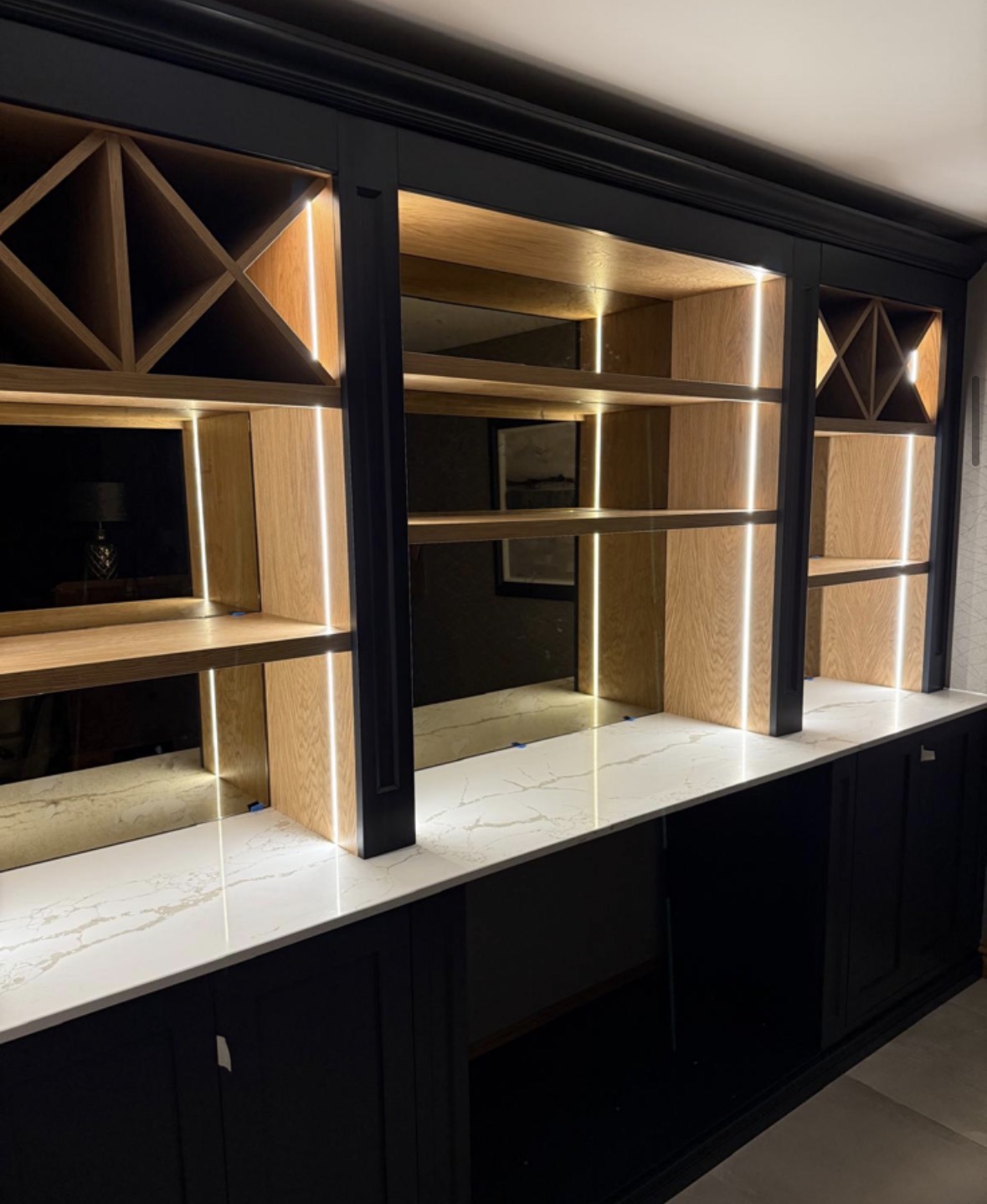
Every project is made individually rather than pulled from a stock range. That has practical consequences for how the workshop is organised: components for a single kitchen, wardrobe run or media wall are set out, cut and finished together, so that grain, colour and hardware line up as intended and nothing is substituted along the way.
This page sets out what happens between an approved specification and a finished piece leaving the workshop. It is written for homeowners who want to understand where their furniture actually comes from, and for architects, designers and other professionals who want assurance that manufacture is controlled and traceable back to the drawing.
It sits between materials and finishes for bespoke furniture, where materials and finishes are agreed, and installing your finished furniture, where the finished components are fitted on site. For the fuller sequence from first conversation to completed installation, see the process page.
What manufacturing covers
01
Setting out from approved drawings
Every component is set out from the drawings and specification that were signed off earlier in the project, so dimensions, junctions and hardware positions are fixed before cutting begins.
02
Cutting and machining
Panels, frames and solid sections are cut and machined to the sizes and details recorded in the specification, with components for one project kept and tracked together through the workshop.
03
Assembly
Carcasses, frames and doors are assembled in the workshop, allowing joints, alignment and hardware fit to be checked and corrected before anything is finished or delivered.
04
Sanding and finishing
Surfaces are prepared and finished to the specified material and finish, applied in workshop conditions so that colour and sheen are consistent across every component of a project.
05
Hardware fitting
Hinges, runners, handles and other specified hardware are fitted and adjusted in the workshop, so that doors and drawers are already operating correctly before they reach site.
06
Workshop check before despatch
Finished components are checked against the approved drawings and specification before they leave the workshop, so that what arrives on site matches what was agreed.
Working from an approved drawing
Nothing is cut until a drawing and specification have been approved. That approval is the reference point for the whole manufacturing stage: dimensions, junction details, material choices and hardware are all taken directly from it rather than interpreted on the day.
Where a project involves several rooms or several types of furniture, the same approved drawings keep manufacturing consistent between them, so that a run of wardrobes and a media wall specified together, for example, are made to the same standard of setting out.
Cutting and machining components
Components are cut and machined to the sizes recorded in the specification, including any allowances needed for site conditions that were identified during survey and design. Edges, joints and fixing points are prepared at this stage so that assembly can proceed without further adjustment.
Because each project is made individually, components stay grouped together through cutting and machining rather than being produced as generic stock, which keeps grain and batch consistent across a single piece of furniture or a run of matching units.
Assembly, sanding and hardware
Carcasses, frames and door and drawer fronts are assembled in the workshop so that fit and alignment can be checked before finishing begins. Any adjustment needed to a joint or panel is made at this point, while the piece is still in a controlled workshop environment rather than on site.
Sanding and finishing follow the material and finish specified earlier in the project. Hardware, including hinges, runners and handles, is then fitted and adjusted so that doors and drawers are already working correctly, reducing what needs to happen once the furniture reaches your home.
A check before anything leaves the workshop
Before components are packed for delivery, they are checked against the approved drawings and specification. This is a straightforward comparison of what has been made against what was agreed, covering dimensions, finish and hardware operation.
The purpose of this step is to catch any discrepancy while the piece is still in the workshop, where it can be corrected without disruption, rather than discovering it during installation.
Made by the people who install it
The team that manufactures your furniture is the same team that installs it, described in full at installing your finished furniture. That continuity means the people fitting your furniture already understand how it was built and why particular details were done a certain way, and can respond directly to a site condition rather than referring the question back to someone who was not involved in manufacture.
For homeowners and professionals working with an architect or interior designer, this connection between manufacture and installation is set out further at bespoke furniture and joinery for architectural projects and bespoke furniture and joinery for interior design schemes, and the wider business is introduced at the about page. It also means a single point of contact can speak with authority about both stages of a project, rather than passing queries between separate manufacturing and installation teams.
What stays consistent through manufacture
- Reference to the approved drawing
- The approved drawing and specification remain the reference point throughout manufacture, rather than being reinterpreted once cutting has started, so that anyone checking a component later can trace it directly back to what was agreed.
- Components kept together
- Components for one project are cut, assembled and finished together, keeping colour, grain and hardware consistent across the whole piece.
- Traceability
- Because manufacture and installation are carried out by the same workshop, any query about a finished component can be traced back to the drawing that produced it.
- No substitution of materials
- Materials and finishes used in manufacture are the ones agreed at specification stage, recorded at materials and finishes for bespoke furniture, and any change to that specification is confirmed with you before it is manufactured.
Send us the drawings, the rooms involved and where the project has reached, and we will tell you what we can design, make and fit.
Design, manufacture, installation
Manufacturing is one stage in a sequence that runs from initial conversation through design, specification, manufacture and installation; the full sequence is explained at the process page.
Questions we are asked
Working together
- Who do we speak to once manufacturing has started?
- You continue to have a single point of contact at Chester Thomas once manufacturing begins, so any question about progress, timing or a specific detail can be answered without needing to track down separate departments within the workshop. If a query arises about how a particular junction, finish or piece of hardware was specified, it can be checked directly against the approved drawing and specification held on file, rather than relying on memory or an assumption about what was agreed earlier in the project.
- Can we visit while our furniture is being made?
- Requests to see progress during manufacture can be discussed with your point of contact at Chester Thomas, and whether a visit is practical depends on the stage a project has reached and the workshop schedule at the time. It is best raised early, ideally when drawings are being approved, so that a suitable point in the manufacturing programme can be identified and planned in rather than arranged at short notice once cutting is already under way.
Design & drawings
- What happens if a site measurement changes after drawings are approved?
- If a site condition changes after drawings are approved, manufacturing is paused on the affected components while the change is reviewed and, if needed, the drawing is revised and re-approved before cutting continues. This keeps what is actually manufactured aligned with the room it is going into, rather than proceeding against a dimension that no longer reflects the site. Components unaffected by the change can generally continue through the workshop while the revision is agreed, so the wider programme is not held up unnecessarily.
- Do you manufacture from our architect's drawings directly?
- Drawings from an architect or designer are used as the starting point to develop the manufacturing drawings and specification that the workshop actually works from, so that dimensions, junctions, materials and finishes are confirmed in a form suitable for cutting before manufacture begins. This step, described further at bespoke furniture technical drawings, exists because a design drawing and a manufacturing drawing answer different questions, and the workshop needs the latter to produce accurate components.
Materials & finishes
- How do you keep colour and finish consistent across a large project?
- Components for one project are finished together in the workshop using the material and finish recorded in the specification, rather than being produced or finished separately as demand arises, which keeps colour, grain and sheen consistent across a run of units or across several rooms specified as part of the same project. Working from a single batch and a single approved specification reduces the chance of a visible mismatch appearing once furniture reaches site.
- What happens if a material specified isn't available when manufacturing starts?
- If a specified material becomes unavailable when manufacturing is due to start, this is raised with you before cutting begins so that a suitable alternative can be discussed and agreed, rather than something being substituted without your knowledge. The specification is only updated once you have confirmed the change, and manufacturing on affected components does not proceed until that confirmation is in place, so the workshop is never working from a specification you have not seen.
Manufacture & installation
- How long does manufacturing take once drawings are approved?
- Manufacturing time depends on the scope of the project, the number of rooms involved, and the complexity of the materials, finishes and hardware specified, so it is discussed and agreed as part of your project programme rather than quoted as a fixed figure in general terms that would not reflect your particular furniture. A programme is set out once drawings and specification are approved, giving a realistic expectation of when manufacture will be complete and components ready for delivery.
- Is everything assembled in the workshop before delivery?
- Carcasses, frames, doors and drawers are assembled and checked in the workshop, with hardware fitted and adjusted so that hinges, runners and handles are already operating correctly before delivery. This means final assembly and fixing on site is more straightforward than starting from unassembled parts, though some components are broken down again for transport and reassembled once on site. Details of what happens once components arrive on site are set out at installing your finished furniture.
- What is checked before our furniture leaves the workshop?
- Before despatch, components are checked against the approved drawings and specification, covering dimensions, finish and the operation of fitted hardware such as hinges, runners and handles, so that what leaves the workshop matches what was agreed at specification stage rather than being assumed to be correct. This check is a straightforward comparison against the paperwork already signed off, and it is intended to catch any discrepancy while the piece is still in the workshop, where it can be put right without disrupting the installation date.
- Do you use subcontractors to manufacture parts of a project?
- Manufacturing is carried out in the Chester Thomas workshop in Derbyshire by the team who go on to install the finished furniture, which is why the same drawings and specification are used throughout the project rather than being handed between separate workshops or subcontracted manufacturers. Keeping manufacture in one workshop makes it easier to track a component back to the drawing that produced it, and means the installation team already understands how a particular piece was built.
Programme
- Can manufacturing start before every room in a project is finalised?
- Where a project covers several rooms, manufacturing can be sequenced so that rooms with approved drawings and specifications proceed through the workshop while others are still being finalised, provided the overall programme and delivery sequence have been agreed in advance with your point of contact. This means a delay in finalising one room does not necessarily hold up manufacture on the rest of the project, though delivery is still coordinated so that finished components are not sitting on site waiting to be installed.
- What happens if there's a delay on site during manufacturing?
- If site progress changes while manufacturing is under way, this is discussed with you so that delivery and installation dates can be reviewed and reset if needed, since finished components are generally held in the workshop rather than delivered ahead of a site being ready to receive them. Manufacturing itself usually continues on schedule, because the workshop programme and the site programme are tracked separately even though they are ultimately coordinated around the same installation date.
Cost
- What determines the cost of manufacturing a piece of furniture?
- Cost depends on factors including the overall scope of the project, the number of rooms involved, dimensions, the materials and finishes specified, the hardware chosen, the complexity of the design and the installation itself. Because these factors vary considerably from one project to another, costs are not published as a general rate or price list; the practical way to understand what your project would cost is to contact us through the contact page and discuss the rooms, materials and finishes you have in mind.
Chester Thomas
- Where is the Chester Thomas workshop?
- The Chester Thomas workshop is in Derbyshire, where all furniture is set out, cut, machined, assembled and finished before being delivered and installed by the same team that manufactured it. Working from a single workshop, rather than distributing manufacture across several sites or subcontractors, keeps drawings, specification and finished components together throughout a project, and means there is one place to refer back to if a question arises about how something was made.
- Do the people who install our furniture also make it?
- Installation is carried out by the same Chester Thomas team responsible for manufacturing, which means they arrive on site already familiar with how a particular piece was built and why certain details were done a particular way. This continuity is useful when a room presents an unexpected condition, since the installer understands the construction of the furniture directly rather than interpreting work carried out elsewhere, and can make an informed adjustment on site rather than referring the question back to a separate workshop.
Related pages
Working with professionals
An overview of how Chester Thomas supports architects, designers and other trades on a project.
Our process
The full sequence from first conversation through design, specification, manufacture and installation.
Bespoke joinery manufacturing
A more technical look at how component schedules and drawings become finished joinery.
Furniture installation
What happens once finished components arrive on site and are fitted into the room.
Materials & finishes
How materials and finishes are specified before manufacturing begins.
About Chester Thomas
Background on the workshop and the team behind design, manufacture and installation.
For architects
How manufacture is coordinated against drawings produced with an architect.
For interior designers
How specified materials and finishes are carried through into manufacture.
Bespoke kitchens
One of the furniture types manufactured individually in the Chester Thomas workshop.
Contact Chester Thomas
Get in touch to discuss a project and how manufacturing would be planned for it.
Talk to Chester Thomas on +44 7418 627358, email info@chesterthomas.com or send project details.
Planning Something Bespoke?
Tell us about your space, what you're looking to create and where the project is located.