
Guides
Bespoke vs made to measure furniture: what's the difference?
Bespoke furniture is designed from a blank page for a specific room, while made to measure typically adapts a standard system to fit given dimensions. The distinction sounds tidy, but different companies use the two words to mean different things.
Bespoke vs made to measure
Ask five furniture companies what "bespoke" means and you will likely get five slightly different answers. At one end of the market it describes furniture designed entirely around a room, with configuration, proportions and materials all developed from scratch. At the other, it is used as a marketing word for a modular range offered in a wider choice of finishes than usual. Neither use is dishonest exactly, but the gap between them matters when you are choosing who to work with.
Made to measure sits in a similar grey area. In its clearest form it means a standard cabinet system, with fixed component widths and a limited set of configurations, cut or adjusted to fit the width, height and depth of a given space. It suits straightforward runs of storage where the room is a regular shape and the internal layout does not need to do anything unusual, even where its internal logic was decided long before that particular room existed.
The more meaningful distinction, in practice, is not the word used but what actually happens at design stage. Does the internal configuration get worked out for how you live, or selected from a limited menu of drawer and shelf combinations? Are materials and finishes genuinely open, or restricted to a catalogue range? Is the piece drawn specifically for the room, accounting for its true proportions and any awkward junctions, or assembled from standard component widths with a filler panel to take up the remainder?
At Chester Thomas, our approach sits at the design-led end: each piece is developed through a proper design process, with internal configuration, materials and dimensions worked out for the specific room rather than selected from a modular system. That is what the chester thomas bespoke furniture design service and how your furniture is made describe. It is a genuinely different proposition to an adapted standard range.
None of this is a criticism of made to measure furniture done well. It has a legitimate place for simpler storage in regular rooms where budget and speed matter more than a fully bespoke layout. The point of this guide is to help you ask the right questions, rather than assume that either word guarantees a particular outcome.
Bespoke design vs made to measure adaptation
| Consideration | Bespoke design | Made to measure |
|---|---|---|
| Starting point | Blank page, designed for the room | Standard system adapted to fit |
| Internal configuration | Developed specifically for how the space is used | Selected from set combinations |
| Dimensions | Drawn to the room's true, often irregular, proportions | Adjusted within standard component widths |
| Materials | Genuinely open choice, agreed at design stage | Limited to a catalogue range |
| Awkward rooms | Angles, services and junctions designed around | Often needs filler panels to take up gaps |
| Design development | Iterative, with drawings reviewed and revised | Largely fixed once a system is chosen |
| Cost factors | Reflects a fully custom design and build | Generally lower, reflecting standard components |
| Best suited to | Irregular rooms or specific storage needs | Regular rooms with straightforward storage |
Why the terminology gets confused
Both words are unregulated, and companies apply them to describe quite different processes. A retailer offering a configurator with a set of standard cabinet widths may reasonably call the result made to measure, since the furniture is indeed measured to a space. A workshop that designs from scratch may also use the word bespoke loosely if only the exterior finish is customised while the internal carcass remains standard.
This is not necessarily misleading, but it means the label alone tells you little. What matters is asking directly how the internal layout is decided, whether dimensions are drawn specifically for your room, and whether the design can genuinely change to suit an unusual space, a chimney breast, a sloped ceiling or a run of services that needs designing around.
Questions worth asking a supplier
Ask whether someone will survey the room in person before any design work is drawn, and whether the resulting layout is unique to your space or built from standard modules. Ask how much the internal configuration, shelf spacing, drawer sizes, hanging space, can actually change.
It is also worth asking who manufactures the furniture and where. A design-led process is only as good as the workshop behind it, and knowing whether a piece is made to order, as described on how your furniture is made, or assembled from pre-cut standard panels, tells you a good deal about what you are actually buying.
When made to measure is the right choice
For a straightforward run of wardrobes in a regular rectangular room, or simple shelving where the internal layout does not need to solve a particular problem, an adapted standard system can be a sensible choice. It tends to suit projects where budget and turnaround matter more than a fully custom configuration, and where the room presents no real complications.
When a fully bespoke design earns its process
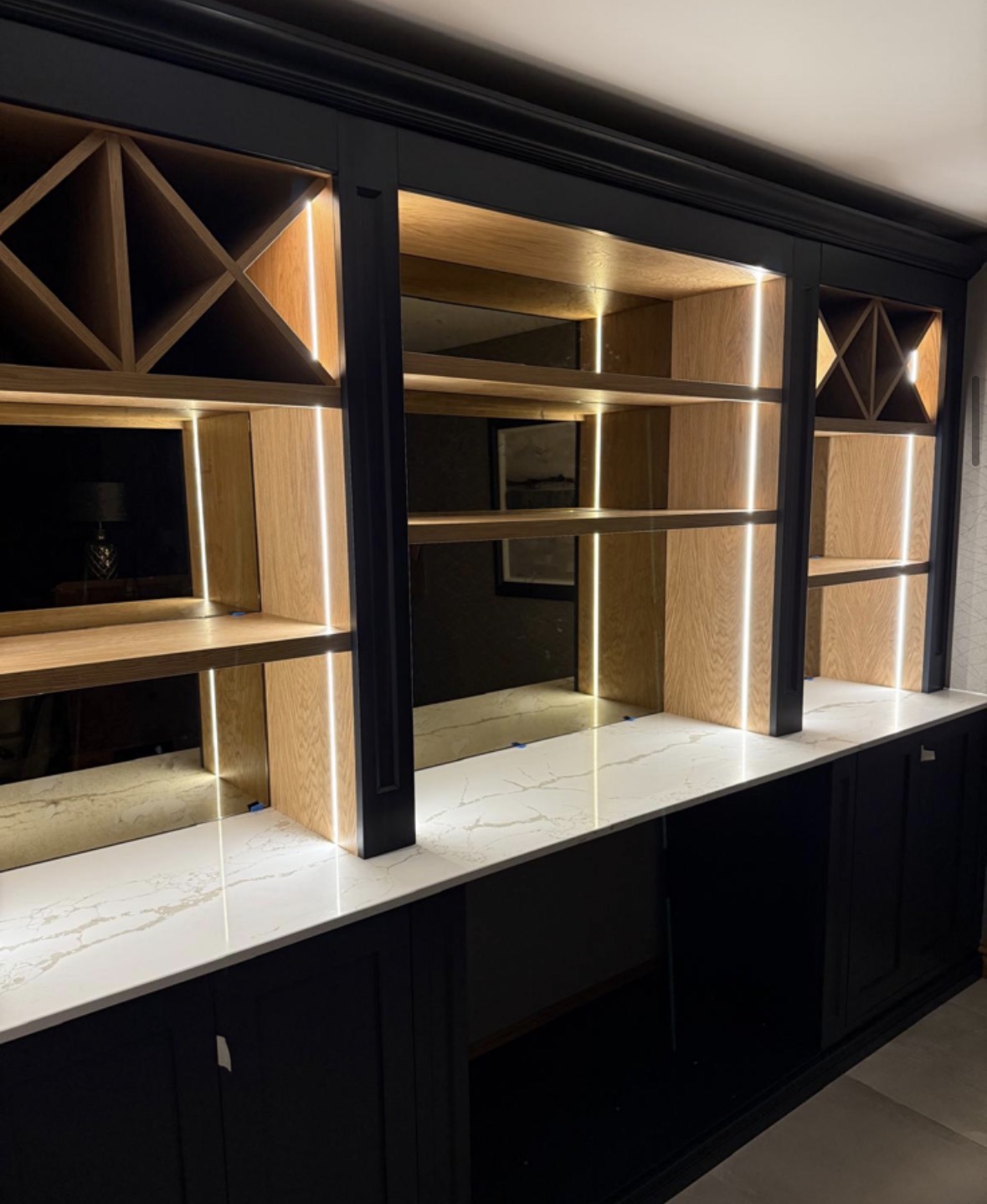
A room with an awkward chimney breast, sloped ceiling, boxed-in services or an unusual footprint benefits from furniture drawn specifically around it, since a standard system will almost always need compromises, filler panels or a layout that does not quite match how the space is used. The same applies where the internal configuration genuinely needs to be particular: a specific run of drawers for a collection, integrated lighting, or a piece spanning several functions in one room, as covered on furnishing a whole room as one design.
What this means for materials
A genuinely bespoke process allows material choice to be part of the design conversation from the outset, oak, walnut, painted finishes, stone or glass, discussed alongside layout rather than picked from a fixed list after the configuration is decided. That sequencing is part of what what made-to-measure joinery actually means at Chester Thomas describes when we use the term ourselves.
Which approach suits your project?
01
Choose a fully bespoke design when…
the room is an irregular shape, has services to design around, or needs an internal configuration built for a specific way of living rather than a standard set of options.
02
Choose made to measure when…
the room is regular, storage needs are straightforward, and a standard internal layout adapted to the wall widths will do the job without compromise.
03
Ask for a survey either way when…
you are unsure which category a project falls into, since an in-person look at the room is the only reliable way to know what it actually needs.
04
Prioritise clear questions when…
comparing quotes, since the word bespoke alone does not tell you how the layout was decided.
How we work
Our own process starts with a survey and a conversation about how a room is used, moves through design development and material selection, and ends with manufacture in our Derbyshire workshop and installation by the same team. The full sequence is set out on the process page.
Questions we are asked
General
- Is bespoke furniture always better than made to measure?
- Not necessarily. Bespoke furniture suits rooms and requirements a standard system cannot accommodate well, but for a straightforward run of storage in a regular room, an adapted standard system can do the job adequately. The right choice depends on the room, not on which word sounds more premium.
- Why do different companies use these words so differently?
- Neither term is regulated, so companies apply them to describe different processes, from a custom design service to a configurator built around standard cabinet widths. It is worth asking a supplier directly how their process works rather than relying on the label alone.
- What should I ask a supplier before choosing them?
- Ask whether someone surveys the room in person, whether the internal layout is designed specifically for your space or chosen from set options, what materials are genuinely available, and where the furniture is manufactured. These questions tell you far more than whether a company calls itself bespoke or made to measure.
- Does made to measure mean the furniture is poor quality?
- No. Made to measure describes how a piece is sized to a room, not the quality of its construction or materials, both of which can vary considerably between suppliers regardless of terminology. Quality is a separate question worth asking about directly.
Design
- Can a bespoke design still use standard-sized components?
- A bespoke design process can specify a standard door width or drawer box where that genuinely suits the layout, while other elements, internal configuration, dimensions and material, are drawn specifically for the room. The distinction that matters is that the choice is made deliberately during design, rather than being the only option a system allows. Using a standard component here or there does not undermine a bespoke approach.
Chester Thomas
- Does Chester Thomas offer made to measure furniture?
- We design and manufacture bespoke fitted furniture, developed room by room through a design process described on the chester thomas bespoke furniture design service and what made-to-measure joinery actually means, rather than adapting a fixed catalogue system to a set of measurements. Every piece begins with a survey of the room and a conversation about how it will actually be used, and the internal configuration is drawn to suit that brief specifically.
Design
- How is the internal configuration of a bespoke piece decided?
- It is worked out during design, based on the room's proportions and how it is used: what needs to be stored or displayed, whether lighting is wanted, and how the piece relates to the rest of the room. This is developed and reviewed with the client before manufacture begins.
- Is a fully bespoke design always necessary for an awkward room?
- Awkward rooms, with sloped ceilings, boxed-in services or unusual proportions, are where a bespoke approach earns its process most clearly, since a standard system will usually need compromises. A survey is the best way to establish what a particular room actually requires.
Materials
- Can materials be changed partway through a bespoke design?
- Materials are usually agreed as part of the design stage, before manufacture begins, since layout and material often influence one another, a heavier stone-effect surround, for instance, can change how a supporting frame is built. Changes are more straightforward earlier in the process than once drawings have been finalised and manufacture is underway, when altering a material can affect dimensions or fixings already committed to the workshop schedule.
Chester Thomas
- Where is bespoke furniture manufactured?
- Our furniture is designed and manufactured in our own Derbyshire workshop, with the same team involved from initial design through to final installation, described in more detail on how your furniture is made and the process page. Keeping design, manufacture and fitting under one roof means the people drawing a piece understand how it will actually be built, and the installers know the design intent rather than working from someone else's plans.
Cost
- What does bespoke furniture cost compared with made to measure?
- Cost depends on the scale, materials and complexity of the piece rather than the label applied to it, so there is no fixed comparison that holds across every project. The most useful step is to discuss your room and requirements through the contact page for a response specific to your project.
Design
- Does whole-room furniture always need to be bespoke?
- Where a single room combines several functions, storage, display, seating and lighting, a bespoke approach tends to make it easier to resolve how those elements sit together, as covered on furnishing a whole room as one design, though the same principles of surveying and design still apply regardless of terminology.
Where to go next
Bespoke furniture design
Design developed from scratch for a specific room.
Made to measure joinery
Our approach to fitting furniture precisely to a space.
Bespoke manufacturing
How designs are made in our Derbyshire workshop.
Whole-room furniture
Combining several functions within one designed scheme.
Bespoke cabinetry
Fitted storage designed for a specific room.
Related guides
Bespoke vs fitted furniture
Fitted describes how furniture sits in a room. Bespoke describes how specifically it was designed. The two are not the same question.
How the design process works
What happens between a first conversation and a finished piece, and why each stage exists.
What to expect from a consultation
What actually happens at a first consultation, and what is worth having ready beforehand.
To talk a decision through, call Chester Thomas on +44 7418 627358, email info@chesterthomas.com or discuss a bespoke design.
Planning Something Bespoke?
Tell us about your space, what you're looking to create and where the project is located.